Why Clients Avoid Login-Based Tools
87% of users abandon tasks due to login issues. If you're asking clients to create accounts just to provide feedback, you're likely losing their engagement. Logins create unnecessary friction, delay projects, and frustrate users. The result? Missed deadlines, vague feedback via email, and strained communication.
Here’s why clients avoid login-based tools:
- Time and Frustration: Creating accounts, resetting passwords, and navigating systems wastes time.
- Privacy Concerns: Many hesitate to share personal data due to security fears.
- Technical Barriers: Non-technical users often struggle with complex login steps.
- Password Fatigue: Managing multiple passwords overwhelms users.
- No Immediate Value: Clients don’t see the need to log in for simple tasks.
Loginless tools solve these problems. They let clients access designs and leave feedback instantly, without creating accounts or managing passwords. Tools like BoastImage use shareable links, on-page commenting, and secure access methods to simplify the process. This approach saves time, builds trust, and accelerates project workflows.
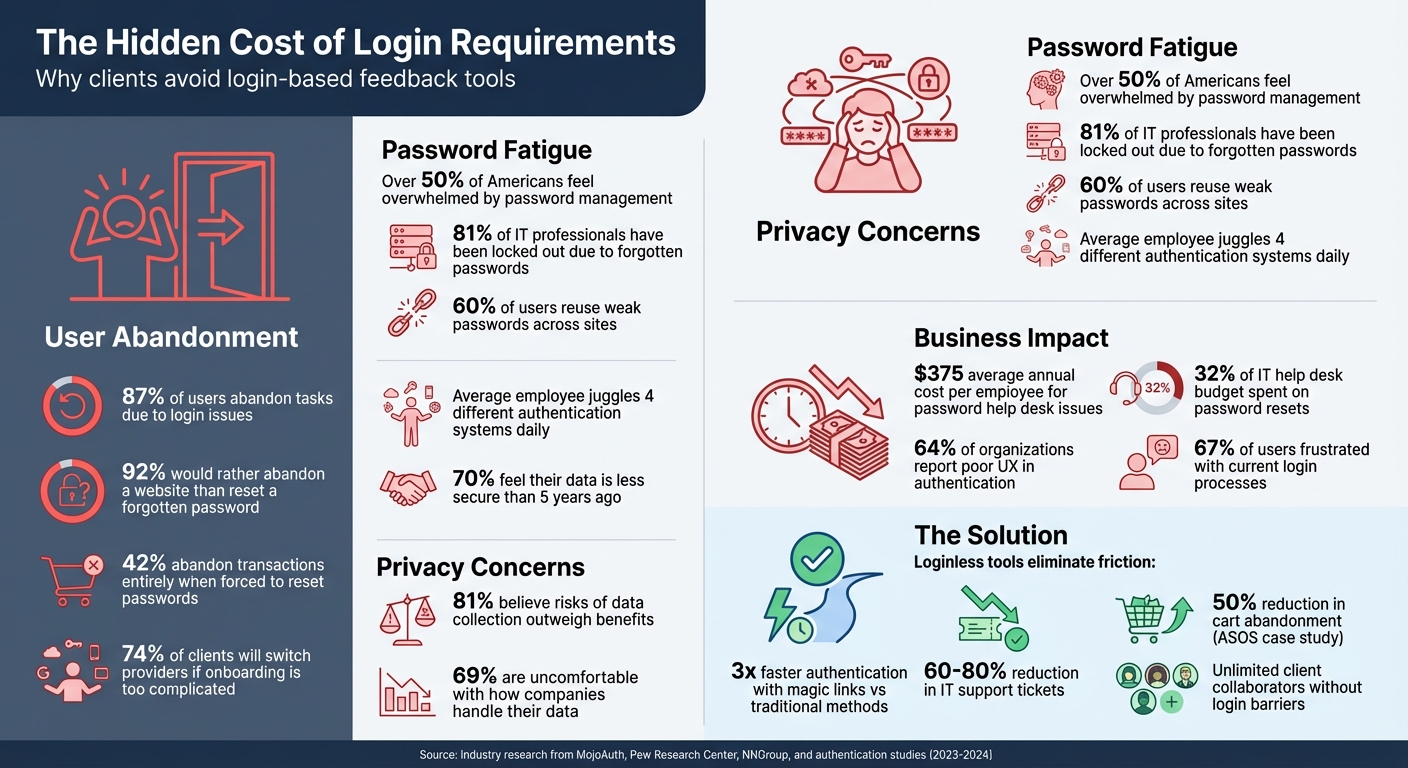
Client Login Friction Statistics: Why Users Abandon Login-Based Tools
The Client Adoption Problem
The Real Cost of Login Requirements
Login requirements don’t just inconvenience clients - they actively slow down your projects. Sending a feedback link that demands account creation means asking clients to stop what they’re doing, create yet another password, and navigate a platform they might not be familiar with - all before they can even see your work. This extra hurdle often delays feedback.
Here’s the kicker: organizations spend an average of $375 per employee each year on password-related help desk issues. But the bigger problem isn’t the money - it’s the time lost. When 81% of professionals admit they’ve been unable to access important information because they forgot a password, it’s not just a minor annoyance. It’s your project stuck in limbo while your client clicks “forgot password,” waits for the reset email, gets sidetracked, and forgets to revisit the task.
"Login friction represents one of the most underestimated barriers to user engagement and revenue growth in digital products and services." - MojoAuth White Paper
This login friction can derail timelines. Clients hit the wall, decide they’ll “get to it later,” and suddenly your quick two-day turnaround spirals into a two-week slog. 42% of users have abandoned a transaction entirely because they were forced to reset a password. In creative projects, this means missed deadlines, delayed launches, and endless follow-ups asking if they’ve had a chance to review your work.
These delays make one thing clear: clients are desperate for simplicity.
Why Clients Want Simplicity
Clients are stretched thin. They’re managing multiple projects, teams, and tools every single day. The average employee already juggles four different authentication systems daily, each with its own password, security questions, and two-factor authentication codes.
Adding another login requirement to their workload isn’t just a minor inconvenience - it’s another time-consuming process before they’ve even seen the value of your work. This goes against a key principle in user experience design called the “reciprocity principle,” which emphasizes delivering value before asking for effort. What clients want is simple: click the link, see the design, leave feedback, and move on with their day. Anything more feels like unnecessary red tape.
"If your login is inconvenient, unclear, takes too long, sticky or clunky, you could be losing customers who will never come back." - Federico Molina, Marketing Lead, Decentraland
The psychology of this matters. A frustrating login process doesn’t just irritate clients - it shapes how they view you. Struggling with a clunky system suggests inefficiency, and 67% of users report frustration with current login processes across digital platforms. That frustration doesn’t stay isolated to the login screen; it seeps into their overall impression of your collaboration.
5 Reasons Clients Avoid Login-Based Tools
Let’s dive into why clients often hesitate when faced with a login screen. For many, every extra step in the login process feels like a distraction from the creative work they want to focus on. These aren’t just small irritations - they can derail projects and leave everyone frustrated.
Time and Friction
Here’s the thing: logins create unavoidable friction. Unlike other parts of a user experience that can be bypassed, a login wall is a hard stop. Clients can’t even glance at your work until they’ve created an account, met password requirements, and verified their email.
This isn’t just about the time it takes. Even a short delay can set the tone. A clunky login process signals inefficiency, making clients wonder if the rest of your tool will feel just as clunky. It’s a first impression you don’t want to mess up.
"Login is the gateway to your whole website and your product beyond that. If customers feel like there are any roadblocks to them entering your website, they'll move on to another." - Federico Molina, Marketing Lead, Decentraland
The numbers back this up: 92% of users would rather abandon a website than reset a forgotten password. And mobile devices make things even worse. Typing passwords on touchscreens leads to errors, while switching apps for two-factor authentication often results in lost progress - forms are cleared, sessions time out, and clients simply give up.
These delays don’t just waste time; they create doubts about data security and usability.
Privacy and Security Concerns
Clients have good reasons to be cautious about sharing their data. 81% of Americans believe the risks of companies collecting their data outweigh the benefits. This isn’t paranoia - it’s a response to years of data breaches and privacy scandals.
Trust is hard to come by. 79% of Americans don’t trust companies to admit mistakes or take responsibility for misusing personal information. A login requirement forces clients to trust your platform before they’ve seen any value, which feels like a leap of faith many aren’t willing to take. In fact, 69% of users are uncomfortable with how companies handle their data.
"81% of the public say that the potential risks they face because of data collection by companies outweigh the benefits." - Pew Research Center
The concern goes even deeper: 81% of U.S. adults feel they have little or no control over the data companies collect about them. When clients encounter a login screen, they’re not just thinking about the task at hand - they’re wondering if their email will be spammed or if their data will end up sold to third parties.
This issue isn’t going away. 70% of adults feel their personal data is less secure now than it was five years ago. Every new headline about a data breach reinforces their reluctance to hand over information.
Technical Barriers for Non-Technical Users
Not all clients are tech-savvy, and many login-based tools assume a level of digital fluency that some simply don’t have. Managing accounts across multiple platforms creates a mental burden. Instead of focusing on reviewing your work, clients are stuck trying to remember which email they used or what the password rules were.
There’s also the issue of timing. Clients expect to see value before they’re asked to provide personal information. Requiring a login upfront breaks this expectation. Without experiencing what your tool can do, the request feels like an unnecessary hassle.
"Another thing that gets me is registering on a thousand different websites. It annoys me to no end, because you're going there for very basic information, so what's the point?" - Study Participant, NNGroup
This was a hard lesson for Task Rabbit, which required users to log in before viewing job listings or contractor profiles. Clients couldn’t evaluate the platform’s value, so they left. Yelp made a similar mistake, hiding the “use without logging in” option under multiple layers, leading users to believe an account was mandatory.
64% of organizations report that poor user experience is a major issue in their authentication processes. If companies struggle with this, imagine how frustrating it is for your clients, who may not even want to use the tool in the first place.
Password Fatigue
Password fatigue is real. Over half of Americans report feeling overwhelmed by the number of passwords they have to manage, with baby boomers being the most affected at 69%. The average employee already juggles four different authentication systems daily, each with its own set of rules and requirements.
Even professionals struggle. 81% of IT and security experts have been locked out of critical systems because they forgot a password. If trained professionals face these issues, your clients - who just want to leave comments on a design - are likely to find it even more challenging.
Ironically, login systems meant to protect data can make things worse. 60% of users reuse weak passwords, and many stay signed in on public devices, creating vulnerabilities. The effort to secure data often backfires because users take shortcuts to make things easier.
"The best security is invisible, working in the background without adding friction. It's about making security seamless, keeping users engaged instead of pushing them away." - Frontegg
The impact is clear: 42% of shoppers abandon their carts when prompted to reset a password. In creative projects, this translates to missed deadlines and endless follow-ups. When clients can’t - or won’t - log in, everything grinds to a halt.
No Clear Immediate Benefit
The core issue is simple: clients don’t see why they need an account to leave a few comments. 3 in 5 Americans prefer to check out as a guest rather than deal with a sign-up process. It’s not laziness - it’s efficiency.
Most clients have been burned before by platforms that demanded personal information but didn’t deliver on their promises. They’ve learned that many login requirements are more about collecting data than providing value.
ASOS demonstrated this in 2017 when they removed the account creation requirement from their checkout process. The result? They cut cart abandonment in half by adding a guest checkout option. For feedback tools, the stakes are even lower. Clients aren’t buying anything - they’re doing you a favor by reviewing your work. Asking them to create an account first feels like charging them for helping you.
12% of online consumers abandon their carts immediately when asked to create an account. For feedback tools, this translates to clients procrastinating, forgetting, or bypassing your system entirely. Instead, they’ll send vague feedback via email, derailing your project timeline and leaving everyone frustrated.
How Loginless Tools Solve These Problems
Loginless tools tackle the frustrations of time, technical hurdles, and security concerns by removing the need for traditional login requirements. Instead of asking clients to create accounts or manage credentials, these tools offer immediate access, making the feedback process seamless and hassle-free.
By eliminating pre-commitment, loginless tools focus on delivering instant functionality. Clients simply click a link, provide their feedback, and move on with their day - no passwords, no email verifications, no lengthy forms. This approach not only simplifies the process but also builds trust by allowing clients to experience the value directly without extra steps.
Research from MojoAuth highlights the psychological impact of login friction, noting that "The psychological impact of login friction often exceeds its actual time cost. Users who spend 30 seconds struggling with password entry may feel more frustrated than users who spend 60 seconds completing a smooth, predictable process". Loginless tools address this frustration by prioritizing ease of use, creating a smoother experience that fosters trust and usability.
Instant Access Without Accounts
Loginless tools rely on methods like magic links or guest access to remove authentication barriers. For instance, a client receives a link via email, clicks on it, and is immediately directed to the feedback board or project page - no passwords or registrations required.
This is especially effective on mobile devices, where typing complex passwords often leads to errors and frustration. Magic links allow users to tap once for access, cutting down authentication time by up to threefold compared to traditional multi-factor authentication methods.
The stakes are high for feedback tools: 74% of potential clients will opt for a different service provider if the onboarding process feels complicated or frustrating. By removing the login barrier, you eliminate a major reason clients delay or avoid providing feedback.
Tools like BoastImage illustrate this in action. Clients receive a shareable link, click it, and immediately see the design or webpage they need to review. They can leave comments directly on the visual without ever having to create an account. Meanwhile, teams still retain essential functionalities like version control, task management, and Kanban boards - ensuring internal workflows remain structured while clients enjoy a frictionless experience.
Building Client Trust and Protecting Privacy
Beyond speed and simplicity, loginless tools strengthen trust by addressing privacy concerns. Without requiring an account, clients can immediately engage with the task at hand, eliminating the hesitation that often comes with sharing personal information upfront. This approach builds trust through action, showing clients exactly what they need to review without unnecessary data collection.
The security model shifts as well. Instead of relying on passwords - 60% of which users admit to reusing across multiple sites - loginless tools utilize secure, time-limited tokens or magic links. These methods are resistant to phishing attempts and avoid the vulnerabilities tied to weak or recycled passwords.
"Demanding that users register or log in before they can use an app or see website information has high interaction cost and defies the reciprocity principle." - Raluca Budiu, Nielsen Norman Group
This approach also reduces IT support costs associated with password management, creating a faster, more efficient workflow for teams while delivering a respectful and seamless experience for clients. By removing these barriers, loginless tools redefine how feedback is collected, making the process simpler and more secure for everyone involved.
BoastImage: Loginless Feedback in Practice
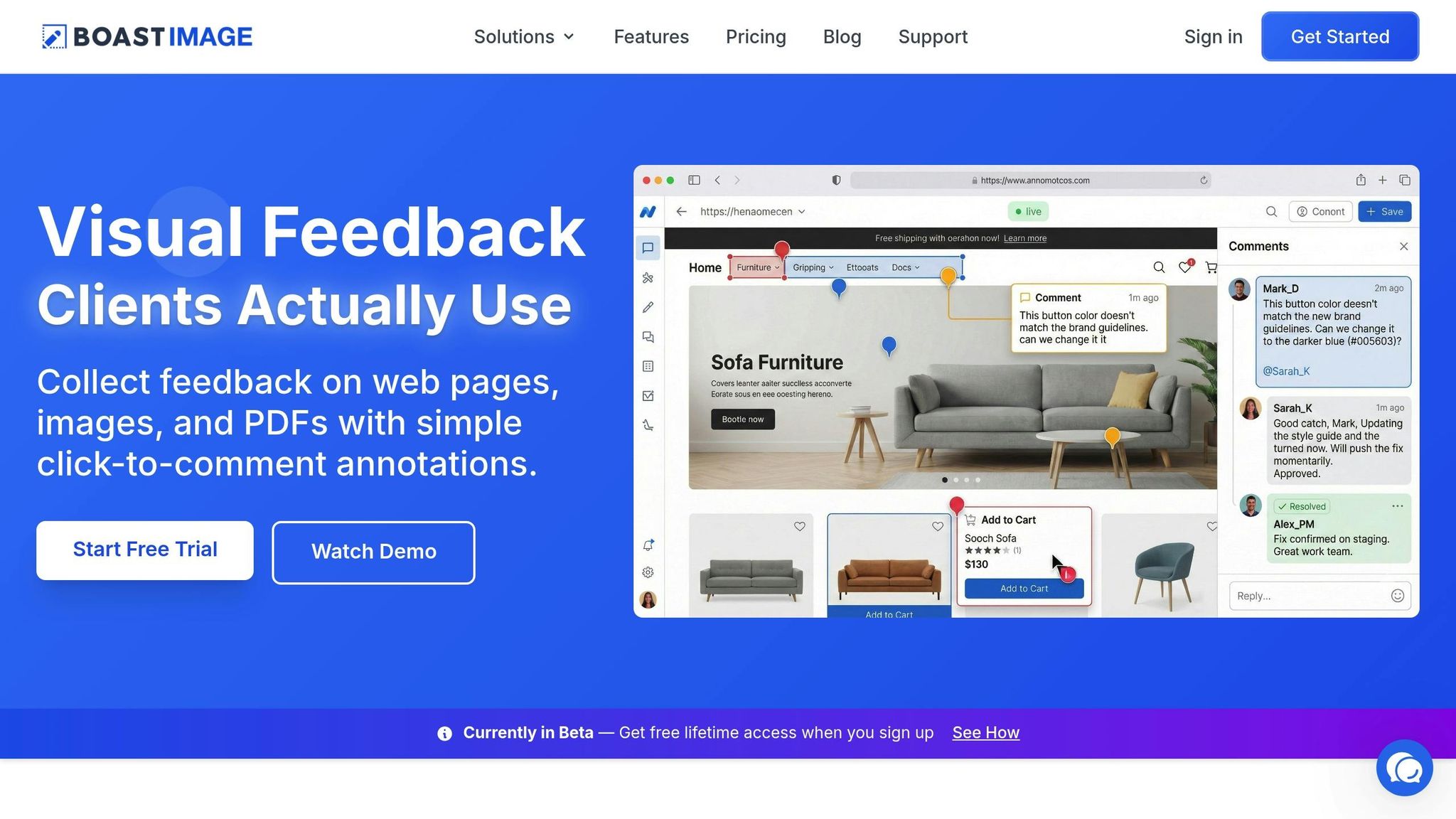
BoastImage tackles the frustrations of login-based tools by simplifying client feedback. Instead of requiring accounts or passwords, it offers a seamless, login-free experience. Clients are sent a shareable link that takes them straight to the design, webpage, or PDF - no sign-ups, no email verifications, just direct access.
BoastImage Features
BoastImage makes feedback intuitive with on-page commenting, allowing reviewers to annotate designs directly. This eliminates the hassle of toggling between the work and a separate feedback tool.
It also supports unlimited external collaborators, so teams can involve as many stakeholders as necessary, without extra costs or onboarding headaches. By removing passwords, the platform sidesteps one of the biggest causes of project delays. At the same time, teams retain access to advanced tools like version control, task management, and Kanban boards - kept behind the scenes to ensure clients enjoy a clean and simple interface.
Another standout feature is its use of the reciprocity principle. Clients can view the work immediately, without needing to register, before providing their feedback. This approach reduces friction and makes the review process more inviting.
How BoastImage Simplifies Feedback
By doing away with logins, BoastImage removes a common obstacle to client participation. With 64% of organizations citing poor authentication experiences as a major frustration, this approach helps prevent clients from ignoring feedback requests or resorting to vague email comments.
The process is incredibly simple: a team member uploads the asset, generates a shareable link, and sends it to the client. The client clicks, reviews the work, and leaves comments - all without the need for an account. This one-click feedback system replaces the usual multi-step authentication process, making workflows smoother for both clients and teams.
sbb-itb-32f6eb2
Benefits of Loginless Tools
When it comes to addressing client adoption hurdles, loginless tools offer clear advantages for both clients and internal teams.
Simpler Client Experience
With loginless tools, clients can dive right into reviewing work with just a single click - no accounts, no passwords, no roadblocks. This isn't just about convenience; it can make or break a project.
This approach aligns perfectly with key UX principles: delivering value upfront before asking for any sort of commitment. By allowing clients to view and provide feedback before requiring any login or setup, these tools help establish trust effortlessly.
The numbers back this up. Research indicates that 74% of clients are likely to switch to a different service provider if the onboarding or initial interaction process feels too complicated. For agencies and freelancers, this means that losing business often has less to do with the quality of work and more to do with cumbersome tools that hinder the feedback process.
By removing these barriers, loginless tools not only enhance client satisfaction but also set the stage for smoother collaboration.
Better Workflow Efficiency for Teams
While clients enjoy a frictionless experience, teams also reap substantial benefits. Consider this: companies typically spend 32% of their IT help desk budget on handling password resets and authentication issues. Loginless tools eliminate this entirely.
Without the need for logins, IT support tickets can drop by 60%-80%. This translates to fewer distractions, less time wasted on troubleshooting, and more hours dedicated to the creative work that drives results. It’s a win-win for everyone involved.
BoastImage Pricing Plans
BoastImage keeps its pricing straightforward with one key idea in mind: your clients shouldn't drain your budget. All paid plans include unlimited external collaborators, so you can invite as many clients as you need without worrying about extra fees for each user.
The tiered pricing system gives teams the flexibility to pick a plan that matches their specific needs - no paying for features you won’t use. For freelancers, the Solo plan starts at just $9.95 per month, making it easy to dive in without dealing with long approval processes. This low-cost entry point makes BoastImage accessible while giving teams the chance to try it out before fully committing.
"Freemium lowers uncertainty by letting customers experience value first and delaying costs until later." - Jonah Berger, Professor at Wharton
With 92% of users abandoning a site rather than resetting a forgotten password, BoastImage tackles both client adoption and cost concerns head-on. By focusing on a smooth, hassle-free experience, its pricing ensures that neither budget constraints nor client access become obstacles.
Plan Comparison
BoastImage’s pricing structure reflects its mission to make collaboration effortless for both teams and clients.
| Plan | Monthly Price | Active Projects | External Collaborators | Storage | Key Features |
|---|---|---|---|---|---|
| Free | $0 | 1 | 3 | 5GB | Unlimited annotations, list view, browser extension |
| Solo | $9.95 | 5 | 10 | 50GB | Version control, Kanban view, priority support |
| Team | $19.95/user | Unlimited | Unlimited | 50GB | Multiple team members, project permissions, custom branding |
| Business | $39.95/user | Unlimited | Unlimited | Unlimited | White-label branding, audit logs, dedicated success manager |
One standout feature across all paid plans is the inclusion of unlimited external collaborators, removing hidden costs and making client collaboration seamless. Considering 86% of customers are willing to pay more for a better experience, BoastImage positions itself as a smart investment for teams that value simplicity and client satisfaction.
Conclusion
Login walls create genuine obstacles that prevent clients from engaging with creative work. When 92% of users abandon websites due to password hassles and 67% report related frustrations, these aren't just small annoyances - they're major roadblocks that can derail projects and strain client relationships.
Loginless tools provide a solution by offering a faster, more straightforward way to gather feedback. Tools like BoastImage eliminate the need for registration, cutting out the friction that often leads clients to ignore feedback requests or resort to vague email responses. The result? Faster project turnarounds and happier clients who actually engage with the tools provided. No accounts. No passwords. No delays.
"Login friction represents one of the most underestimated barriers to user engagement and revenue growth in digital products and services." - MojoAuth
Traditional login-based tools force clients to jump through unnecessary hoops before they can participate. Loginless alternatives flip the script - clients simply click a link, share their feedback, and they’re done. BoastImage is a prime example of how this approach transforms feedback into a smoother, faster process.
The benefits go beyond convenience. With 74% of potential clients likely to choose a different provider if the onboarding process is difficult, prioritizing a seamless client experience is no longer optional - it’s essential. Streamlining feedback workflows with tools like BoastImage turns what used to be a frustrating bottleneck into a competitive advantage. Sometimes, the simplest solution truly is the most effective.
FAQs
Why do clients often avoid using login-based tools for feedback?
Login requirements can often be a stumbling block for clients. Asking users to create accounts or remember passwords disrupts the flow of the feedback process, making it feel tedious and time-consuming. Research indicates that many users abandon tasks when confronted with login hurdles, which can result in stalled projects or disengaged clients.
Tools like BoastImage eliminate this issue by removing the need for accounts or logins entirely. With a simple link, clients can provide feedback directly - no passwords, no hassles. This streamlined approach ensures a quick and seamless process, allowing feedback to move forward without unnecessary interruptions or drop-offs.
How do loginless tools build trust and make client feedback easier?
Loginless tools simplify collaboration by removing the need for account creation, a step many clients find both tedious and unnecessary. Instead of juggling usernames or resetting forgotten passwords, clients can share feedback instantly through a secure link. This approach respects their time and focuses on building a smoother, more positive relationship.
Without the hassle of logging in, providing feedback becomes quicker and easier. Clients can review designs, leave comments on specific sections, and share their insights without confusion or back-and-forth emails. This streamlined process cuts down on miscommunication and speeds up decision-making, enabling freelancers, agencies, and teams to wrap up projects more efficiently.
Take BoastImage, for example. It lets clients comment directly on web pages, images, or PDFs - no account required. Behind the scenes, internal tools like task management and version control stay out of sight, delivering a seamless experience for clients while ensuring teams stay organized and on track.
Why do clients struggle with login-based tools?
Clients often struggle with password fatigue when navigating login-based tools. Juggling multiple passwords, facing account lockouts, or going through the hassle of resetting credentials can quickly become overwhelming - particularly for users who aren't tech-savvy.
This frustration doesn't just stop at annoyance; it can lead to real consequences. Many users abandon sign-ups or purchases entirely when faced with login troubles. Others resort to reusing weak passwords across various platforms, which opens the door to security vulnerabilities. Removing the need for accounts and logins can simplify the process, making the experience smoother and encouraging users to stay engaged.