Conflicting Stakeholder Input: Examples and Fixes
Stakeholder conflicts can derail projects. Misaligned priorities, vague feedback, and unclear roles often lead to delays, budget overruns, and missed goals. For example:
- Sales vs. Engineering: Sales pushes for quick features to close deals, while engineering needs time to maintain quality.
- Marketing vs. Sales: Marketing prioritizes bold campaigns; sales focuses on immediate lead conversion.
- Executives vs. Support: Executives push for new features; support teams need resources for bug fixes.
How do you fix this? Start by listening to stakeholders individually, define shared goals with clear KPIs, centralize feedback using tools like Boast, and apply prioritization frameworks like RICE. Workshops and structured feedback systems can also help align everyone and prevent future conflicts.
The key is to ensure decisions are based on data, not personal opinions, and to create transparent systems for communication.
Resolving Stakeholder Conflicts: Strategies to Align Priorities: 3 Strategies for Project Success
sbb-itb-32f6eb2
Why Stakeholders Disagree: Common Causes
Conflicts among stakeholders often arise from structural differences within an organization, not personal disputes. For example, sales teams are driven by the need to close deals quickly to hit quarterly targets, while engineering teams require time to address technical debt and ensure quality. Finance departments focus on controlling costs and maximizing ROI, whereas marketing prioritizes brand visibility and user acquisition. These differing priorities reflect deep-rooted organizational values that naturally clash.
"Every stakeholder is right from their perspective. Sales needs the feature to close deals. Engineering needs time to do it properly. Support needs the bug fixed yesterday... All legitimate. All incompatible." – Figr
Another source of tension lies in how success is measured. Executives often focus on metrics like revenue growth and market share, while customer support teams are more concerned with reducing ticket volume and improving retention rates. Without shared success metrics, decisions can become subjective, leaving product managers to juggle conflicting priorities rather than driving unified strategies.
External feedback adds another layer of complexity. New users may prioritize ease of use and a smooth onboarding process, while power users demand advanced features to enhance their experience. Sales teams might advocate for the needs of high-value clients, whereas support teams push for fixes that benefit the broader customer base. Given limited resources - time, budget, and attention - organizations are forced to prioritize, often leading to friction even when every stakeholder's concern is valid.
"The friction is not that anyone is wrong. The friction is that the org has to choose one path at one time, with limited time, limited attention, and real consequences." – Figr
Ambiguity in roles and responsibilities only exacerbates these challenges. Without a clear RACI matrix (Responsible, Accountable, Consulted, Informed), stakeholders may make conflicting decisions on the same issue, causing delays and confusion. Recognizing these structural differences is a critical first step toward addressing conflicting stakeholder feedback, which will be explored further in the upcoming checklist.
Examples of Stakeholder Conflicts
Marketing vs. Sales: Campaign Design Disagreement
Marketing teams often aim for bold, attention-grabbing visuals to enhance brand presence, while sales teams lean toward designs centered on driving conversions and closing deals quickly. The root of this conflict lies in differing success metrics - marketing prioritizes brand reach and customer engagement, while sales focuses on immediate lead conversion and revenue. When these teams fail to align on campaign goals, it often leads to endless revisions and delayed projects. Each department pulls the creative vision in opposing directions, weakening the campaign's overall focus and effectiveness.
Client vs. Development Team: Feature Feasibility Dispute
Clients frequently request what appear to be minor tweaks - like a small UI adjustment or an added feature - without fully understanding the technical complexities involved, such as coding standards, technical debt, or release timelines. A great example is a seemingly simple Skype UI update that required three months of backend work.
"Product management involves diplomacy between different people with different agenda, egos, ideas, conflicts, and mistrusts." – Bartosz Jaworski, Product Manager
This problem gets worse when sales teams promise clients new features without consulting the engineering team first. Later, they may discover that the requested changes are either technically impractical or impossible to deliver within the expected timeframe. This misalignment can lead to scope creep, rushed releases that compromise quality, and heightened stress for the development team.
Executive vs. Support Team: Product Priority Conflict
Executives often focus on introducing new features and enhancements that drive ROI and strengthen market competitiveness. On the other hand, support teams prioritize resolving bugs and ensuring product stability to reduce customer complaints and churn. This tension grows when executives view maintenance tasks as secondary to growth initiatives, especially if the product appears to be functioning well on the surface.
"A meeting without a decision is not neutral. It is a decision to drift, and drift creates more conflict." – Figr.design
When resources are divided between flashy features and essential fixes, the project can enter a state of "decision drift". Support teams, burdened by unresolved customer issues, may feel undervalued, while executives see maintenance as a distraction from strategic goals. If support teams are excluded from early-stage discussions, critical issues might only be identified late in the process, leading to rushed fixes or substandard updates at the last minute.
Checklist: How to Resolve Stakeholder Conflicts
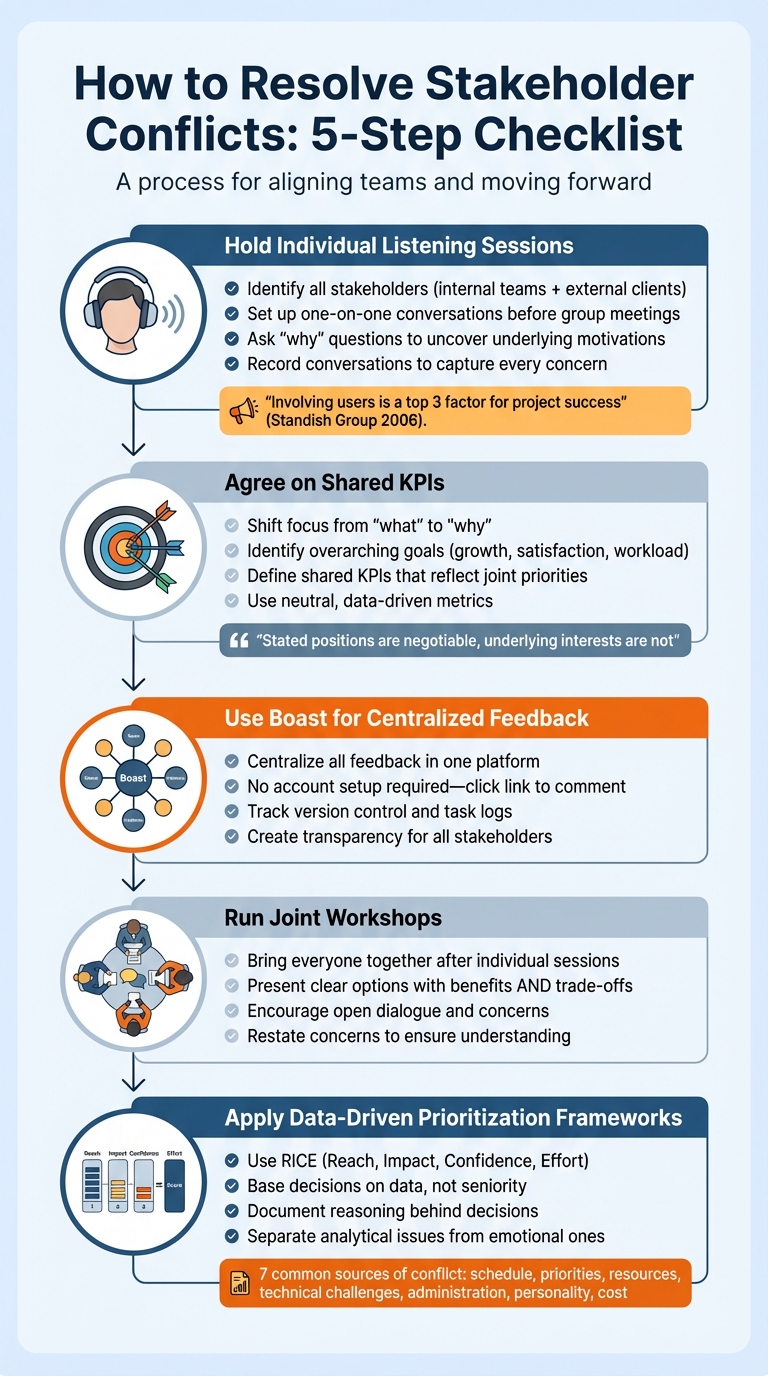
5-Step Process to Resolve Stakeholder Conflicts
Step 1: Hold Individual Listening Sessions
The first step is to identify all stakeholders, including both internal teams and external clients. Once you have a list, set up one-on-one conversations with each person before gathering everyone together. These sessions aren’t about pitching solutions but understanding the reasons behind their perspectives.
Ask questions to uncover the "why" behind their positions. For instance, a marketing director advocating for a bold redesign might be worried about staying competitive, while a developer rejecting a new feature could be trying to avoid technical complications. According to the Standish Group 2006 Chaos Report, involving users is one of the top three factors that contribute to project success. Use this opportunity to challenge your assumptions, and make sure to record these conversations to capture every concern.
The insights you gain here will set the stage for aligning goals in the next step.
Step 2: Agree on Shared KPIs
Once you’ve gathered individual perspectives, shift the focus from what stakeholders want to why they want it. For example, if the sales team insists on a new feature by Q2, the real motivation might be closing an important deal. Understanding these drivers opens the door to alternative solutions.
"Stated positions are negotiable, underlying interests are not. Find the interests to find the solution." – Figr.design
Find common ground by identifying overarching goals like company growth, customer satisfaction, or manageable workloads. Then, define shared KPIs that reflect these priorities. For example, instead of measuring Sales on "deals closed" and Engineering on "features shipped", create a joint KPI like long-term customer success. Use neutral, data-driven metrics - such as user research or bug counts - to move the conversation from subjective opinions to objective trade-offs.
Step 3: Use Boast for Centralized Feedback
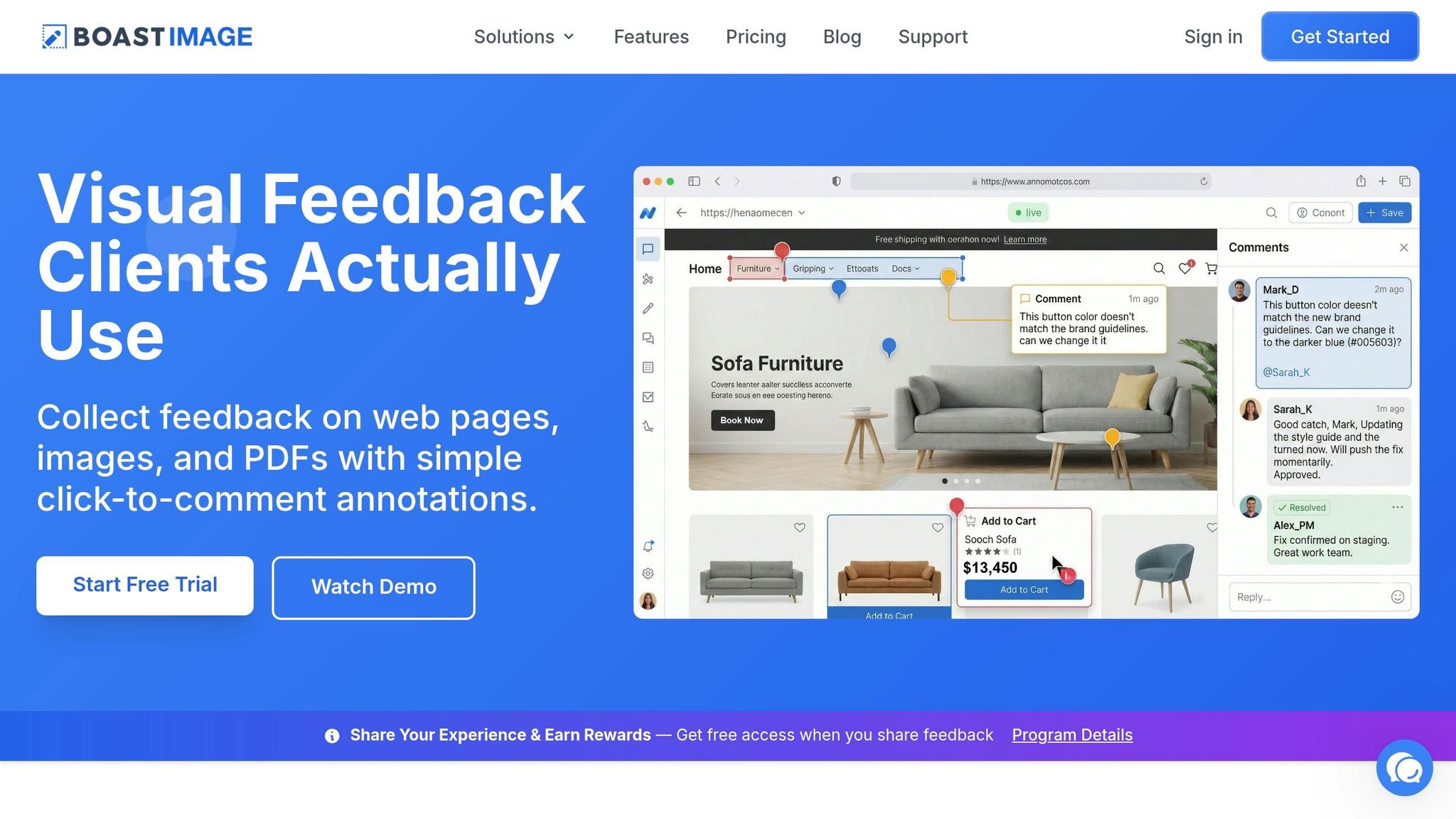
Centralizing feedback is critical to avoid confusion and conflicting requests. When input is scattered across emails, chats, and meetings, it’s easy for details to get lost or misunderstood. A centralized visual feedback platform like Boast brings all input into one place, making it accessible to everyone.
Boast simplifies feedback collection without requiring account setups. Stakeholders can click a link to comment directly on web pages, images, or PDFs. The platform also keeps track of version control and task logs, ensuring everyone works from the latest draft and providing a neutral reference for resolving future disputes. Transparency helps stakeholders see where their requests align - or conflict - making it easier to address issues upfront.
Step 4: Run Joint Workshops
After gathering individual feedback and agreeing on shared KPIs, bring everyone together for collaborative workshops. These sessions are about solving problems as a team. Present clear options, outlining both their benefits and trade-offs. For instance, if a partial solution reduces risk but delays a campaign by two weeks, share both aspects so the group can focus on making an informed decision rather than defending personal preferences.
"One of the most important means of overcoming the resistance is to listen to the concerns of the relevant stakeholders." – Peter Block
Encourage open dialogue during these workshops. Let stakeholders voice their doubts and concerns, as this can uncover potential risks and improve planning. Restating their concerns in their own words helps them feel understood and reduces the likelihood of repeated demands later.
Step 5: Apply Data-Driven Prioritization Frameworks
When conflicts persist despite these efforts, turn to objective prioritization frameworks to guide decisions. Tools like RICE (Reach, Impact, Confidence, Effort) help evaluate options based on measurable factors rather than seniority or volume. This approach ensures decisions are based on data, not personal biases.
Research highlights seven common sources of project conflict: schedule, priorities, resources, technical challenges, administration, personality clashes, and cost. By using frameworks like RICE, you can separate analytical issues from emotional ones. Document the reasoning behind prioritization decisions to prevent the same debates from resurfacing in future project cycles.
Preventing Future Conflicts with Feedback Tools
Using feedback tools effectively can help prevent future conflicts by addressing common issues like scattered communication and misaligned expectations. These tools streamline the process, ensuring everyone stays on the same page.
Why Login-Free Visual Feedback Works
When clients or stakeholders face hurdles like creating accounts, remembering passwords, or navigating onboarding, they often sidestep official channels. Instead, they might send feedback through emails or Slack messages, creating a chaotic trail that's hard to manage.
Login-free feedback tools remove these barriers entirely. Stakeholders can simply click a link, annotate directly on the design, and share their input without hassle. Plus, when feedback is visible on a shared platform, stakeholders can see conflicting suggestions in real time. This often leads to self-corrections before the team even gets involved.
Visual annotation also encourages clarity. Instead of vague comments like "make it pop", stakeholders can pinpoint specific elements and explain exactly what they want changed. This reduces misunderstandings and minimizes endless revision cycles.
Structuring Feedback with Version Control and Kanban Boards
Behind the scenes, teams need systems to organize feedback efficiently. Version control ensures stakeholders are always commenting on the latest design. If someone references an outdated version, you can redirect them to the most current file, avoiding unnecessary rework.
Kanban boards further streamline the process by categorizing feedback into actionable tasks. Teams can label input as "Critical", "UX Improvement", or "Subjective Preference", helping prioritize changes that matter most. This keeps workflows organized without overwhelming clients. Stakeholders provide their input and move on, while teams manage the complexity behind the scenes.
Ensuring Clear and Actionable Feedback
Centralized feedback systems are key to avoiding redundant revision cycles. By housing all comments in one place, teams create a single source of truth that tracks decisions and their reasoning. This record is invaluable when revisiting settled issues or onboarding new team members.
Establishing clear policies upfront also helps maintain control. For example, limiting revision rounds to three and setting firm deadlines for feedback submission encourages thoughtful, timely input. Tools like Boast, which allow unlimited external collaborators, ensure every stakeholder can contribute without complicating the process. These structured systems keep projects on track while giving all voices a chance to be heard.
Conclusion: Aligning Stakeholders for Project Success
Stakeholder conflicts often highlight the importance of a project and demand constructive negotiation to move forward. As restruggle.com wisely points out, "Stakeholder alignment isn't about getting everyone to agree with you. It's about ensuring everyone understands what you're building, why you're building it, and what success looks like."
The challenges outlined in this article - whether it's marketing versus sales, clients versus developers, or executives versus support teams - underscore the need to tackle structural problems with practical solutions. Approaches like individual listening sessions, shared KPIs, and data-driven frameworks can help bring clarity and foster collaboration. These tools allow you to secure stakeholder buy-in early, without forcing everyone into complete agreement.
Alignment is not a one-time task - it’s a continuous process as goals, priorities, and people shift over time. Centralized feedback platforms, such as Boast, play a key role in this process by consolidating communication. When feedback lives in one accessible location, contradictions become easier to spot and address before they escalate. This proactive approach ensures smoother collaboration and sets the foundation for adaptive alignment.
As restruggle.com further explains, "The goal isn't perfect information distribution to everyone - it's ensuring the right people have the right context at the right time to make good decisions." Using structured decision-making frameworks like RACI, turning abstract debates into concrete visuals, and documenting the reasoning behind major decisions all help streamline the process. These strategies reduce last-minute surprises and empower faster, more informed decision-making.
Now is the time to act. Begin by mapping out your stakeholders based on their influence, establish clear decision-making boundaries, and implement systems that surface potential conflicts early. By treating stakeholder disagreements as opportunities for negotiation rather than roadblocks, you’ll drive your projects forward with clarity and confidence.
FAQs
How can I tell if a stakeholder conflict is structural or personal?
To figure out whether a stakeholder conflict is structural or personal, you need to dig into its root cause.
Structural conflicts usually come from clashing roles, priorities, or objectives. For instance, imagine marketing pushing for quicker results while engineering prioritizes product stability - those differing focuses can create friction.
On the other hand, personal conflicts are tied to individual dynamics, such as biases, misunderstandings, or strained relationships. If stakeholders still can't agree even when their goals align, chances are the issue is personal.
The approach to resolving these conflicts differs: tackle structural issues by refining processes and clarifying roles, while personal conflicts call for trust-building efforts and improved communication.
What shared KPIs work best when teams measure success differently?
The best shared KPIs are those that emphasize broad objectives, bringing stakeholders together under a unified vision. For instance, focusing on clarity in communication, progress toward strategic goals, and overall stakeholder satisfaction can help align diverse teams. These metrics create a shared understanding of success and keep everyone moving in the same direction.
How can I stop feedback from getting scattered across email, Slack, and meetings?
To keep feedback organized and avoid confusion, use a centralized feedback platform. Tools like BoastImage allow clients to leave clear, visual comments directly on designs, eliminating the need to juggle input from multiple channels.
Establish clear processes from the start - set specific goals, limit the number of revisions, and rely on a single feedback hub. This approach simplifies communication, keeps all feedback in one place, and makes it easier to track and implement changes effectively.