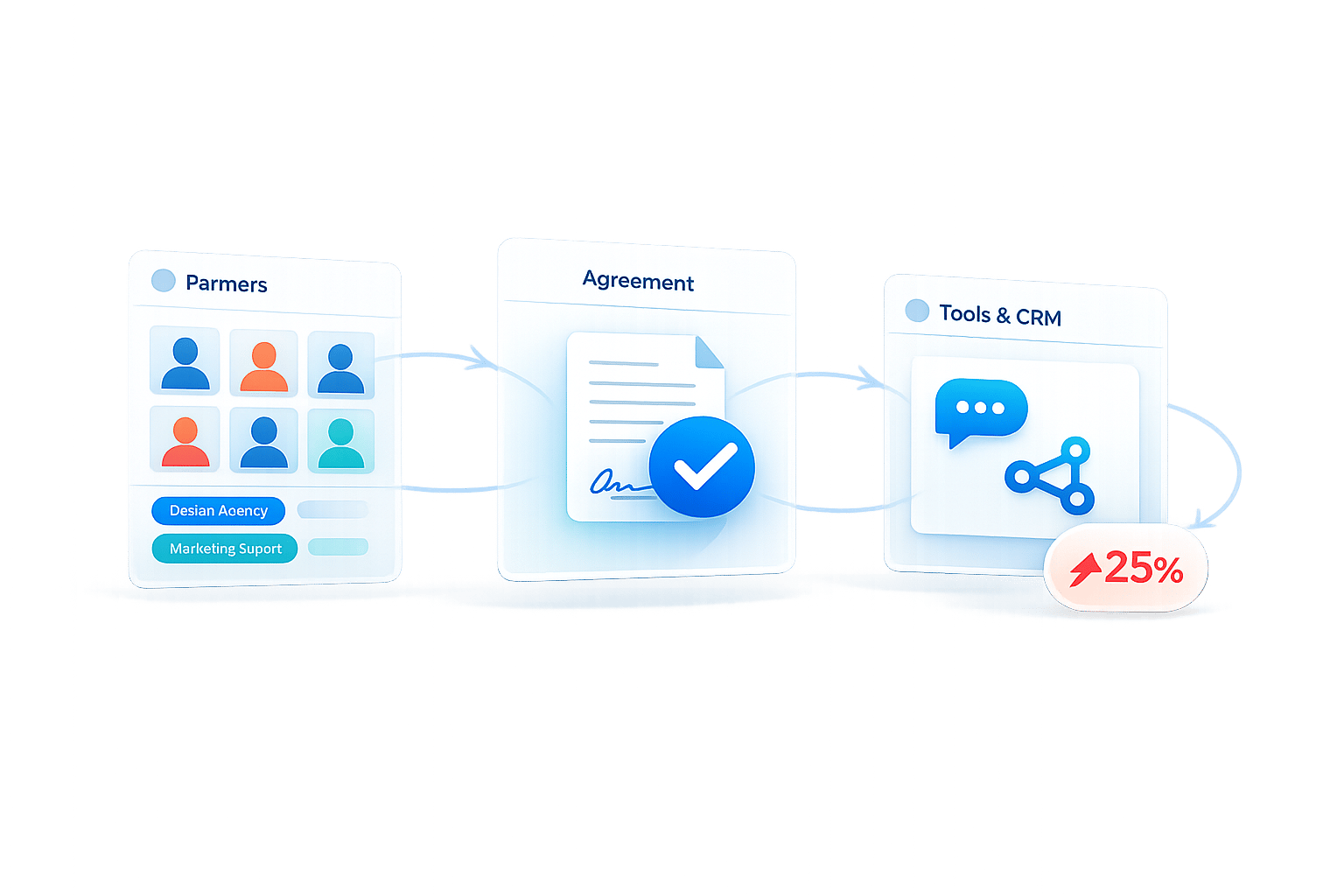
How To Build Referral Partnerships For Agencies
Want more reliable revenue for your agency? Referral partnerships can help you generate leads that are 3x more likely to convert than those from paid channels. By creating a structured referral system, agencies can increase revenue by 20–30%, reduce acquisition costs, and improve client retention.
Here’s how to build a referral program that works:
- Find the right partners: Focus on businesses that share your target audience and align with your standards.
- Personalize outreach: Craft tailored messages to initiate meaningful conversations.
- Start small: Test partnerships with low-commitment collaborations like webinars or content swaps.
- Formalize agreements: Set clear terms for referrals, payments, and responsibilities.
- Equip partners: Provide tools like one-pagers, email templates, and case studies to simplify referrals.
- Track performance: Monitor metrics like referral volume, conversion rates, and revenue impact to refine your approach.
Key takeaway: A referral program isn’t luck - it’s a system. With the right partners, tools, and processes, your agency can turn trusted relationships into consistent revenue.
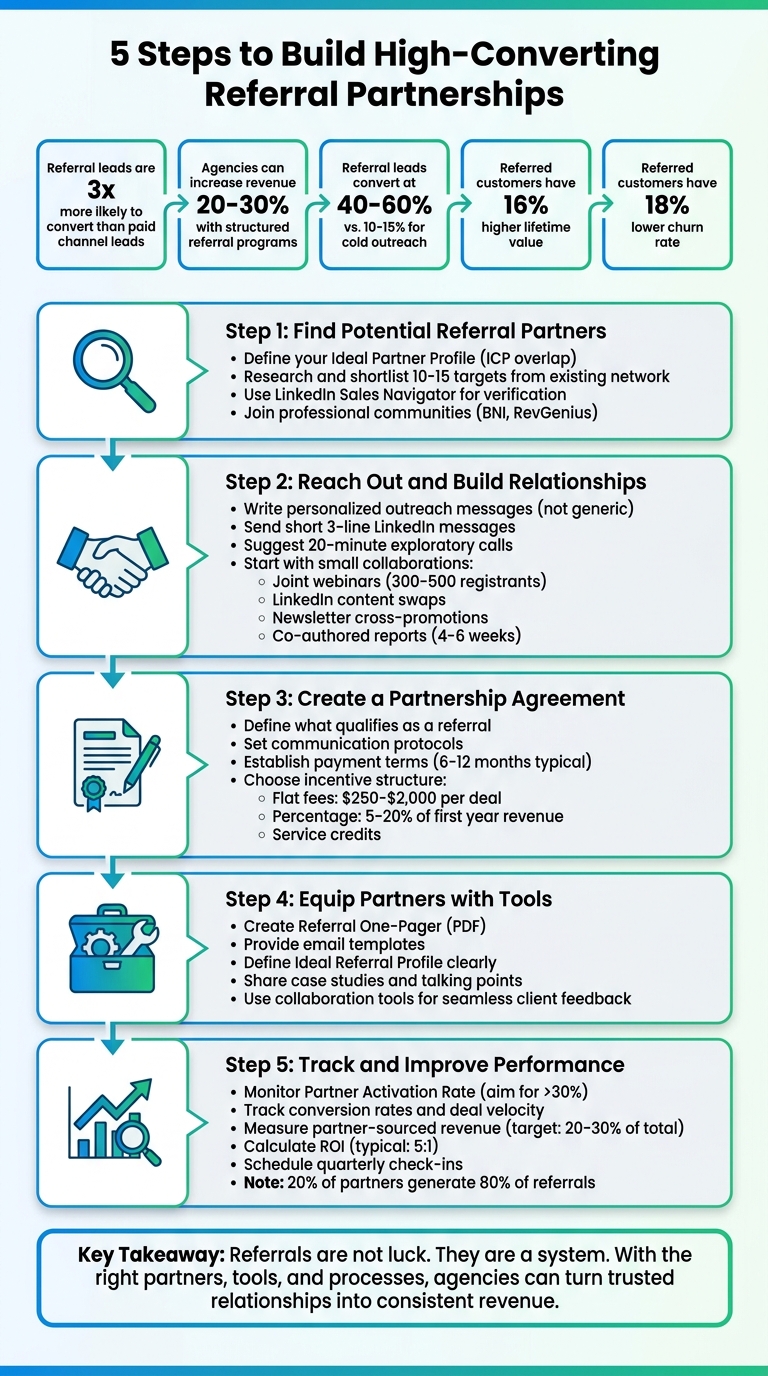
5-Step Process to Build Agency Referral Partnerships
The agency referral playbook with Dave Plunkett
sbb-itb-32f6eb2
Step 1: Find Potential Referral Partners
Building a steady stream of referral revenue begins with finding the right partners. These aren't just random contacts who might mention your name; they are businesses that serve the same clients you do, precisely when those clients are in need of your services.
Define Your Ideal Partner Profile
Start by mapping out your client’s ecosystem to pinpoint complementary service providers. For instance, if you’re a web development agency focusing on B2B SaaS startups, your ideal partners could include branding studios, SEO agencies, legal firms, fractional CFOs, HR platforms, and business consultants.
The key is Ideal Client Profile (ICP) overlap. Partners who share your ICP are more likely to send referrals that fit your business. But it’s not just about client alignment - look for partners who share your commitment to quality and uphold the same professional standards. A poor referral can harm your reputation just as much as a misstep on your part.
Timing is another critical factor. Choose partners whose services align with when your clients need them. For example, if you run an SEO agency, partnering with a web development firm makes sense because new websites often require both optimization and strong copywriting.
"Your referral engine starts with a crystal clear vision about who you want sending business your way. Nailing down your Ideal Referral Partner Profile separates agencies that grow from those that spin their wheels." - Tobias Nagel, Author, Editorialge
Once you’ve nailed down your partner profile, it’s time to research and create a shortlist of the best candidates.
Research and Shortlist Partners
Your existing network is the perfect starting point. Reach out to former colleagues, current vendors, and trusted connections. Aim for an initial list of 10–15 targets. These relationships are already built on trust, making them easier to convert into referral partnerships.
Take advantage of tools like LinkedIn Sales Navigator to verify company details and identify decision-makers. Dive deeper by analyzing the tech stacks of your top clients. Look for recurring tools like CRM systems, marketing automation platforms, or project management software. Then, connect directly with partnership or business development leads at those companies - many tech providers have structured programs designed to encourage tool adoption.
Join professional communities where your ideal partners are active. Organizations like Business Network International (BNI) or online groups such as RevGenius are excellent places to meet service providers who are also eager to build referral relationships. For example, in March 2026, LevelUp Leads identified 15 ideal partners through such networks, resulting in a steady flow of warm leads.
Before reaching out, take the time to understand each potential partner's key business challenges. Offering something of value upfront - like a free website audit or a strategy session - shows your expertise and makes it easier for them to recommend your services.
Step 2: Reach Out and Build Relationships
Once you've pinpointed potential partners that align with your goals, the next step is reaching out with intention. Think of this as starting a meaningful business conversation - not delivering a sales pitch.
Write Personalized Outreach Messages
Sending generic messages won’t cut it. Take the time to research each potential partner - their clientele, challenges, and needs. Your message should clearly explain why you’re reaching out to them specifically and how a partnership could benefit both of your client bases. Back this up with some proof, like a description of your ideal client, examples of recent work, and a clear idea of what you can bring to the table.
A short, tailored LinkedIn message can work wonders. In just three lines, you can explain why you chose them, highlight your shared audience, and suggest a quick 20-minute exploratory call. For instance, if you’re a web development agency reaching out to a branding studio, you might point out how their clients often need technical support after completing their brand strategy.
This approach shows you’re interested in building a mutually beneficial relationship - not just chasing leads. And it works: referrals from trusted partners convert at rates of 40–60%, compared to just 10–15% for cold outreach.
"Referrals are not luck. They are a system. Here's how to build the partner program that makes them reliable." - Arjun Mehta, Agency Sales Coach, Yuktis
Use this initial outreach to build trust and test the waters with smaller collaborations.
Start with Small Collaborations
Begin with low-stakes collaborations to see how well you work together. These small projects help establish trust and offer a glimpse into your partner’s communication style, quality of work, and client alignment.
For example, hosting a joint webinar can attract 300–500 engaged registrants, giving both partners access to a valuable audience. Other quick-win ideas include LinkedIn content swaps or newsletter cross-promotions, which can help generate immediate leads. If you’re ready to invest a bit more time, co-authoring an industry benchmark report over 4–6 weeks can deliver long-term benefits like inbound leads and backlinks.
Starting small gives you the chance to fine-tune the partnership. When both sides are consistently delivering value and the collaboration feels natural, you’ll have a strong foundation for taking the relationship to the next level.
Step 3: Create a Partnership Agreement
Once you've confirmed a strong partnership through smaller collaborations, it's time to formalize things with a written agreement. Without clear terms, misunderstandings can arise over referral credits, fee triggers, or the agreement's duration.
A well-thought-out referral agreement sets clear expectations and ensures fair compensation. Think of it as a roadmap that turns potential opportunities into consistent revenue. This doesn't mean you need a dense legal document - just a clear framework outlining expectations, processes, and incentives so both sides can focus on creating value.
This step transitions your partnership from informal trials to a structured, professional arrangement.
Define Roles, Processes, and KPIs
Start by defining what qualifies as a "referral." Does it mean simply passing along contact details? Or does it involve a warm introduction where the referrer participates in the initial conversation? Be specific here to avoid future disputes. For instance, you might require referrals to meet certain criteria, such as minimum budget or company size, to ensure they align with your target market.
Next, outline communication protocols. Decide how introductions should be made - via email, phone, or frictionless referral forms - and clarify whether your partner will stay involved after the introduction. Regular check-ins, like monthly or quarterly calls, can help both sides review the pipeline and refine referral quality.
Payment terms are another key area. Typically, fees are paid when a contract is signed or after the first payment is collected, not just when a lead is passed along. Clearly define how long the payment obligation lasts - common durations range from 6 to 12 months or cover the first project only - to prevent indefinite commitments.
Finally, establish how revenue is defined. For example, distinguish between "gross revenue" and "net revenue." Using net revenue - excluding refunds, credits, and pass-through costs - ensures fees are based on actual earnings. Most agencies prefer fees tied to collected revenue rather than billed revenue to avoid issues with unpaid invoices.
Once roles and metrics are clear, the next step is designing incentives that drive results.
Set Up Incentive Structures
Pick an incentive model that encourages high-quality referrals while managing costs. Here are some common options:
- Flat Fees: These range from $250 to $2,000 per closed deal and are easy to calculate. They also avoid sharing sensitive revenue data. However, they might not motivate referrals for high-value clients since the reward doesn’t scale with deal size.
- Percentage-Based Commissions: Typically 5% to 20% of the first year’s revenue or first project value, this model ties rewards to the deal's value and scales naturally. That said, it requires clear revenue definitions and can be harder to track, especially for long-term retainers.
- Service Credits: These help conserve cash flow and build loyalty if your partner is also a client. However, they’re less appealing if the partner doesn’t use your services.
| Incentive Model | Pros | Cons |
|---|---|---|
| Flat Fee | Easy to calculate; predictable costs | Might not motivate high-value referrals |
| Percentage-Based | Rewards scale with deal value | Needs clear revenue definitions; harder to track |
| Service Credits | Preserves cash flow; strengthens relationships | Limited appeal if partner doesn’t use services |
You might also consider two-sided incentives, where both the referrer and the new client benefit. For example, the partner could earn a commission while the client receives a service credit. This approach fosters trust and a sense of shared gain, though it may increase acquisition costs.
Whatever model you choose, make sure payments are timely. Delayed payments are a frequent source of partnership friction.
Step 4: Equip Partners with Tools and Resources
To generate quality referrals, your partners need practical tools and resources. Without these, they may struggle to explain your services effectively or identify the right prospects. A well-thought-out toolkit can make their job easier and more efficient.
When partners have access to ready-to-use templates, clear guidelines, and easy-to-understand tools, they can confidently promote your agency. And it’s worth the effort - referral leads are 3x more likely to convert compared to leads from paid marketing channels.
Provide Referral Materials
Start by creating a "Referral One-Pager" - a concise PDF that showcases your services, outlines your unique value, and details the referral program. This document should address the essentials: what your agency does, your ideal clients, and the rewards partners can earn for successful referrals. Keep it visually appealing and easy to skim.
Offer pre-written, customizable email templates to save your partners time. For instance:
"Hi [Prospect Name], I’ve been working with [Your Agency] on [specific project], and they’ve done an incredible job with [specific outcome]. Knowing your challenges with [pain point], I thought you should connect."
Clearly define your Ideal Referral Profile so partners know who to refer. Include details like company size, industry, budget range, and the challenges your agency is best equipped to solve. For example, Amanda Lee, Client Success Director at Yuktis, helped secure 23 new clients in one year - bringing in over $400,000 in revenue - by giving her partners precise referral criteria. When partners know exactly what you’re looking for, the leads they send are more likely to be a perfect fit.
Add to your toolkit with talking points, case studies, and snapshots of past results. These materials provide partners with tangible proof when prospects ask, "Why should I choose your agency?" The easier you make it for your partners to sound informed and credible, the more referrals you’ll see. This approach aligns seamlessly with your structured referral outreach, creating a smooth process from start to finish.
Next, let’s explore how to simplify client collaboration to further strengthen your partnerships.
Use BoastImage for Client Collaboration
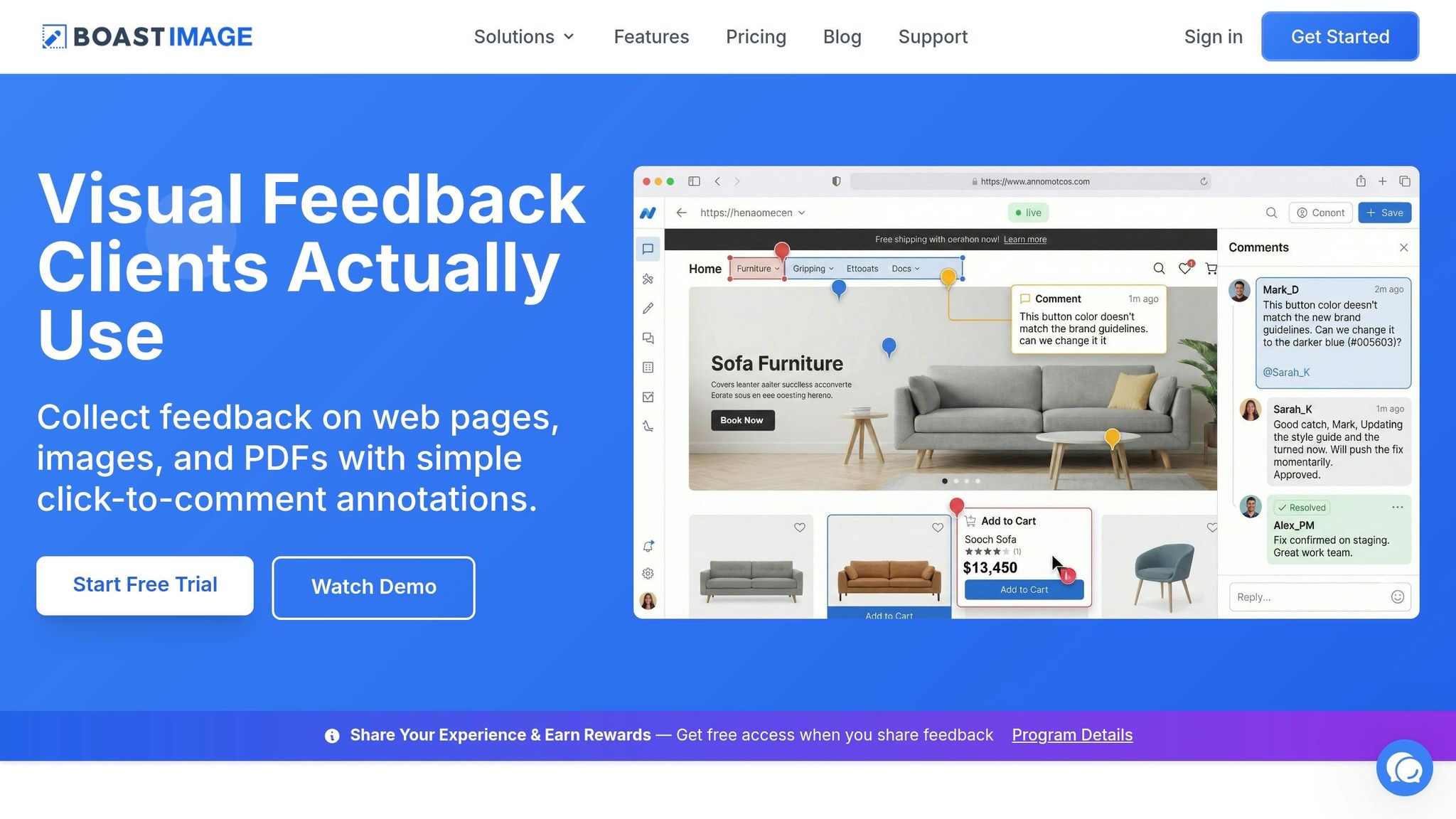
Efficient collaboration is just as important as referral materials when working with partners. Joint projects often hit a snag during actionable client feedback workflows. Many traditional tools require clients to create accounts or navigate complicated dashboards, which can slow things down.
BoastImage solves this problem with a client-first visual feedback board. It eliminates barriers for external reviewers by allowing clients to provide feedback on web pages, images, or PDFs without needing logins or training. This makes the process seamless and professional, especially when working with referred clients.
For instance, if you’re co-managing a website redesign with a partner, you can send the client a BoastImage link to review mockups. The client simply clicks the link, leaves comments, and moves on. Meanwhile, you and your partner can view all feedback in one organized space, complete with version tracking, tasks, and Kanban boards. Plus, all paid plans include unlimited external collaborators, so your clients won’t impact your budget.
Step 5: Track and Improve Partnership Performance
Once your referral program is up and running, the next step is to measure its success and refine your approach. Tracking performance is essential if you want to maintain consistent revenue growth. Interestingly, 20% of partners often generate 80% of referrals. Your goal? Identify these top contributors and focus on strengthening those relationships.
Monitor Key Metrics
To understand how well your partnerships are performing, track these critical metrics:
- Referral volume and quality: Count the leads each partner sends and calculate your "Partner Activation Rate." This rate reflects the percentage of partners who’ve sent at least one referral in the past 90 days. If it drops below 30%, it’s time to re-engage those partners with new resources - or consider removing them from the program. Providing them with a website feedback tool can simplify the review process and make collaboration more attractive.
- Conversion rates: Keep an eye on how quickly referral leads convert compared to cold outreach. Monitor deal velocity to ensure referred leads are moving efficiently through your pipeline.
- Financial impact: Measure partner-sourced revenue, average deal value, and overall ROI. Partnerships can account for 20–30% of an agency's total revenue and often deliver a 5:1 ROI, outperforming outbound marketing.
- Client retention: Referred customers tend to stick around longer, with a 16% higher lifetime value and an 18% lower churn rate compared to non-referred customers.
Here’s a quick breakdown to help you stay organized:
| Metric Category | What to Track | Why It Matters |
|---|---|---|
| Lead Generation | Referral volume, Partner Activation Rate | Measures partner engagement and reach |
| Sales Efficiency | Close rate, Deal velocity, Win rate | Evaluates the quality and speed of referred leads |
| Revenue & Profit | Partner-sourced revenue, Average deal value, ROI | Determines the financial viability of the partnership |
| Long-term Value | Customer Lifetime Value (LTV), Churn rate | Assesses the quality of the clients being referred |
By staying on top of these metrics, you’ll have a clear picture of which partnerships are thriving and which need attention.
Schedule Regular Check-ins
Collecting data is just the beginning. To truly optimize your referral program, set up regular check-ins with your partners - quarterly reviews work well for this. These meetings are your chance to dig into the numbers and uncover what’s working and what’s not. Use the time to celebrate successes, address challenges, and gather feedback.
"Referrals are not luck. They are a system." - Arjun Mehta, Agency Sales Coach, Yuktis
During these sessions, share updates on how referrals are performing. For example, if a partner’s lead resulted in a closed deal, let them know the deal size and timeline. If it didn’t close, explain why. This level of transparency not only builds trust but also helps partners fine-tune the leads they send your way. Don’t forget to express gratitude - thank them when you receive a referral and again when a deal closes.
"A referral partner who receives a bonus but no acknowledgment feels transactional." - Tobias Nagel, Author, Editorialge
Another important aspect of these check-ins is keeping your partners updated on your Ideal Referral Profile. As your agency grows and evolves, your target audience may shift. Keeping partners in the loop ensures the leads they send align with your current goals. And when you achieve joint wins, celebrate them publicly (with permission) on platforms like LinkedIn to foster goodwill and strengthen the partnership.
Conclusion
Creating referral partnerships isn’t just about hoping for a few good leads - it’s about building a system that consistently transforms trusted relationships into reliable revenue. The agencies growing the fastest have shifted away from relying on chance and instead developed structured programs. These programs include clear partner profiles, formal agreements, and regular communication to keep partnerships strong and effective.
The numbers tell the story: a well-run referral program can increase revenue by 20–30% and deliver referral lead close rates of 40–60%, compared to just 10–15% for cold outreach. To achieve these results, relationship management is key. Regular activities like sharing content monthly, scheduling quarterly check-ins, and hosting bi-annual in-person meetings ensure your agency stays top of mind. Success in this area also hinges on having solid partnership agreements and tools that make collaboration easy and efficient.
This guide has outlined how to approach strategic partnerships step by step - from identifying the right partners to formalizing agreements and providing them with the tools they need. Each phase plays a role in creating a dependable system for driving revenue.
For smooth client collaboration, consider tools like BoastImage. With BoastImage, clients can share feedback effortlessly - no logins or training required. They simply click a link, comment directly on the work, and they’re done. This hassle-free process not only speeds up project timelines but also leaves a positive impression on both your clients and your referral partners.
FAQs
How do I pick the best referral partners for my agency?
To find the right referral partners, aim for professionals whose services align with yours and who already have connections with your ideal clients. Think of individuals like consultants, accountants, or web developers - people who naturally work with the same audience you’re targeting. Strengthen these partnerships by offering clear incentives and maintaining consistent communication to keep them engaged in referring clients to your agency. Focus on partners who are well-regarded and can reliably provide high-quality referrals.
What should a referral partnership agreement include?
A referral partnership agreement needs to spell out key details to ensure clarity and avoid misunderstandings. These include the services provided, the parties involved, and the payment terms - whether it's a percentage-based or flat fee, along with the timing of payments. It should also specify how long referral fee obligations last.
Additionally, the agreement should cover confidentiality clauses, termination conditions, and the responsibilities of each party. To make it official and enforceable, signatures from all parties are essential. This step helps prevent disputes, sets clear expectations, and safeguards both sides in the partnership.
How do I track and improve referral partner results?
To get the most out of your referral partner program, start by setting clear metrics. Focus on key indicators like the number of referrals, conversion rates, and revenue generated. These will help you measure success and pinpoint areas for improvement.
Leverage tracking tools to monitor performance and accurately attribute results to individual partners. This data will highlight who your top performers are and where adjustments might be needed. Regularly reviewing this information allows you to fine-tune incentives or communication strategies to keep partners engaged and motivated.
Additionally, create feedback loops to understand what drives your partners. By listening to their input, you can refine your program and ensure it aligns with their goals. This approach helps turn referrals into a dependable and scalable way to grow your business.