Client Feedback Without Login: The No-Account Solution
The #1 reason clients ghost feedback tools? You asked them to create an account.
24% of users abandon processes at account creation. Another 36% quit if registration feels complicated. Traditional login systems achieve only 60-85% success rates.
The cost? $6,000-$12,000 per year in lost time chasing clients, explaining tools, and managing password resets.
This page explains why "client feedback without login" isn't just convenient—it's essential for agencies, freelancers, and teams who can't afford to lose half their clients to signup friction.
Why Login Requirements Kill Client Feedback
Requiring clients to log in to give feedback is slowing you down. Why? Because every extra step - like creating accounts or verifying emails - causes drop-offs. Research shows 24% of users abandon the process when faced with account creation, and login success rates are only 60%–85%. This means delays, miscommunication, and endless follow-ups.
How to Get Client Feedback Without Accounts
The solution? Loginless feedback. Clients simply click a link, leave comments, and move on - no passwords, no dashboards, no frustration. This approach boasts a 99.9% success rate and cuts time to feedback by over half. It's faster, smoother, and keeps projects on track.
Here's why loginless workflows work better:
- Fewer steps: No account setup, password resets, or email verifications.
- Higher engagement: Clients focus on giving feedback, not navigating tools.
- Improved efficiency: Projects move forward without unnecessary delays.
- Lower cost: Save $6K-12K annually by eliminating support overhead for password resets, onboarding, and chasing down ghosted clients. Read more about the hidden cost of "just create an account".
The Real Cost of Login Requirements
Time and Money Wasted on Account Setup
Forcing clients to create an account for every feedback request introduces hidden costs that can quickly pile up. These small delays in account setup waste valuable time - time that could otherwise be spent on billable work. Think about the steps involved: with magic links, users have to enter their email, switch to their inbox, find the message, copy the code, and submit it. That’s nine steps in total. Each extra step increases the chance that users will get distracted or give up entirely. Not only does this waste time, but it also boosts the likelihood of user abandonment.
The Numbers Behind Client Abandonment
Complex registration processes are a major reason clients abandon feedback tools. Research shows that these processes can lead to abandonment rates as high as 36%. Even when clients complete the registration, login success rates hover between 60% and 85%, meaning a significant portion of users still struggle to access the tool on their first attempt. When clients get stuck or give up during registration, the entire project timeline can be thrown off track.
The Ripple Effect of Delayed Feedback
Login issues don’t just lead to abandoned registrations - they can disrupt the entire feedback process. If clients face hurdles logging in or verifying their accounts, providing timely feedback becomes a challenge. These delays often stretch beyond what most clients expect, causing a loss of momentum. Worse yet, when clients resort to sending vague emails or texts instead of using a structured feedback system, teams lose access to essential features like visual annotations and threaded discussions. The result? Miscommunication, confusion, and project delays that could have been avoided.
5 Barriers That Stop Clients From Giving Feedback
Every additional step in the feedback process creates friction, and login requirements are often the biggest culprits. Let’s break down the most common barriers that prevent clients from sharing their feedback and why so many requests go unanswered.
1. Account Creation
The moment a client clicks on your feedback link and sees "Create an Account", you've likely lost a chunk of your audience. Research shows that requiring account creation can lead to a 24% drop-off rate in feedback scenarios. Busy clients often abandon requests when faced with the hassle of setting up an account and creating yet another password. UX copywriter Scarlett Payne sums it up perfectly:
"People are tired of collecting accounts and passwords... if you require an account to buy your products, the path of least resistance might involve not purchasing from you."
The same logic applies to feedback: if it feels like a chore, clients won’t bother.
2. Email Verification
Even if clients make it past the account creation step, email verification is another roadblock. This process, often described as:
"incredibly tedious"
requires users to switch tabs, find the verification email, copy a code, and return to paste it - all of which adds unnecessary complexity. Research manager Zach Capers from Capterra notes that email verification:
"adds a time‐consuming step, alienates privacy‐focused consumers, and risks losing a sale."
With 66% of consumers expecting online tasks to take no more than four minutes, these extra steps can easily push clients to abandon the process altogether.
3. Forgotten Passwords
Even if clients successfully create an account, the next hurdle comes when they forget their password. Login success rates typically range from 60% to 85%, meaning a significant number of users struggle to access their accounts later. Password managers, which could help, often fail to auto-fill credentials for feedback tools, leaving clients to manually retrieve or reset their passwords. This extra hassle often leads to complete abandonment.
4. Learning a New Tool Each Time
If clients don’t use your feedback tool regularly, they’ll likely forget how it works by the time they return. As web designer Brad Frost points out:
"When we try to get too clever we force users to learn new conventions which slows them down."
Each unfamiliar interface increases cognitive load, making it harder for clients to engage - especially when they’re already managing multiple projects.
5. Remembering Which Platform to Use
Clients often juggle feedback tools from various agencies, freelancers, and internal teams. If too much time has passed since the last project, they may forget which platform they’re supposed to use. When they can’t quickly figure it out, they’ll often default to sending feedback via email or text - completely bypassing your structured system.
These barriers illustrate how login requirements and unnecessary steps can discourage feedback, paving the way for a simpler, login-free approach. By removing these obstacles, you can make it easier for clients to share their thoughts without hesitation.
Why Feedback Tools Are Moving Away From Login Requirements
Industry Recognition of the Login Problem
The feedback tool industry has long acknowledged a critical issue: requiring users to create accounts significantly reduces participation. Agencies and freelancers have seen this problem firsthand - forcing clients to log in often leads to abandoned feedback processes. While many platforms emphasize features designed to improve team efficiency, the real challenge lies elsewhere. The bottleneck isn’t internal productivity; it’s getting clients to engage in the first place.
To address this, more platforms are now offering guest access options. This shift is backed by multiple studies showing that account requirements create a major hurdle. Research also highlights a strong consumer preference for simpler, more streamlined processes. These findings underline a key point: simplifying workflows for clients is essential for effective feedback collection.
Results From Loginless Systems
Adopting loginless systems has proven to be a game-changer. These systems eliminate unnecessary steps, leading to a massive improvement in feedback efficiency. For example, loginless workflows boast a 99.9% success rate, compared to just 60%-85% with traditional account-based methods. They’re also significantly faster - tasks are completed 15 times quicker, reducing friction and increasing conversion rates by up to 400%.
Time is critical here. Studies show that 66% of consumers expect to finish online tasks within four minutes, and 28% expect it done in two minutes. Every extra second adds frustration, making loginless systems a clear winner in meeting consumer expectations.
Consumer preferences further validate this approach. A striking 93% of users favor biometric or passwordless authentication over traditional passwords. As Raluca Budiu from Nielsen Norman Group explains:
"Passwords are a major pain point in any user experience. Until recently, this pain point was considered unavoidable".
The success of loginless systems aligns with the strategy used by companies like BoastImage, which have shown that removing the account barrier leads to faster project completion and fewer follow-up reminders. The takeaway is simple: if you want effective feedback, ditch the login requirement.
sbb-itb-32f6eb2
Login-Required vs. Loginless: A Workflow Comparison
Login-Required vs Loginless Feedback Workflow Comparison
The Login-Required Workflow
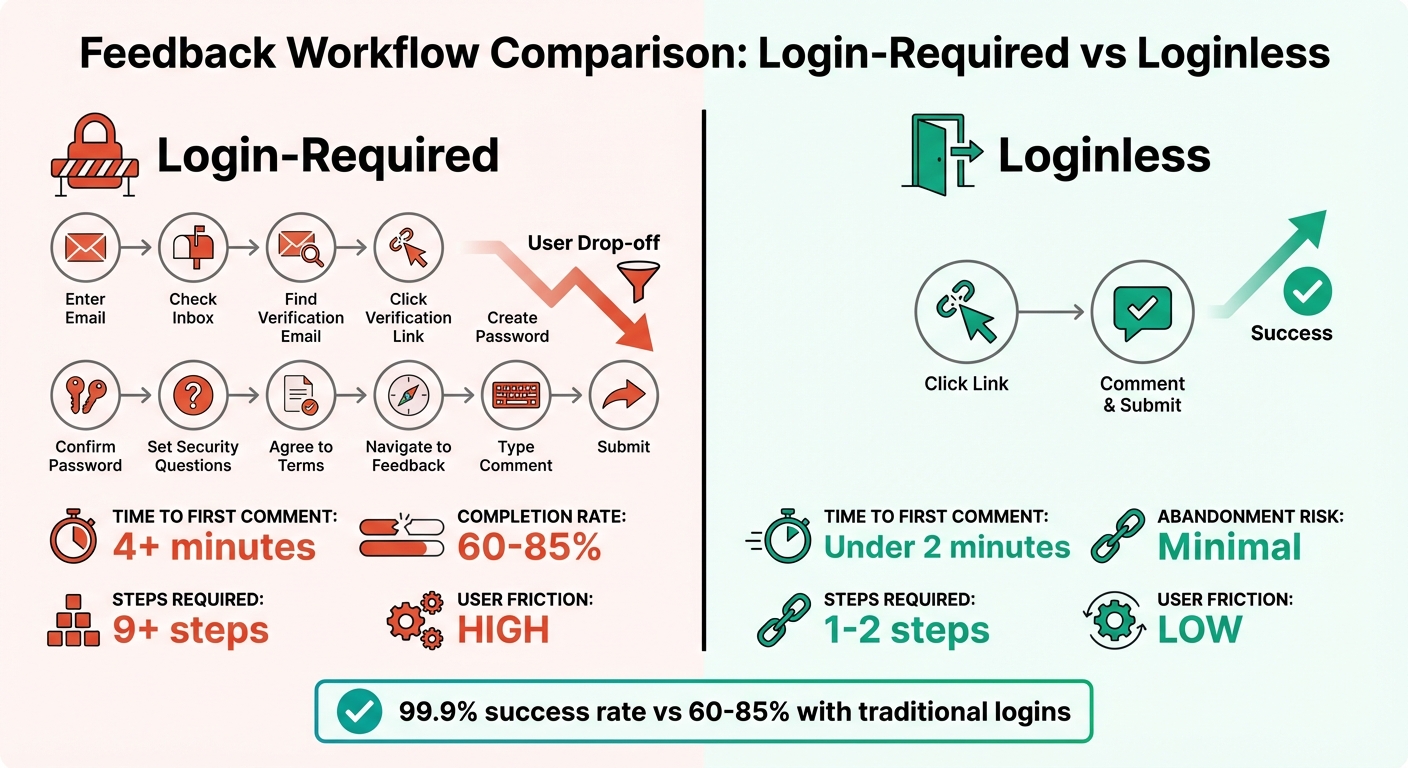
The traditional feedback process can feel like a marathon. It starts with your client clicking a link, only to be met with a lengthy, multi-step account setup - often requiring nine steps - before they can even log in. And that’s assuming everything works smoothly, which, let’s be honest, rarely happens.
Here’s the reality: 24% of users abandon the process entirely when asked to create an account. Another 36% quit if the registration feels overly complicated. Even for those who stick it out, traditional login systems only achieve a 60% to 85% success rate. Meanwhile, you’re stuck sending follow-up emails like, “Did you get my link?” as deadlines inch closer and frustration mounts.
The Loginless Workflow
Now, compare that to the loginless workflow, which removes all the hassle. You send a link, your client clicks it, and they’re immediately looking at the work - no dashboards, no confusing navigation, no onboarding tours. They can simply click on the page and leave a comment. For most users, the entire process takes less than two minutes, with an astounding 99.9% success rate. No passwords to reset, no verification emails to chase down - just a smooth, friction-free experience every time, even if they return months later. It’s a streamlined approach that keeps the focus on what matters: meaningful feedback.
Side-by-Side Comparison
| Metric | Login-Required | Loginless |
|---|---|---|
| Time to First Comment | Typically exceeds four minutes | Under two minutes |
| Completion Rate | 60%–85% success rate | 99.9% success rate |
| Abandonment Risk | 24%–36% due to registration | Minimal - no barriers |
| Steps Required | 9+ steps (with email verification) | 1–2 steps (click and comment) |
| User Friction | High - password issues and delays | Low - instant access |
The difference is night and day, especially when managing multiple clients. A login-required system forces everyone through a tedious process, adding unnecessary delays and frustration. On the other hand, loginless feedback eliminates these roadblocks, saving time and money while keeping the focus on collaboration. With no passwords to remember or hurdles to overcome, clients can dive straight into providing feedback - making the entire process smoother and more efficient. This comparison highlights why ditching login barriers is a game-changer for effective client engagement.
How BoastImage's Loginless Feedback Works
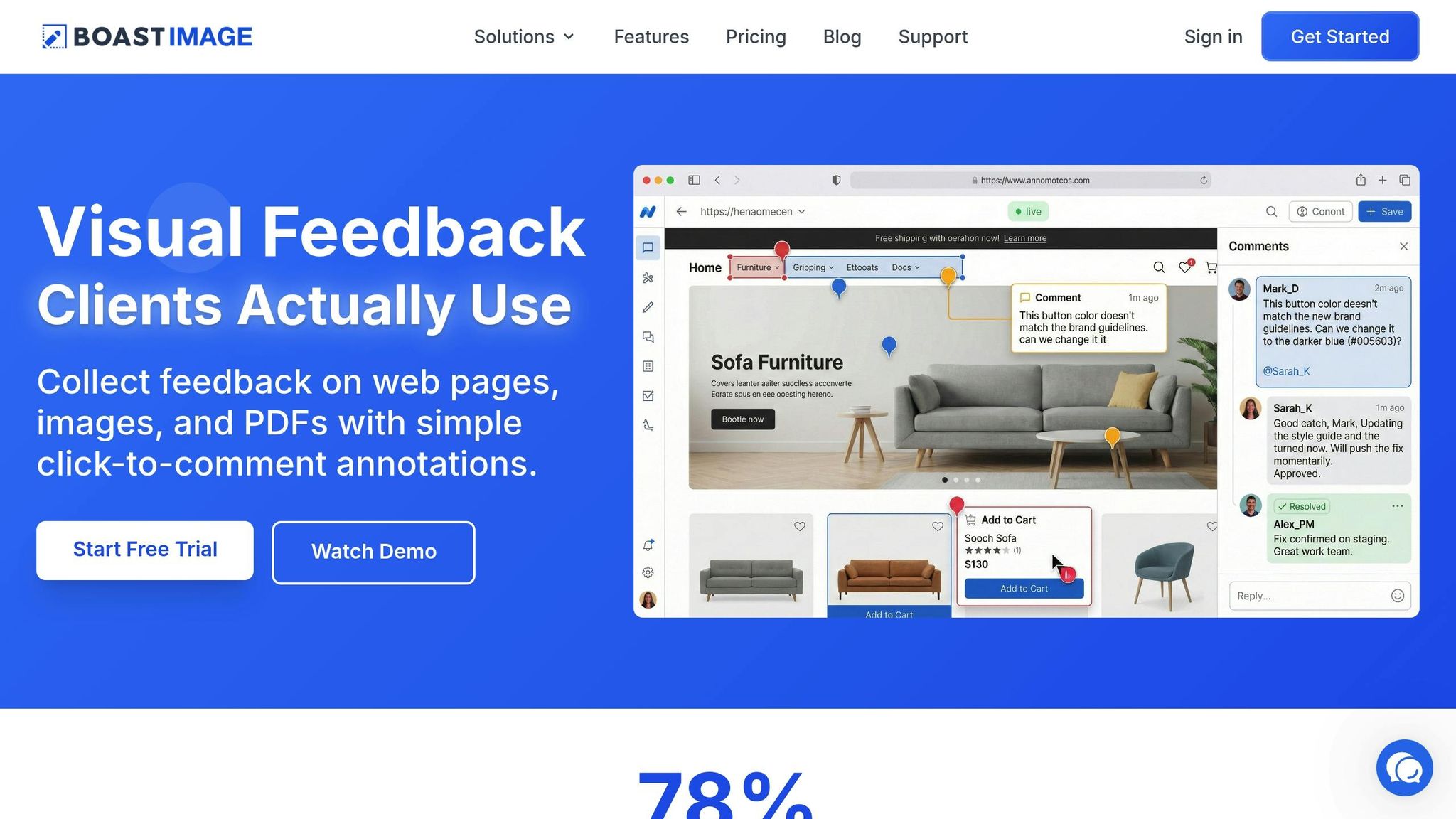
BoastImage tackles the common hurdles of feedback by removing unnecessary steps, making the process quicker and more efficient.
Click, View, Comment - No Login Needed
With BoastImage, giving feedback is as easy as 1-2-3: click the link, view the design or mockup, and leave a comment. There’s no need to create an account, verify an email, or remember a password. Clients are instantly directed to the work and can share their thoughts right away. This hassle-free method skips the usual login routines, speeding up the feedback process.
Now, let’s look at how BoastImage keeps things secure while staying login-free.
Capture Any Web Page Instantly
Get our free Chrome extension to capture full pages, visible areas, or selected regions—all without leaving your browser.
Install Chrome ExtensionSecurity and Tracking Without the Hassle
While simplicity is key, security is never overlooked. Even without logins, BoastImage ensures accountability by using email-ledger tracking. Every comment is recorded along with helpful details like browser type, screen resolution, and timestamps, creating a reliable audit trail without the need for passwords. For extra-sensitive projects, you can add an optional access code (a simple PIN) for an added layer of protection. This lets you control who can view your work while keeping the process fast and user-friendly.
Links That Never Expire
Unlike magic links that vanish after one use, BoastImage links stay active indefinitely. Clients can bookmark the link and revisit it anytime - whether it’s days, weeks, or months later - to provide more feedback. There’s no need to re-authenticate or search for new access codes. This feature ensures a seamless experience, especially for ongoing projects or revisions.
As Brad Frost aptly puts it:
"Enter email... Open new tab... Open inbox... Find message... Open message... Copy password... Go back... Paste... Submit. It's overwhelming."
With BoastImage, that overwhelming process is a thing of the past. Persistent access keeps things simple, so clients can focus on the work, not the tool.
Conclusion
The numbers speak for themselves: 24% of users abandon a process as soon as they're asked to create an account. These interruptions don’t just waste time - they also put a halt to valuable feedback.
By removing these hurdles, the feedback process becomes seamless. When clients can simply click a link and share their thoughts immediately - no accounts, no confusing tools - you’re aligning with how people naturally behave. Without the need for logins, feedback happens faster, response rates improve, and those tedious follow-ups become a thing of the past.
This approach ties back to the idea that every extra step slows down timely feedback. As Steve Jobs famously said, "One of the things I've always found is that you've got to start with the customer experience and work backward to the technology". That’s exactly the philosophy behind BoastImage. Clients enjoy an effortless experience that’s intuitive and quick, while you gain access to structured feedback, version control, and project management tools - all without creating barriers like login screens.
Curious to see it in action? Experience instant feedback for yourself. See How It Works.
FAQs
How does feedback without login improve client engagement?
Eliminating the need for clients to create an account removes common obstacles like sign-up forms, email verification, and password hassles. These extra steps often frustrate users, leading to drop-offs - over 40% of people abandon processes that require a login. By cutting out these barriers, feedback completion rates can jump from 40-60% all the way to 60-90%, while response times shrink from days to just hours.
This simplified approach not only speeds things up but also reduces decision fatigue, showing clients that their time is respected. When sharing feedback becomes quick and easy, satisfaction improves, and relationships grow stronger. In essence, no-login feedback transforms a tedious process into a seamless interaction, encouraging quicker responses and better engagement.
How does BoastImage ensure security for loginless feedback?
BoastImage takes security seriously, even when it comes to loginless feedback. To ensure only the right people can access your feedback links, you can add an optional access code. This code acts as a gatekeeper, requiring entry before anyone can view or leave comments. On top of that, every comment is meticulously tracked in an email ledger. This ledger logs the reviewer’s email, the time of their feedback, and the exact comments they made, giving you a clear record of who said what.
For even more control, BoastImage lets you customize project-level permissions. You can decide whether links are view-only, allow comments, or come with expiration dates. You can also revoke access at any moment. And if you want an extra layer of security, BoastImage offers passwordless authentication. This might include one-time passwords (OTPs) or passkeys sent directly to a reviewer’s verified email or device. These features keep your content secure while ensuring the process remains straightforward and hassle-free.
Why do traditional login systems cause users to abandon feedback requests?
Traditional login systems often push users away due to the extra hassle they bring. Think about it: setting up an account, verifying your email, and trying to remember yet another password - it’s a lot. These steps can feel overwhelming, often leading users to give up before they even get started.
This complexity doesn’t just wear people out - it chips away at trust and convenience. It’s even worse when users have to repeat the same process across multiple platforms or projects. Streamlining access can make a huge difference, boosting both user engagement and completion rates.
Related Blog Posts
Ready to streamline your feedback workflow?
Try Boast free for 14 days. No credit card required.
Start Free Trial