
Retainer Models for Long-Term Client Growth
Tired of chasing new clients? Retainer models could be your solution. Instead of one-off projects, retainers offer steady, recurring revenue by establishing ongoing agreements with clients. This approach not only stabilizes cash flow but also strengthens client relationships and improves long-term business planning.
Here’s the key idea: Retainers shift the focus from selling hours or tasks to delivering consistent results and access to expertise. Whether it’s fixed-fee packages, performance-based agreements, or pay-for-access retainers, there’s a model that fits your services and client needs.
Why it matters:
- Retainers reduce the cost of client acquisition (5–25x cheaper than finding new clients).
- A 5% increase in client retention can boost profits by 25–95%.
- Agencies with 60%+ recurring revenue often achieve higher valuations (3–5x annual revenue).
Types of Retainers:
- Fixed-Fee: Clients pay a set amount for defined deliverables (e.g., $3,000/month for SEO or content creation).
- Performance-Based: Payment tied to measurable results (e.g., leads or revenue growth).
- Pay-for-Access: Clients pay for ongoing advice and availability, often at premium rates.
How to make it work:
- Clearly define deliverables, scope, and limits (e.g., number of revisions and delays).
- Use SMART goals to measure success and avoid scope creep.
- Offer tiered packages to match different budgets and needs.
- Maintain regular communication through reports and structured feedback reviews to build trust.
Switching to retainers can help you escape the feast-or-famine cycle, grow your business, and secure lasting client partnerships.
Webinar | Agency Retainers That Work: How to Package, Price & Prove Ongoing Value
sbb-itb-32f6eb2
Types of Retainer Models
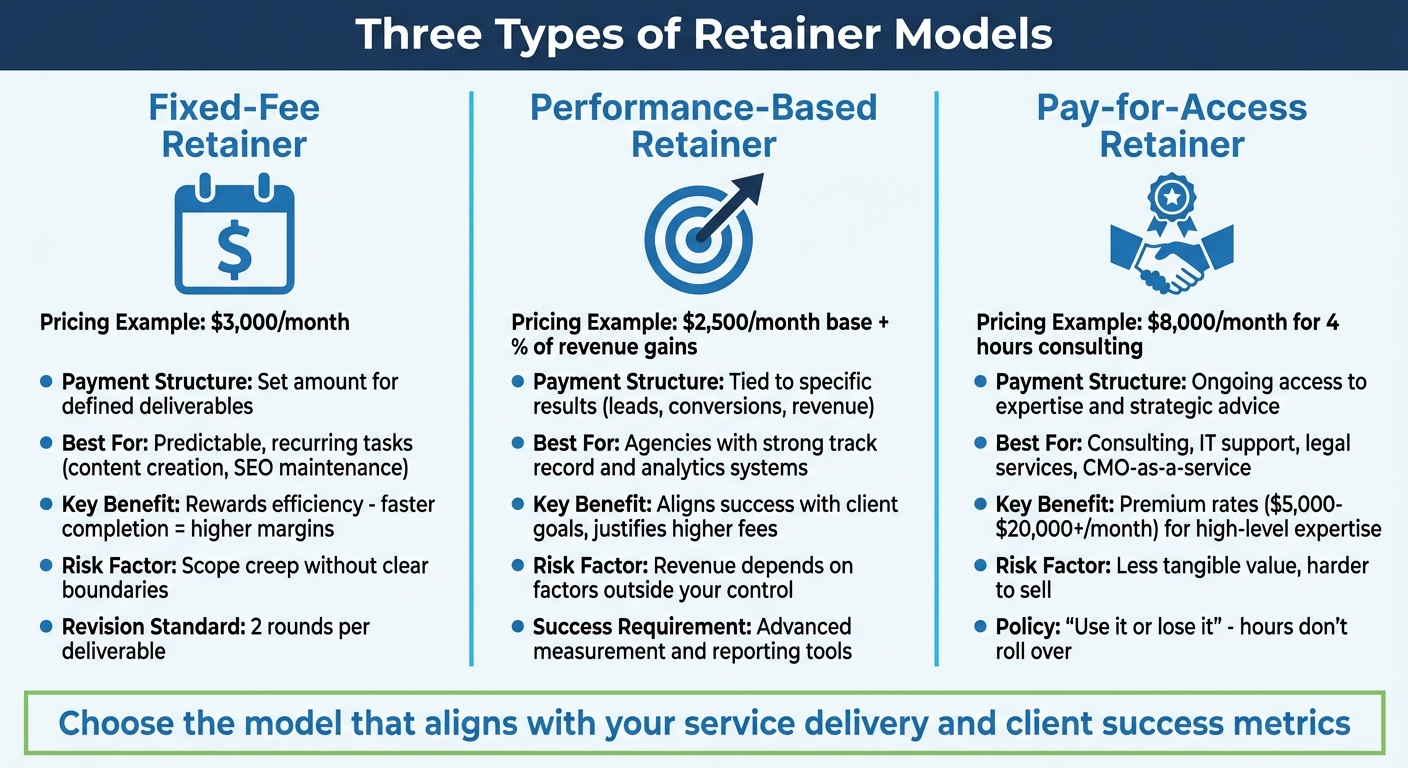
Three Types of Retainer Models Compared: Fixed-Fee, Performance-Based, and Pay-for-Access
Retainer models come in various forms, each with its own way of delivering value and maintaining predictable revenue. The three most common types - fixed-fee, performance-based, and pay-for-access - cater to different client needs and reward specific aspects of your work, whether it’s efficiency, measurable results, or expertise. Knowing the nuances of these models can help you craft agreements that work for both you and your clients.
Fixed-Fee Retainer
With a fixed-fee retainer, clients pay a set amount - monthly or quarterly - for a clearly defined scope of work, regardless of how much time it takes to complete. For instance, a client might agree to pay $3,000 per month for a package covering a set number of blog posts and social media graphics. Whether it takes 15 hours or 40 hours, the fee remains the same.
This model is ideal for predictable, recurring tasks like content creation or SEO maintenance. It rewards efficiency: the faster you complete the work (potentially with the help of automation tools like AI), the higher your profit margins. But there’s a catch - scope creep. Without clear boundaries, clients may request additional work outside the original agreement. Marina Domoney, Marketing Communications Lead at BugHerd, puts it succinctly:
"Your retainer problem is a structure problem, not a client problem."
To avoid eroding your margins, define the scope of work in detail. Include limits on revisions - two rounds per deliverable is a common standard - and establish that anything beyond the agreed-upon scope requires a formal change order.
Performance-Based Retainer
Performance-based retainers tie your payment to specific results, such as leads generated, improved conversion rates, or revenue growth. Instead of billing for hours or deliverables, you’re compensated based on outcomes. A common setup includes a base fee (e.g., $2,500 per month) plus a percentage of revenue gains above a certain baseline.
This model aligns your success with your client’s goals, making it easier to justify higher fees when you exceed expectations. It can also boost client trust and retention over time. On the flip side, it’s riskier. Revenue depends on hitting targets, which can be influenced by factors outside your control, like market trends or how well the client implements your recommendations.
Agencies with a strong track record and advanced analytics systems are best suited for this model. Confidence in your ability to move key metrics - and the tools to measure and report those results accurately - is non-negotiable.
Pay-for-Access Retainer
Pay-for-access retainers are all about availability and expertise rather than specific deliverables. Think of it as offering clients ongoing access to your strategic advice and insights. For example, a client might pay $8,000 per month for four hours of consulting, quarterly strategy sessions, and priority access for urgent questions.
This model elevates you to the role of a strategic partner rather than a task executor. It’s especially common in fields like consulting, IT support, legal services, and CMO-as-a-service, where your value lies in your experience and judgment rather than the volume of work produced. These retainers often command premium rates, ranging from $5,000 to $20,000 or more per month, reflecting the high-level expertise involved.
The challenge? The value is less tangible than a list of completed deliverables, which can make it harder to sell. Clients may question the investment if they feel they’re not fully utilizing your availability, especially during slower periods. To address this, many agencies adopt a "use it or lose it" policy, where unused consulting hours don’t roll over to the next month. Despite this hurdle, pay-for-access retainers are a great way to build stable, long-term partnerships and avoid the feast-or-famine cycle common in project-based work.
How to Structure Retainer Agreements
A well-crafted retainer agreement helps avoid misunderstandings, unexpected scope changes, and profit loss. The aim is to create a document that safeguards both parties while fostering a steady, predictable working relationship.
Defining Deliverables and Scope
Clarity is critical for ensuring profitability. Instead of vague terms like "marketing services" or "design work", be specific about what’s included each month. For instance, specify deliverables such as "four blog posts up to 1,000 words each" or "10 social media posts per week." This eliminates confusion and ensures clients know exactly what they’re getting.
Just as important is outlining what’s not included. A dedicated "What’s Not Included" section can spell out services that require additional fees or fall outside the agreement. For example, if a $3,500 monthly retainer covers SEO maintenance but excludes paid ad management, make that clear upfront.
Another safeguard is setting limits on revisions. Specify how many rounds of revisions are included - two per deliverable is a common standard - to avoid endless back-and-forth. For requests outside the agreed scope, establish a formal change order process. This would require a separate quote and written approval before any extra work begins.
Once the scope is clearly defined, maintain regular communication to ensure ongoing alignment.
Building Client Feedback Loops
After defining the scope, an effective feedback process is vital for smooth execution. Consistent communication keeps the relationship on track and minimizes surprises when it’s time to renew the agreement. A good rhythm might include weekly check-ins, monthly reports, and quarterly strategy calls. This approach keeps clients informed without overwhelming anyone with constant updates.
"The best account managers I've seen are the ones where clients don't have to reach out for updates. It's about having a routine cadence of communication."
- Josh Kimmes, CEO, Bear North Digital
For visual deliverables like web designs or PDFs, streamline feedback by using tools that simplify the process. For example, platforms like BoastImage allow clients to comment directly on designs via a link. Clients get an easy-to-use interface, while your team benefits from built-in features like version tracking and task management. With plans starting at $9.95 per month, even with unlimited external collaborators, it’s a cost-effective way to keep feedback organized.
Transparency is another key factor. Amanda Walls, Director at Cedarwood Digital, highlights the importance of showing clients the value they’re getting:
"Value reviews to show clients what has been paid for vs what has been delivered... is especially valuable for clients who spend a lot of time on communication and don't realise it's eating into their delivery budget."
- Amanda Walls, Cedarwood Digital
Set clear response time expectations in your agreement, such as requiring a 24-hour response during business days. This helps manage expectations and prevents burnout. Mid-contract "health checks" can also be useful for identifying what’s working and addressing any issues before renewal discussions.
Setting Key Performance Indicators (KPIs)
In addition to defining services and feedback processes, measurable goals are essential for proving value. KPIs help both parties stay aligned on what success looks like. For example, SEO retainers might track metrics like organic traffic growth, keyword rankings, or backlink acquisition. For lead generation, clearly define what makes a lead "qualified", such as "VP-level contacts at B2B SaaS companies", to avoid disagreements over lead quality.
Track these KPIs consistently and share results in monthly reports. Automated dashboards can provide real-time updates, reducing the need for clients to ask for progress reports. This proactive approach builds trust and reinforces the value of the retainer.
Also, ensure payment terms are clear. It’s standard to require payment upfront for the upcoming month to maintain steady cash flow. Include a termination clause requiring 30- to 60-day written notice, allowing both parties to exit gracefully if needed.
According to research from the Project Management Institute, nearly 50% of projects experience scope creep. By creating a detailed agreement with clear deliverables, feedback processes, and KPIs, you can significantly reduce this risk. Investing time in upfront clarity leads to smoother collaboration and stronger client relationships.
Pricing Retainer Models for Profit
Setting the right retainer pricing is essential for building a stable business. It ensures your costs are covered while delivering consistent value to clients.
Calculating Pricing Based on Value
The first step is determining your Minimum Viable Retainer. This involves adding up your direct labor costs, overhead (like software and office space), administrative time for calls and reports, and management oversight. Once you've got this baseline, apply your target profit margin to establish the minimum you should charge.
But pricing shouldn't stop there. Beyond covering costs, factor in a premium for your expertise, market position, and the potential return on investment (ROI) your work delivers. For example, if your efforts significantly boost a client's revenue, even a modest retainer fee can represent a great ROI for both sides.
"Undercharging is a silent killer in agency retainer management."
To ensure profitability, calculate your Effective Hourly Rate (EHR) by dividing your monthly income by the actual hours worked. If your EHR falls below your target rate, it's a sign you need to adjust the scope, the price, or both. Research indicates that successful agencies aim for delivery margins of 60–70% on direct costs and overall net profit margins of 25–35%. However, many agencies average closer to 15%, showing there's room for improvement with better pricing strategies.
Another critical aspect is accounting for non-billable hours. Activities like project management, reporting, and client meetings can take up 20–30% of your time. If you don't factor these into your pricing, your margins will take a hit. It's also smart to include a small buffer - around 10% - to handle minor ad-hoc requests without constantly renegotiating terms.
By using these metrics, you can design flexible pricing structures that align with different client needs.
Creating Tiered Retainer Packages
Once you've established value-based pricing, the next step is to create tiered packages. Not every client has the same needs or budget, so offering three distinct tiers - like Foundation, Growth, and Partnership - provides options while encouraging clients to choose the middle tier, which can be your most profitable.
| Tier | Monthly Price | Typical Deliverables |
|---|---|---|
| Foundation | $1,500–$3,000 | Core services, monthly reporting, one strategy call |
| Growth | $3,000–$7,500 | Bi-weekly calls, priority support, quarterly reviews |
| Partnership | $7,500–$20,000+ | Full-service, dedicated account manager, weekly access |
For perspective, 64% of SEO agencies charge less than $1,000 per month for retainers, while only 2% charge over $5,000. The average monthly retainer for an SEO agency is $3,209, compared to $1,348 for freelancers. These benchmarks can help you position your pricing competitively while still ensuring profitability.
"The beauty of tiered pricing packages is psychological. You're not asking 'Do you want to work with us?' You're asking, 'Which level fits your goals?'"
- Ken Yarmosh
Having standardized deliverables for each tier simplifies revenue forecasting and reduces the back-and-forth of custom negotiations. Be sure to define strict scope boundaries to avoid scope creep, and consider implementing a "use it or lose it" policy for hours-based tiers. This approach prevents resource spikes and encourages clients to maximize their investment.
Finally, remember that retaining clients is far more cost-effective than acquiring new ones. In fact, acquiring a new client costs 5–7 times more, and increasing client retention by just 5% can boost profits by 25–95%. Starting with the right pricing sets the foundation for long-term client relationships and profitability.
Converting Clients to Long-Term Retainers
Shifting from one-off projects to ongoing retainer agreements doesn’t just happen - it’s a deliberate process that starts with positioning and clear communication. Focus on services that require continuous attention, like SEO, Google Ads management, or website upkeep. Present the retainer as the logical next step to safeguard the client’s initial investment and ensure sustained progress.
Set expectations early by introducing concepts like a monthly rhythm or "growth sprint" during your first conversations. This helps reframe your role from being just a vendor to becoming a trusted advisor.
For clients who might be hesitant, consider offering a 60-day pilot program. Use this trial period to showcase clear, measurable results before transitioning into a full retainer agreement. It’s worth noting that retaining an existing client is far more cost-effective than acquiring a new one - 5 to 7 times cheaper, in fact. Plus, boosting client retention by just 5% can increase profits by 25% to 95%. Starting these discussions early and framing retainers as a way to protect and build on their investment lays the groundwork for lasting partnerships.
Once this operational shift is underway, having well-defined goals in the contract becomes essential.
Using SMART Goals in Contracts
When converting clients to retainers, the next step is ensuring contract goals are crystal clear. This is where SMART goals - Specific, Measurable, Achievable, Relevant, and Time-bound - come into play. Instead of vague commitments, provide precise deliverables like "Publish four 1,000-word blog posts per month targeting keywords with 500–2,000 searches".
SMART goals not only help track success but also keep scope creep - something that affects nearly half of all projects - in check by clearly defining what "done" looks like. For example, if your retainer includes content creation, specify details like the number of revision rounds (two per deliverable is a common standard) to manage workload and maintain profitability.
Tie these goals to meaningful business outcomes rather than just outputs. For instance, if managing Google Ads, focus on metrics such as reducing cost per acquisition or increasing the number of qualified leads within a set timeframe. This shifts the conversation from hours worked to the value delivered.
When clients see consistent, measurable progress, they’re much more likely to renew. Tools like BoastImage - a user-friendly visual feedback board that allows clients to comment directly without needing logins - can also help streamline approvals and keep projects moving smoothly.
Running Regular Reviews and Adjustments
Once SMART goals are in place, regular performance reviews ensure those targets stay aligned with your client’s evolving needs. Schedule quarterly business reviews to evaluate progress, gather feedback, and uncover opportunities to expand your services.
"The best account managers I've seen are the ones where clients don't have to reach out for updates. It's about having a routine cadence of communication."
- Josh Kimmes, CEO, Bear North Digital
Start these reviews with high-level results - like "Signups increased by 14%" - to highlight ROI before diving into tactical details. Use these meetings to refine strategies and adapt to any changes in the client’s business.
Between quarterly reviews, maintain consistent communication through weekly updates, monthly reports, and automated dashboards. These tools provide transparency and keep clients informed about ongoing work.
Lastly, include flexibility in your retainer agreements with clauses that allow for periodic adjustments to scope and fees. As your client’s business grows, their needs will change. Regular reviews give you the chance to expand your services, update pricing, and strengthen the relationship - turning a one-time project into a long-term partnership.
Conclusion
Retainer models transform the way agencies operate by turning unpredictable project-based income into steady, recurring revenue. This shift breaks the feast-or-famine cycle that often keeps agencies in a constant state of uncertainty. And the financial benefits are clear: agencies earning 80% of their revenue through retainers achieve valuations 3–5 times higher than those relying solely on project work - even with the same revenue levels.
The real strength of retainers lies in the long-term value they create. By working with clients consistently over time, you gain a deeper understanding of their needs, build trust, and deliver better results. This creates a cycle where retaining clients becomes easier - and it’s worth noting that keeping an existing client costs 5–7 times less than bringing in a new one.
Industry leaders emphasize this approach:
"The retainer model isn't just about stability - it's about creating partnerships with clients who trust you to deliver results month after month."
- Josh Kimmes, CEO, Bear North Digital
To make retainers work, focus on services that require ongoing management - like SEO, paid advertising, or website maintenance - and package them into clear, tiered options. Clearly define the scope of work, use SMART goals to measure progress, and keep clients engaged with automated dashboards and quarterly reviews. When clients see consistent, measurable improvements that align with their goals, renewing their contracts becomes an easy decision.
FAQs
Which retainer model fits my services best?
The best retainer model hinges on your specific goals, the needs of your clients, and the type of services you provide. Tiered retainers are a great fit if you offer clearly defined, results-oriented packages at varying price levels. On the other hand, full-service retainers are ideal for agencies that provide comprehensive, hands-on support over time. To build predictable revenue and foster long-term client relationships, opt for a model that matches your ability to consistently deliver results while meeting your clients’ expectations for collaboration and outcomes.
How do I prevent scope creep on a retainer?
To keep scope creep in check on a retainer, it’s essential to set clear boundaries right from the start. Define the scope of work, deliverables, and limitations in detail. A well-structured agreement can spell out exactly what’s included, minimizing misunderstandings.
Regular communication is key - keeping both sides aligned on progress helps manage expectations effectively. Make sure to outline the limits of the retainer upfront and require formal approval for any extra work outside the agreed scope. Revisiting the scope periodically during the engagement ensures that the pricing or terms can be adjusted if new requests come up.
What should I track to prove retainer ROI?
To show the return on investment (ROI) of retainers, focus on tracking metrics that highlight both value and profitability over time. Some key indicators to monitor include recurring revenue, client retention rates, and lifetime value (LTV). Additionally, evaluate cost savings from reduced client acquisition efforts, the frequency of upsells, and improvements in operational efficiency - such as better time utilization and healthier project margins. These metrics not only help demonstrate ROI but also support pricing justification and uncover potential growth opportunities.