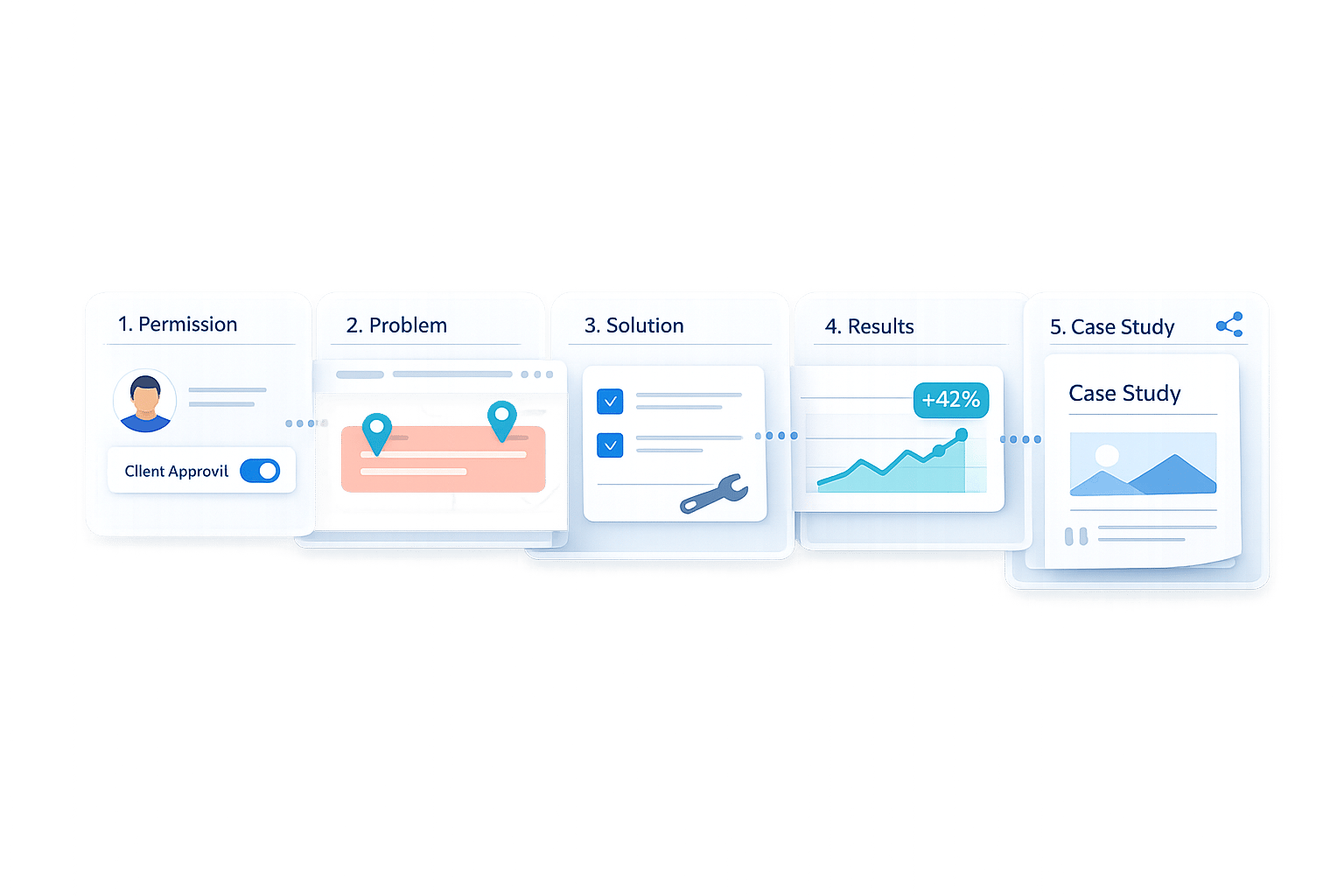
5 Steps to Turn Client Wins Into Case Studies
Want to attract more clients and close deals faster? Case studies are your secret weapon. Unlike testimonials, they dive deep into a client’s journey, showing the problem they faced, the solution you provided, and the measurable results achieved. Here’s why they matter: 71% of B2B buyers review case studies before making decisions, and nearly 40% of SaaS marketers find them highly effective for driving sales.
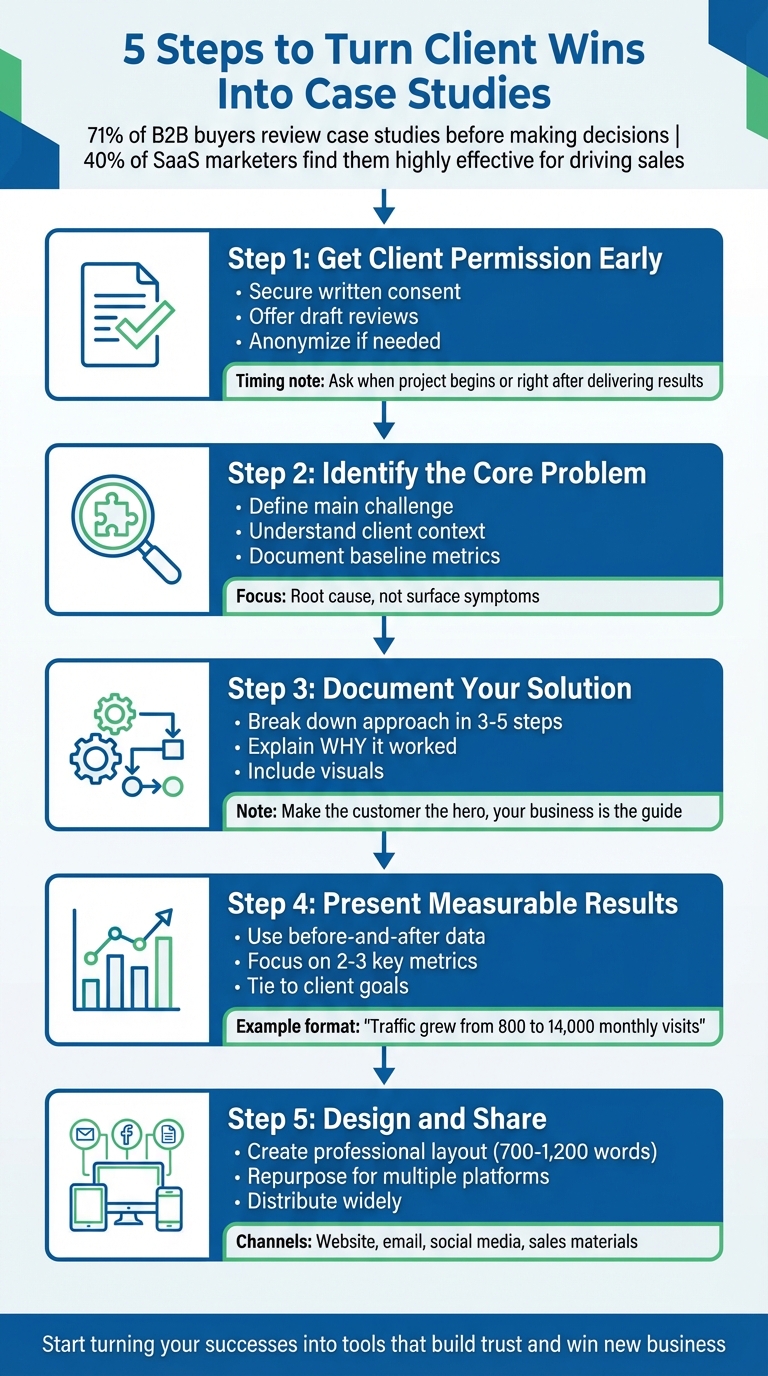
Here’s the process in five steps:
- Get client permission early: Secure written consent and offer drafts for review using a feedback tool. If needed, anonymize details to respect privacy.
- Identify the core problem: Define the client’s main challenge and their unique context to make the story relatable.
- Document your solution: Break down your approach step-by-step, explaining why it worked and including visuals for clarity.
- Present measurable results: Use specific data (e.g., "traffic grew by 200%") and tie outcomes to the client’s goals.
- Design and share: Create a professional layout, repurpose content for multiple platforms, and distribute widely.
Case studies don’t just tell stories - they prove your expertise with real results. Start turning your successes into tools that build trust and win new business.
5-Step Process to Create Effective Client Case Studies
How to Create Powerful Client Case Studies
sbb-itb-32f6eb2
Step 1: Get Client Permission and Collect Testimonials
Getting written consent from clients is a must to avoid any legal complications and maintain strong relationships. The ideal moment to ask is either when the project begins or right after delivering results - when the success is still top of mind.
Ask for Permission Early
Waiting too long to ask for permission can make the conversation feel awkward and might even reduce the chances of getting approval. Be upfront about the process: explain where the case study will be published, how much time it will take (usually around 30 minutes for an interview), and what information will be included. Always offer clients the chance to review and approve the draft before it’s published.
If a client is hesitant about being publicly featured, suggest an anonymized version instead. For example, you could refer to them as “A B2B SaaS Company in the Finance Industry.” This allows you to showcase your work and results without compromising their privacy. Position the request as a win-win by emphasizing how the case study not only highlights your expertise but also boosts their reputation as a leader in their field.
"Many of your clients will probably be happy to be featured in a case study, as long as you make them look good and avoid giving away anything they don't want to be public knowledge." - Joe Kindness, Founder & CEO, AgencyAnalytics
Once you’ve secured their permission, shift your focus to gathering detailed and impactful testimonials.
Collect Specific Client Testimonials
Generic praise like “They were great to work with!” doesn’t persuade potential clients. Instead, ask open-ended questions that encourage specific and meaningful responses. For example, try questions like, “What was the biggest change you noticed after implementing our solution?” or “What would you tell another company facing similar challenges?”. These types of questions help uncover both measurable results (like KPIs or hard data) and emotional insights (how the client felt before and after the problem was resolved).
Additionally, request a headshot and permission to use the client’s name, title, and company logo. These elements make the story feel more personal and instantly build trust with potential clients . During the interview, aim to gather performance metrics and screenshots to back up the client’s feedback with concrete evidence.
Step 2: Identify the Core Problem and Client Context
Once you've gathered testimonials, the next step is honing in on the client's core challenge. Why? Because when potential clients read your case study, they're silently asking themselves, "Does this sound like my situation?". The more precise you are about the problem and the client's circumstances, the easier it becomes for others to connect with the story.
Define the Main Problem
Focus on identifying the root cause, not just the surface-level symptoms. For instance, if a client says, "Our website traffic is low", the underlying issue might be a lack of a content strategy, reliance on branded search terms, or a confusing user experience that discourages visitors. Dig deeper by asking what solutions they tried before working with you and why those efforts didn’t work. This not only clarifies the problem but also highlights the value of your unique approach.
Take this example: In 2026, Kayak Online Marketing helped Omni Circuit Boards tackle a slow and inefficient intake process. The result? Lead generation skyrocketed from 155 to over 6,000 monthly, and they achieved 144+ Page 1 rankings within a year.
"The challenge section shows you understand the problem deeply. This is where trust is built." - Alfred AI
During client interviews, ask questions that reveal the emotional side of the challenge, such as, "How did this issue affect your team?". These questions uncover the human element behind the numbers, making your case study more relatable. Additionally, document baseline metrics during onboarding - things like revenue, time spent, or conversion rates - so you can clearly show the "before" and "after" states.
Once the challenge is clearly defined, use the client's specific context to add depth and make the story resonate.
Describe the Client's Background
Details matter. Include specifics like the industry, company size, and objectives to help readers see themselves in the story. For example, instead of saying "a consulting firm", describe it as "a 12-person management consulting firm billing $250/hr". This kind of detail helps similar businesses picture similar results.
Here’s a real-world example: Between January 2020 and February 2022, LeadG2 collaborated with Questco, a national Professional Employer Organization (PEO), to address a lack of strong sales assets in the competitive HR market. Blog Manager Laura MacPherson spearheaded the effort, publishing 3 to 5 persona-driven posts monthly and creating a gated resource center on HubSpot. The results? A 77% boost in organic traffic, a 65% overall traffic increase, and record-breaking lead generation, with 88 submissions - including 61 new contacts. By sharing Questco’s background as a national PEO in a crowded HR space, the case study becomes instantly relevant to similar businesses.
When providing context, balance transparency with privacy. If your client prefers anonymity, use descriptive placeholders like "A 50-person SaaS company in the finance industry" to maintain credibility while respecting their confidentiality.
Step 3: Document Your Solution and Process
Once you’ve identified the client’s challenge, the next step is to detail your solution. This involves outlining your strategy, the methods you used, and the steps you took. The goal isn’t just to explain what you did but also why you chose that specific approach. This helps establish your expertise and gives potential clients a clear understanding of your decision-making process. By building on the client’s context and the defined challenge, you can showcase your professional methodology.
Explain Your Approach
Break down your strategy into 3–5 clear steps that anyone can follow. Avoid using technical jargon - focus on clarity. For example, instead of saying, "We optimized the conversion funnel", explain it in practical terms like, "We replaced a complex 90-field quote form with a simple 3-question intake process and a file upload system."
A great example of this is Omni Circuit Boards and their collaboration with Kayak Online Marketing. By simplifying their user experience and publishing technical design guides, they saw significant improvements in both lead generation and search rankings. Their case study didn’t just list the tactics used - it also explained why simplifying the process was critical and outlined how it was implemented step by step.
"The best case studies make the customer the hero of the story. Your business is the guide that helped them succeed." - Rankai
Be sure to include any adjustments or refinements made along the way. This shows that your solution wasn’t a one-size-fits-all approach but was tailored to the client’s specific needs. For instance, Drucker & Scaccetti, a tax advisory firm, partnered with Square 2 Marketing to adopt a bold "Reality Marketing" strategy. They rebranded themselves as "The Tax Warriors®" and implemented a high-frequency content strategy, publishing 3–5 posts per week. This approach increased their organic traffic by 1,800% (from 800 to over 14,000 monthly visits) and boosted monthly leads by 1,033%. Their case study didn’t just share the results - it explained why they chose a high-content velocity and detailed how they executed it week by week.
Whenever possible, use visuals to back up your process. Screenshots of dashboards, workflow diagrams, or before-and-after comparisons can make your methods more transparent and easier to understand.
Use BoastImage to Streamline Feedback
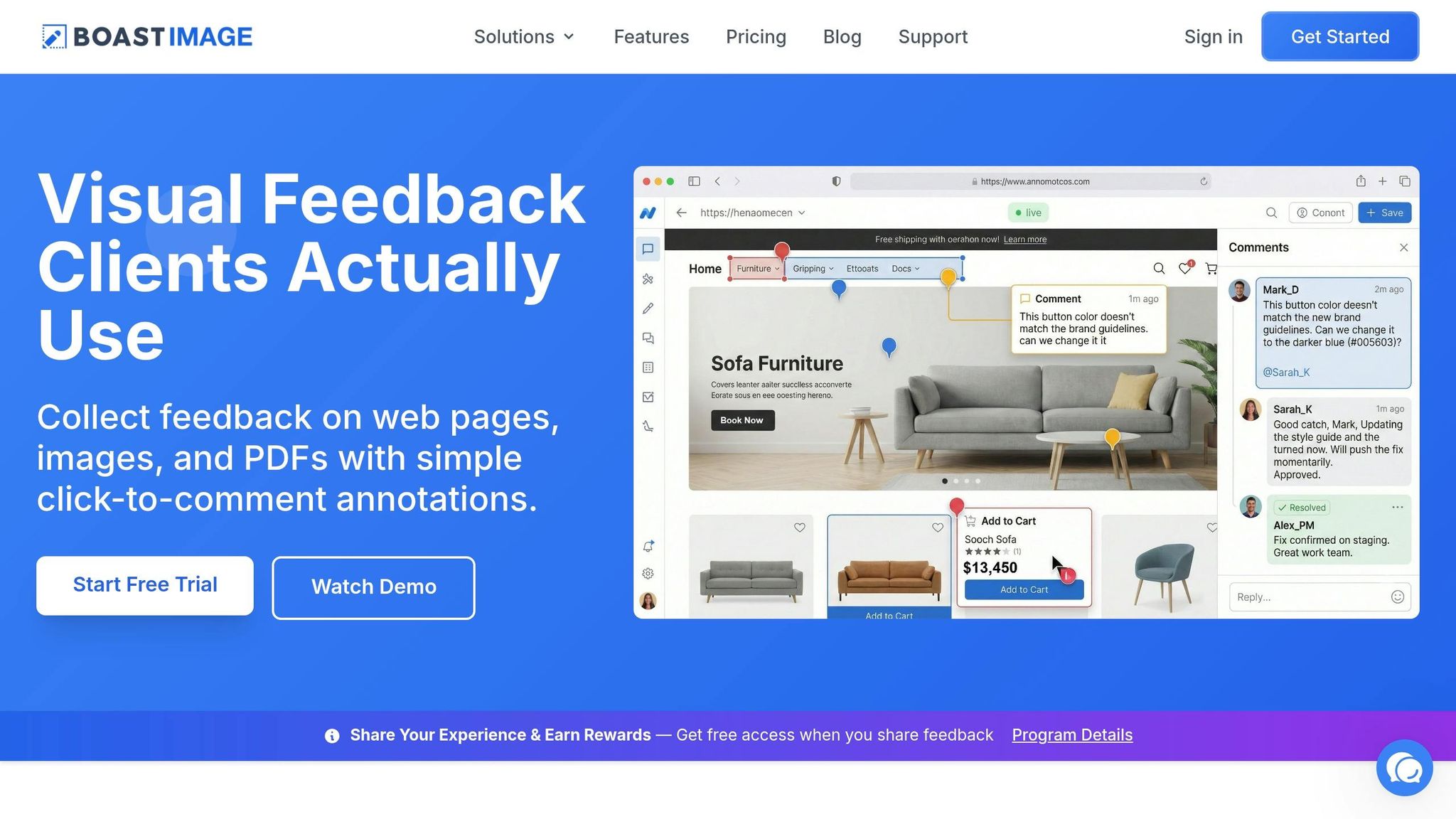
Capturing feedback and tracking changes in real time can be challenging, but tools like BoastImage can make this process much smoother. BoastImage allows clients to comment directly on pages, images, or PDFs through a simple link - no login required. This eliminates unnecessary friction and encourages clients to provide more detailed feedback, giving you richer documentation for your case study.
For agencies and freelancers, this tool can be a game-changer. It lets you track every comment, tweak, and iteration in one place. When it’s time to write the case study, you’ll have a clear timeline of how the project developed. This makes it easier to craft an "Implementation Story" that highlights the quality of your partnership and your onboarding process.
Additionally, BoastImage offers version control and Kanban boards, which allow you to show prospects the tools and workflows you used without overwhelming them with unnecessary complexity.
"AgencyAnalytics automated the work of two to three full-time employees. It's been a massive savings cost-wise and efficiency-wise. It's also been a dramatic time-saver." - AgencyAnalytics Case Study
Step 4: Present Measurable Results and Outcomes
This is the point where your case study transitions from storytelling to delivering solid proof. Quantifiable data doesn’t just make your success stand out - it gives potential clients the evidence they need to justify their decision. Without concrete numbers, you're relying on trust alone, and trust doesn’t close deals like hard evidence does. Let’s break down your success with clear, measurable outcomes.
Include Specific Numbers and Data
Use a before-and-after approach to highlight the transformation. For instance, instead of simply saying "we increased traffic", say something like, "organic traffic grew from 800 to 14,000 monthly visits." That kind of detail leaves no room for doubt. A great example is Rankai’s work with the beauty brand LiveTinted in March 2026. By focusing on high-intent educational queries and publishing over 20 pages per month, they achieved a 79% increase in organic clicks (from 18,463 to 33,071 monthly) and boosted non-branded keywords by 252% in just three months.
Stick to 2–3 key metrics that directly address the client’s initial challenges. For instance, after simplifying their intake process, Omni Circuit Boards saw monthly leads skyrocket from 155 to over 6,000 in just 12 months. This also led to securing 144+ Page 1 rankings on Google.
To make your results even more impactful, include visual evidence like screenshots from tools such as Google Search Console, CRM dashboards, or analytics software. Charts and graphs are especially effective for busy decision-makers - they can scan your case study in under a minute and still walk away impressed.
Frame Outcomes Around Client Value
Tie your results to what truly matters for your client. If your work saved them 12 hours a week, explain how that extra time translated into higher productivity, reduced stress, or even increased billing hours. For example, when Square 2 Marketing partnered with Drucker & Scaccetti, they didn’t just showcase traffic growth. They highlighted how a massive 1,800% increase in organic traffic (from 800 to over 14,000 monthly visits) led to a 1,033% monthly jump in leads within a year. That’s the kind of result that makes prospects think, "Can this happen for me, too?"
Combine hard metrics like revenue growth, cost savings, and conversion rates with softer outcomes such as improved morale or reduced frustration. For example, one managing partner at Greenleaf Partners shared:
"Before, I dreaded Monday mornings because I knew my inbox would have 200+ emails. Now I start the week with a clean briefing that tells me exactly what needs my attention. It's not just a time-saver. It changed how I feel about my work".
That emotional impact can be just as persuasive as the numbers.
It’s worth noting that 71% of B2B buyers review case studies during their purchasing process, and nearly 40% of SaaS marketers consider case studies highly effective for boosting sales. By framing results in terms of client value, you’re not just reporting numbers - you’re showing prospects why your solution could be the one they’ve been looking for.
Step 5: Design and Distribute Your Case Study
Once you've gathered your client data and crafted a compelling narrative, the next step is to design and share your case study effectively. A poorly designed case study or limited distribution can hurt its impact. Your aim? Make it easy to read, professional, and available wherever your potential clients are searching.
Create a Professional Layout
First impressions matter - your case study needs to grab attention within seven seconds. To achieve this, focus on visual hierarchy. Start with an eye-catching visual or a standout statistic to immediately communicate value. Break up the text with headings, subheadings, and short paragraphs, and use visuals like charts or graphs to present data clearly. Including a professional headshot paired with a direct quote can also add a personal touch, making your story relatable and trustworthy.
Keep the length between 700 and 1,200 words for the best results. Use plenty of white space to avoid overwhelming readers with dense blocks of text. Adding a TL;DR summary at the top is a smart move - it can quickly outline the client name, the problem, the solution, and three key statistics for those who skim. You don’t need to be a design expert to create something polished; tools like Canva or similar platforms can help you craft a clean, professional layout. Finally, wrap up your case study with a clear call-to-action, whether it’s scheduling a demo, requesting a consultation, or downloading a PDF version.
Once your case study is designed, the next challenge is ensuring it reaches the right audience.
Share Across Multiple Channels
To maximize impact, distribute your case study across various platforms. Start by creating a dedicated case study library on your website and embedding individual stories on service-specific pages. Equip your sales team with PDF versions or one-pagers they can share during calls or include in proposals. Email newsletters are another great way to nurture leads - highlighting success stories can showcase value to potential clients.
Repurposing your case study into different formats can also expand its reach. Turn it into a blog post, a series of LinkedIn updates, an infographic, or even a quick video testimonial. Sharing key quotes or statistics on social media can help engage audiences who prefer bite-sized content. For gated content, consider requiring a form submission for access to high-value case studies - this approach can help you capture leads. If you're running paid ads, client testimonials and impressive results can attract high-intent prospects.
Before publishing, it’s essential to get client feedback on your drafts. Tools like BoastImage (https://boastimage.com) make this process simple. Clients can review your case study by clicking a link and leaving comments directly on the PDF or webpage - no accounts or logins required. This hassle-free process ensures you get accurate feedback on design and content, allowing you to refine the case study before it goes live.
Conclusion
Case studies transform your successes into compelling sales tools. With 73% of B2B buyers reviewing case studies during their decision-making process, it’s clear that prospects actively seek evidence of your ability to deliver results. Failing to document these wins means missing opportunities to shorten your sales cycle and justify premium pricing.
Building a case study library doesn’t have to be overwhelming - even a single well-crafted story can make a difference. The most effective agencies treat case studies as timeless resources that work nonstop - addressing objections, establishing trust, and guiding potential clients from hesitation to confidence. As business coach Greg Faxon wisely says: "When you say you're great, no one listens. But when other people say you're great, it builds trust".
When creating your case studies, focus on quality over quantity. A single, well-documented success story will always carry more weight than a handful of vague testimonials. Make your headline pop with your biggest achievement, clearly outline the client’s challenge, detail your solution, and back it all up with measurable results.
Over time, your case study library will only get better. Update stories as long-term outcomes become clear, adapt them for different platforms, and use them strategically throughout your sales process. Agencies that consistently document their results can prove their expertise before the first sales call even begins.
Turn your next client success into your strongest sales tool.
FAQs
What if my client won’t approve being named?
If your client prefers to remain unnamed, you can still tell their story effectively through anonymized storytelling. Focus on the challenges they faced, the solutions you provided, and the results achieved - without mentioning their name or brand. Alternatively, you might request selective approval to share the story with identifying details removed or opt for fully anonymous participation. This way, you can demonstrate success while ensuring their confidentiality is respected.
What 2–3 metrics should I include?
When crafting case studies, it's essential to include metrics that demonstrate the real-world impact of your work. Here are three key areas to focus on:
- Measurable Results: Showcase specific, quantifiable outcomes. For instance, did your solution lead to a "20% increase in sales", a "30% reduction in operational costs", or a "50% improvement in efficiency"? Numbers like these make your success tangible.
- Problem-Solution Impact: Highlight how your solution directly addressed the client's challenges. Did you resolve a bottleneck, streamline a process, or boost customer satisfaction? Clear before-and-after comparisons can be powerful.
- Client Success Indicators: Metrics like retention rates, satisfaction scores, or repeat business can illustrate the trust and satisfaction your client gained. These indicators show the long-term value of your solution.
Including these metrics ensures your case studies not only tell a compelling story but also back it up with data that resonates with potential clients.
How do I turn client feedback into case study proof with BoastImage?
To build an engaging case study using BoastImage, follow these steps:
- Gather Client Feedback: BoastImage makes it easy to collect visual feedback from clients. No need for logins or accounts, simplifying the process for everyone involved.
- Develop the Narrative: Use the feedback to craft a compelling story. Focus on the challenges your client faced, the solutions provided, and the results achieved. Incorporate their comments and visuals to make the case study more impactful.
- Secure Permission Early: While collecting feedback, ask for the client’s approval to use their input in your case study. This ensures a smooth process later on.
- Publish and Share: Turn the collected feedback into a results-focused case study and share it widely to showcase your success.