How to Scale Personalized Outreach Without Losing Quality
Scaling outreach without sacrificing personalization is possible by focusing on relevance, leveraging automation wisely, and maintaining a clear process. Here's how:
- Focus on Relevance: Define your Ideal Client Profile (ICP) using detailed data like job roles, company signals, and industry trends. Segment your audience into tiers to allocate effort where it matters most.
- Use Automation Smartly: Automate repetitive tasks like data collection and trigger tracking, but keep personalization intact with tools like AI for drafting personalized messages. Always include a quick human review to ensure quality.
- Adopt a Multi-Channel Approach: Combine email and LinkedIn for targeted outreach. Prioritize speed and relevance by acting on real-time business triggers like funding rounds or leadership changes.
- Track and Improve: Monitor metrics like response rates and conversions to identify what works. Use feedback systems to refine messaging and avoid irrelevant outreach. This is especially critical when clients ghost feedback tools, as it stalls the optimization loop.
Scaling outreach is about creating systems that balance efficiency with meaningful connections. By focusing on real-time signals, leveraging automation, and refining efforts through feedback, you can achieve higher engagement and conversion rates.
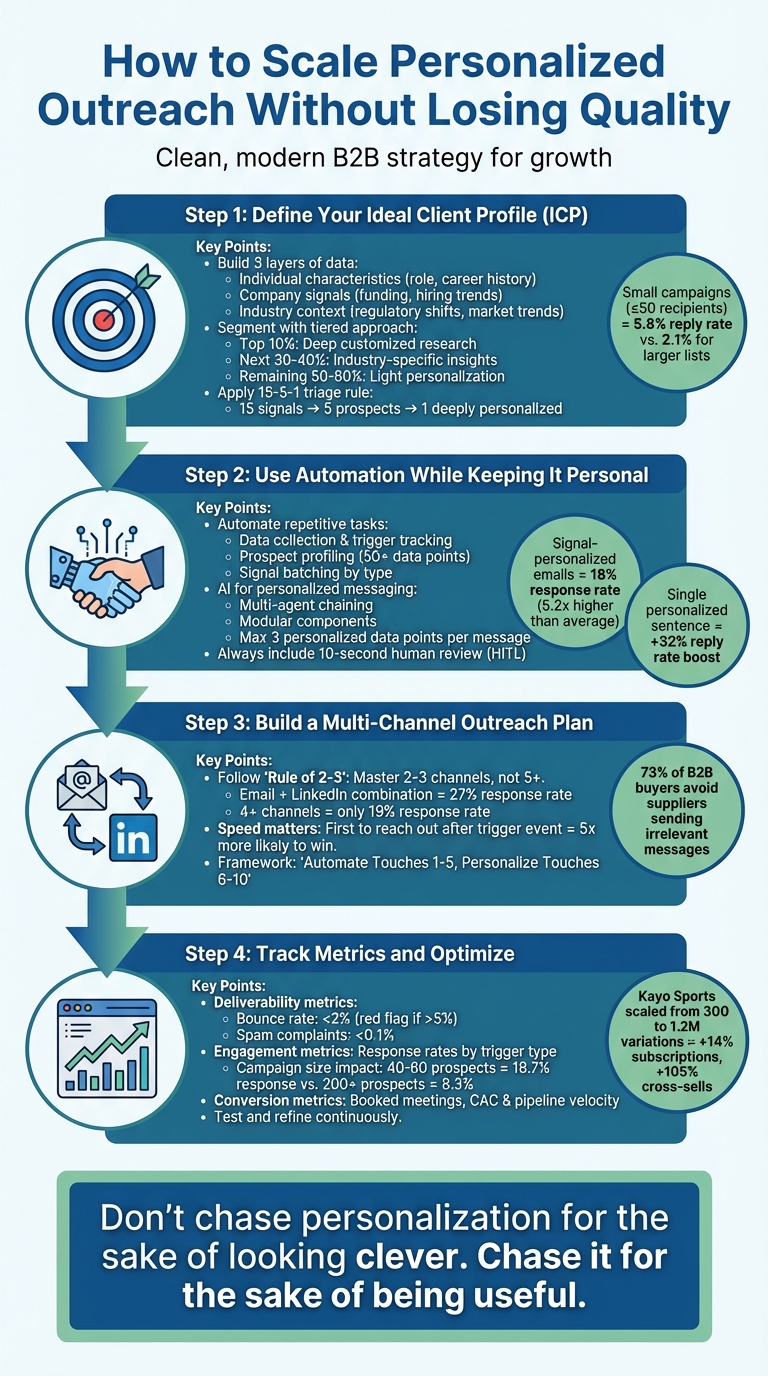
4-Step Framework for Scaling Personalized Outreach Without Losing Quality
Scale Personalized Outreach to ICPs with AI Automation
sbb-itb-32f6eb2
Define Your Ideal Client Profile
Your Ideal Client Profile (ICP) is the foundation for successful, scaled outreach. Without it, your outreach efforts risk becoming generic, failing to connect with prospects who could be high-value clients. As Valentino Arnawa from LeadGeeks Inc. explains, "Scaling outreach without ICP clarity is one of the most common outbound scaling mistakes and one of the hardest to recover from".
A well-defined ICP goes far beyond basic details like company size or industry. It requires three layers of data: individual characteristics (such as role, career history, and public statements), company signals (like funding rounds, hiring trends, or earnings call insights), and industry context (including regulatory shifts or market trends). This approach helps you understand not just who your prospects are but why they should care right now. Let’s dive into how to build an ICP that powers effective, scalable outreach.
Build Your ICP Framework
To create a solid ICP, start by identifying the traits that define your best clients. This includes firmographic data like industry, company size, location, and growth stage. Add technographic data to uncover integration needs and technology preferences.
Next, incorporate intent and trigger signals - real-time events that indicate a prospect’s readiness for your solution. These could be funding announcements, leadership changes, or hiring surges. Behavioral data from first-party sources, such as visits to your pricing page, webinar participation, or LinkedIn engagement, can also highlight active interest.
Focus on professional relevance by referencing career achievements, business challenges, or key initiatives mentioned in earnings calls. Avoid overly personal details to maintain professionalism.
Segment Your Audience
A strong ICP isn’t just about gathering data - it’s about using it to create targeted segments. This allows you to craft tailored messaging without researching every single prospect individually. Small, focused campaigns (targeting 50 recipients or fewer) see reply rates of 5.8%, compared to just 2.1% for larger lists. Group prospects by signal type - such as "leadership change" or "Series B funding" - to ensure consistent and relevant messaging.
To allocate resources wisely, use a tiered approach:
- Top 10% of strategic accounts: Conduct deep, customized research.
- Next 30–40%: Provide industry-specific insights and address role-based challenges.
- Remaining 50–60%: Use light personalization with dynamic fields.
This structure allows you to scale while maintaining relevance where it matters most.
Streamline your efforts further with the 15-5-1 triage rule: narrow down 15 signals to 5, then deeply personalize the top 1. This ensures that your highest-value prospects receive the focused attention they deserve. With your ICP defined and segmented, you’ll be ready to introduce automation that keeps personalization intact while scaling your outreach.
Use Automation While Keeping It Personal
Automation doesn’t mean giving up the human element - it’s about freeing your team to focus on what truly matters. The key is knowing which tasks to automate and which require a personal touch. For example, signal-personalized emails boast an 18% response rate, which is 5.2x higher than average. Why? Because the best outreach blends automation’s efficiency with human insight.
Focus on automating repetitive, data-heavy tasks, leaving strategy and relationship-building to your team. The goal isn’t to avoid automation but to use it wisely, so your team can spend more time fostering genuine connections instead of getting bogged down with manual work.
Automate Data Collection
Start by automating the process of tracking trigger events that signal when a prospect might be ready to engage. These could include funding announcements, leadership changes, product launches, or even a technical shift like a GA4 migration. Instead of manually digging for these signals, let automated tools flag them in real time and sort prospects by event type - such as "Series B funding" or "new CMO hired."
Once you’ve identified these signals, use automated data enrichment tools to create detailed prospect profiles. AI can clean up job titles, standardize company names, and extract over 50 data points, including psychographic and financial indicators, all before you even draft a message. This eliminates the need for manual research while setting a solid foundation for personalized outreach.
To streamline your process further, organize outreach by batching prospects based on signal type rather than working through account lists one by one. For instance, handle all "leadership change" signals on Monday and all "funding round" signals on Tuesday. This approach reduces context-switching and ensures consistent messaging.
Apply AI for Personalized Messaging
When it comes to creating personalized messages at scale, the secret lies in guiding AI effectively. The most efficient method involves multi-agent chaining, where specialized AI agents handle different tasks. For example, one agent gathers data, another drafts the content, and a third checks for brand alignment and factual accuracy. This division of tasks avoids the overly mechanical tone that can come from single-prompt AI.
Start by developing a clear brand voice guide. This should include a tone grid (e.g., "confident but not overly promotional"), approved phrases, and words to avoid. Use contextual prompting to give AI detailed instructions, audience segments, and a few human-written examples. This can cut editing time by 30%.
Instead of relying on static templates, try modular components - such as opening hooks, value propositions, and social proof blocks - that adjust dynamically based on the prospect’s data. Keep personalization simple by limiting each message block to a maximum of three personalized data points (like industry, job title, or recent activity) to ensure a natural tone. Even adding a single personalized sentence can boost reply rates by 32%.
To maintain quality, add a "human-in-the-loop" (HITL) step for a quick 10-second review to verify tone and accuracy. Also, configure your automation tools to pause sequences the moment a prospect replies, so you don’t accidentally send follow-up emails to someone who has already engaged. Randomizing email send times during business hours and setting daily limits per mailbox can also help avoid appearing automated.
Build a Multi-Channel Outreach Plan
To create a winning outreach strategy, you need to combine automation with personalization and then expand it across the right mix of channels. The key is to focus on where your ideal clients are most active. Instead of trying to cover every platform, concentrate on mastering 2–3 channels. For example, email and LinkedIn sequences have shown a 27% response rate, while campaigns using four or more channels only averaged 19%. In outreach, quality beats quantity every time.
The goal is to meet your prospects where they already spend their time while keeping your messaging personalized and consistent. Choose your channels carefully and ensure your team can manage them effectively without getting bogged down by manual tasks.
Choose the Right Channels
For most agencies targeting high-value B2B clients, the email and LinkedIn combination is a great place to start. These two platforms work well together, allowing for a natural flow of communication - like sending an email first, then following up with a LinkedIn connection request that references the same topic.
Your channel selection should also depend on account value and engagement signals:
- For the top 10% of accounts, such as enterprise clients or C-level executives, go for a high-touch approach. This might include personalized phone calls alongside your digital outreach.
- For the middle 30-40%, stick to email and LinkedIn but add trigger-based timing. For example, reach out after a funding announcement, leadership change, or relevant job posting.
- The bottom 50-60% can rely on automated email sequences with lighter personalization.
Stick to the "Rule of 2-3": excel at two to three channels rather than spreading yourself too thin. Trying to manage five or more channels often leads to a lack of focus and a disjointed experience for prospects. Also, speed matters. The first seller to reach out after a trigger event is 5x more likely to win the deal. So, while channel variety is important, acting quickly on relevant signals is even more critical.
Once you’ve chosen your channels, the next step is to ensure your messaging remains consistent and tailored.
Keep Messaging Consistent and Personalized
Consistency means using a unified tone and approach across all platforms while adapting to each channel’s strengths. For example, your email might address a specific pain point, while your LinkedIn message could reference a recent post the prospect shared. Both should reinforce the same core reason for reaching out.
To keep everyone aligned, use a centralized "source of truth" that includes approved messaging templates, value propositions, and proof points. Whether it’s AI tools or human reps creating the outreach, this shared resource ensures your communication stays on-brand and relevant as you scale.
Follow the "Automate Touches 1-5, Personalize Touches 6-10" framework. Start with high-quality templates that include some personalization for the first few touchpoints. Then, shift to more manual, deeply personalized messages for prospects showing engagement - like opening an email multiple times or visiting your LinkedIn profile. This approach balances efficiency with a human touch.
Finally, organize your outreach by signal type rather than working through account lists one by one. For example, handle all "leadership changes" on Monday and all "funding announcements" on Tuesday across email and LinkedIn. This method reduces context-switching and helps you craft sharper, more relevant messages for each group.
Set Up Feedback Systems to Maintain Quality
Scaling outreach without a solid feedback system can backfire, potentially harming your reputation. As your campaigns grow and automation comes into play, it's essential to have clear processes to catch quality issues before they reach your audience. Why? Because 73% of B2B buyers actively avoid suppliers who send irrelevant messages, often mentally blacklisting them. A reliable feedback loop allows you to identify these missteps early and adjust your strategy based on actual data.
The focus should be on tracking what truly matters. Instead of just monitoring overall response rates, dig deeper. Analyze performance by trigger type - such as leadership changes or earnings reports - to uncover which signals warrant more personalization. With 87% of sales teams now leveraging AI, prospects are inundated with generic, machine-written content. Your feedback system should help separate low-value, automated noise from meaningful, signal-based outreach that can achieve response rates of 18%. Now, let’s outline how to build an efficient process for capturing and acting on this feedback.
Create a Feedback Collection Process
To preserve the quality of your outreach, start with a human-in-the-loop (HITL) review. This means every AI-generated or automated message gets a quick 10-second check for accuracy, tone, and relevance. This simple step ensures errors are caught before they reach prospects. Additionally, you can deploy specialized AI agents to enforce quality standards, such as requiring each message to include at least one verified signal and ensuring it aligns with your approved voice profile.
Implement a reply-classifier agent to sort inbound responses into categories like questions, scheduling requests, or "not interested" replies. Feeding this data back into your system refines future messaging. Pair this with a tiered personalization strategy to ensure your efforts align with the value of each account.
Set up automated guardrails to pause campaigns if key metrics - like bounce or complaint rates - dip below acceptable levels. These guardrails allow you to respond quickly to quality issues. Use accepted drafts and corrections as training examples to improve future AI output. Also, track metrics like "duplicates avoided" to prevent team members from contacting the same prospect twice.
Streamline Feedback with Boast
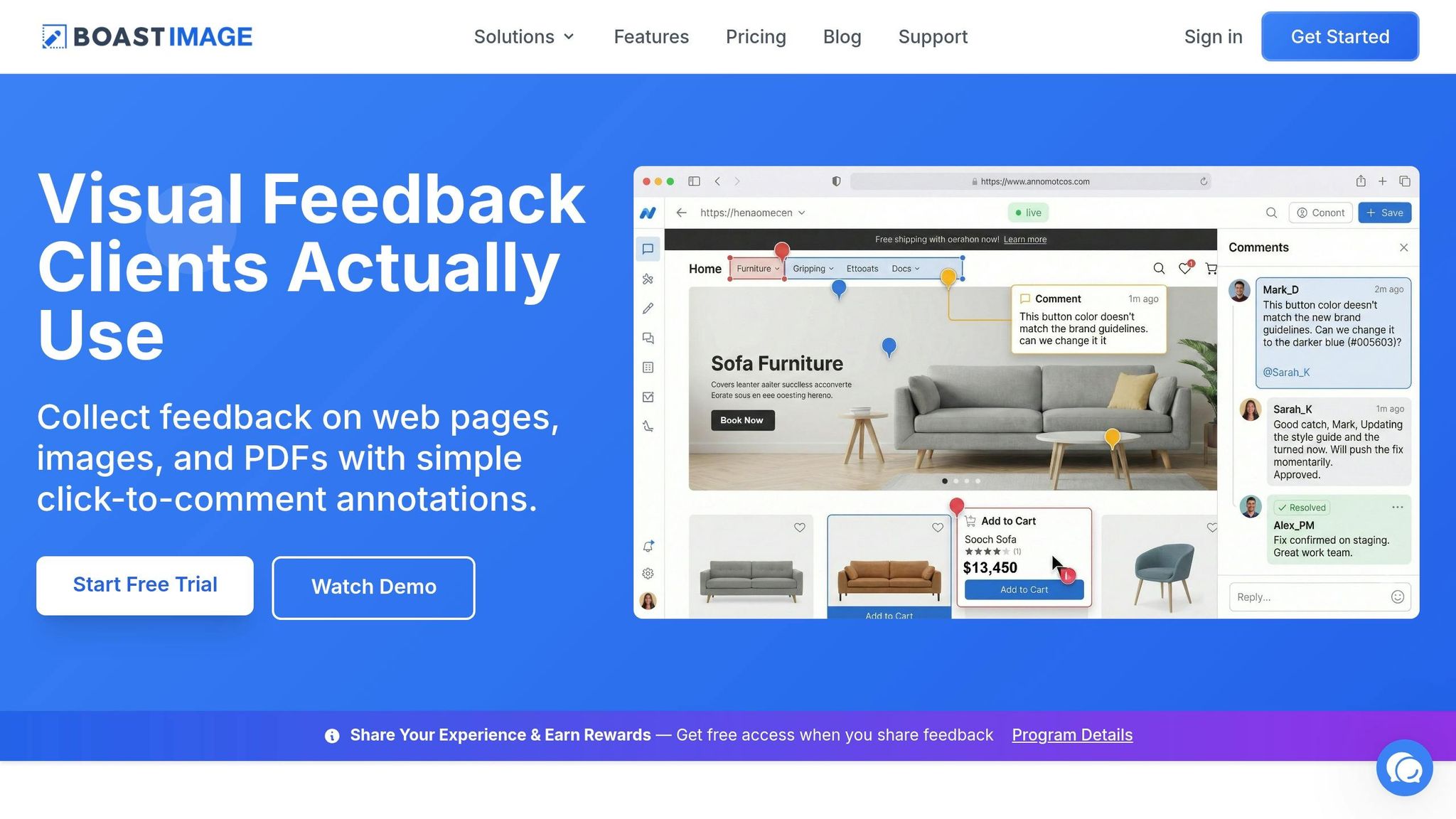
When creating outreach materials - whether it’s email templates, LinkedIn graphics, or proposals - timely feedback is crucial. Boast (https://boastimage.com) makes this process easier by allowing reviewers to comment directly on your work without needing to log in or create accounts. They simply click a link, leave their feedback, and they’re done.
For agencies scaling their outreach efforts, this tool speeds up iteration cycles. Your team can share draft emails, landing page designs, or campaign visuals with clients and receive clear, visual feedback within hours instead of days. Boast keeps things simple for clients while providing your team with structured internal feedback through features like version tracking, task management, and Kanban boards. With unlimited external collaborators included in all paid plans (starting at $9.95/month for Solo), you can involve as many stakeholders as needed without worrying about costs. This streamlined, client-friendly approach ensures feedback stays organized and actionable, helping you maintain high-quality, personalized outreach as you grow.
Track Metrics and Optimize Over Time
Once you've gathered quality feedback, the next step is to measure your outreach performance and make adjustments. Scaling outreach without understanding performance is like driving without a dashboard - you’re flying blind. To achieve meaningful results, focus on metrics like deliverability, engagement, and conversions.
Identify Your Key Metrics
Start with deliverability metrics. Keep your bounce rate below 2% and spam complaints under 0.1% to maintain a strong sender reputation. If your bounce rate climbs above 5%, it’s a red flag that needs immediate attention.
Engagement metrics are equally important. Monitor open rates, reply rates, and positive reply rates. For example, tracking how response rates vary by trigger type can help you fine-tune your approach. Campaign size also plays a big role - smaller campaigns targeting 40–60 prospects see an average response rate of 18.7%, while larger campaigns aimed at over 200 prospects drop to just 8.3%.
On the conversion side, measure outcomes like booked meetings, opportunities created, and deal velocity to assess how effectively your outreach moves prospects through the sales funnel. Metrics like client acquisition costs (CAC) and pipeline velocity give you a clearer picture of your overall efficiency. Just as feedback helps spot quality issues, these metrics reveal where strategic adjustments are needed.
Test and Refine Your Approach
With your metrics in place, it’s time to test and refine your outreach methods. A good rule of thumb is the 15-5-1 approach: for every 15 signals you identify, reach out to 5 prospects and deeply personalize outreach for 1. This keeps your efforts focused and manageable.
Experiment with A/B testing to pinpoint what works. Test elements like subject lines or calls-to-action (CTAs) to see what drives better results. Personalize your outreach across three levels: individual (specific to the recipient’s role), company (aligned with their strategic goals), and industry (based on broader market trends). To streamline your process, batch outreach by signal type - like tackling all "new executive hire" signals on the same day. This reduces context-switching and ensures consistent messaging.
Real-world examples show how this approach pays off. In fiscal year 2024, Kayo Sports scaled its outreach from 300 to 1.2 million variations using personalization automation. This led to a 14% increase in subscriptions, an 8% lift in average annual occupancy, and a 105% boost in cross-sells. Similarly, a PPC agency targeting e-commerce brands used product-page data to craft tailored emails. By sending 150 emails daily across four inboxes, they secured 32 meetings per month with an 11.4% reply rate. These successes highlight the value of constant testing and refining based on real data.
Conclusion
Throughout this guide, we've seen that scaling outreach doesn't have to mean choosing between volume and quality. The key lies in creating systems that keep your outreach relevant, even as you grow.
A tiered approach works best: dedicate deep personalization to your top 10% of strategic accounts, use signal-based frameworks for mid-tier prospects, and rely on light automation for the rest. This way, you can avoid burnout while ensuring high-value opportunities get the attention they deserve.
The real game-changer is relevance, not surface-level personalization. Focus on real-time business triggers like funding rounds, leadership changes, or hiring trends. As the SalesRoads Content Team wisely put it:
"Don't chase personalization for the sake of looking clever. Chase it for the sake of being useful".
AI tools can help with data collection and drafting, but don’t skip a quick human review. Incorporate the 15-5-1 rule to keep your outreach focused and effective. When personalized efforts and human oversight come together, you can use feedback to continuously improve.
Feedback is your quality checkpoint. Track metrics like bounce rates, replies, and conversions to identify and address problems early. For instance, small, targeted campaigns of 50 recipients or fewer have a 5.8% reply rate - nearly three times higher than the 2.1% seen in large, unoptimized blasts. Keep testing, refine using real data, and steer clear of irrelevant messaging that could hurt future outreach efforts.
FAQs
How do I choose the best trigger signals to personalize outreach?
Pick trigger signals that are specific, verified, and actionable. These could include recent company updates, behavioral patterns, or directly expressed needs. The key is to focus on data points that genuinely reflect a prospect’s interests or challenges.
Leverage AI tools to research and craft personalized messages at scale. By segmenting your audience into smaller, tightly defined groups, you can ensure your outreach feels relevant and tailored. This method helps you maintain a genuine connection while scaling your efforts efficiently.
What should I automate, and what must stay human-reviewed?
To expand personalized outreach without compromising on quality, use AI tools to handle repetitive tasks such as data collection, enrichment, and creating initial drafts. These tools help streamline the process and produce structured, scalable messages efficiently.
That said, leave tasks like final message approval, tone refinement, and client-specific edits to human review. This ensures the outreach feels authentic and tailored. Striking this balance allows you to maintain genuine, high-quality communication while benefiting from the efficiency of automation.
Which outreach metrics matter most as I scale?
When scaling your outreach efforts, it's crucial to keep an eye on response rates, reply rates, and engagement signals. These metrics reveal how effectively your messaging connects with prospects and gauge the relevance of your outreach. Tracking these ensures you maintain a high standard and steer clear of generic or ineffective communication as your outreach grows.