
How Agencies Measure Onboarding Success
Onboarding is the make-or-break phase for agencies. A well-executed process leads to better client retention, faster results, and fewer delays. But when onboarding is messy, it causes frustration, wasted time, and even early client churn.
Here’s what you need to know:
- 80% of executives say improving onboarding boosts revenue, renewals, and referrals.
- 85% of delays during onboarding are caused by incomplete client tasks.
- Agencies lose $141 per project due to inefficiencies that could be automated.
The best agencies measure success using metrics like Client Effort Score (CES) and Time to First Value (TTFV). These help identify friction points, reduce delays, and deliver value sooner. Automation, structured workflows, and personalized onboarding strategies also save time and improve retention.
Want to keep clients longer and improve profitability? Focus on delivering value fast, simplifying processes, and tracking key metrics.
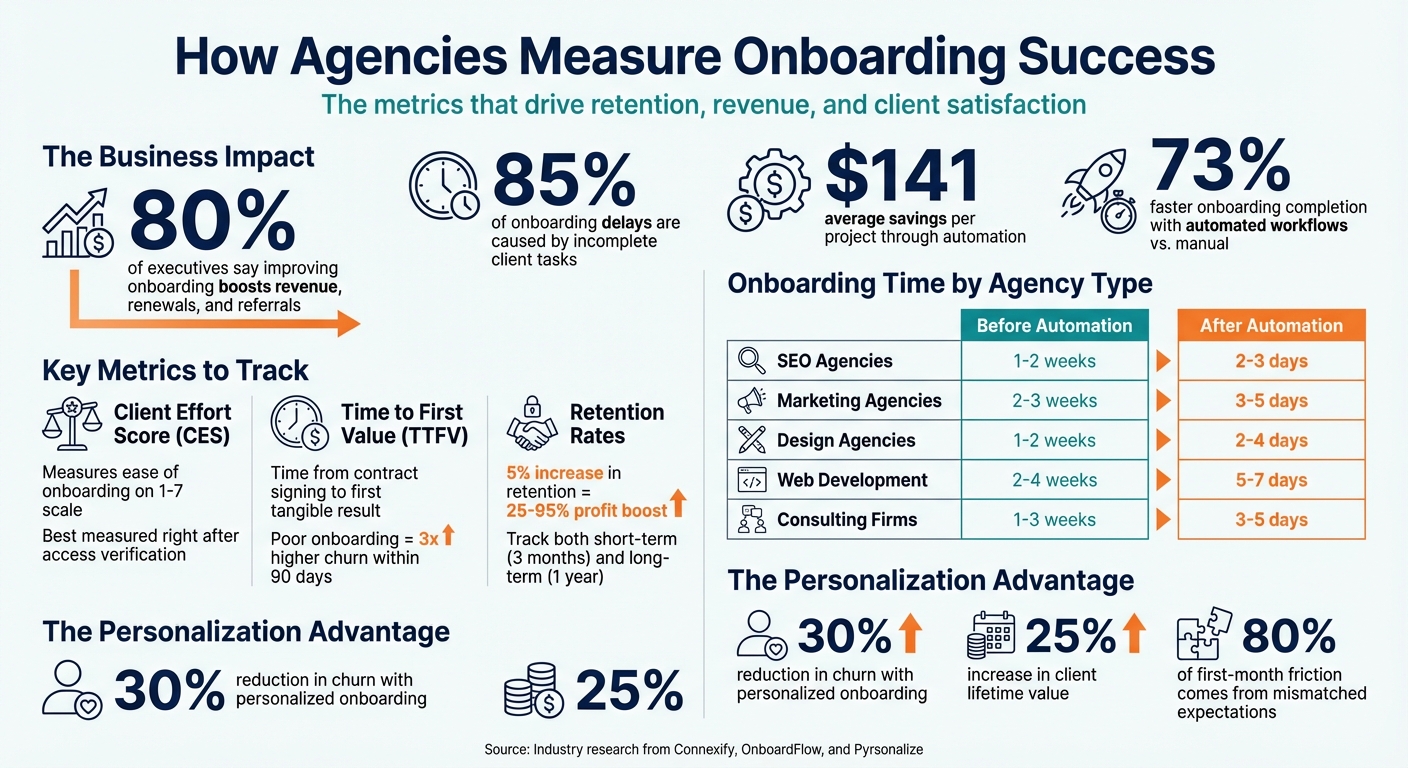
Key Metrics and ROI of Effective Agency Client Onboarding
Customer Onboarding Metric: TIME to FIRST VALUE
sbb-itb-32f6eb2
Metrics for Measuring Onboarding Success
Measuring onboarding success boils down to determining when your team can operate smoothly without delays. By treating onboarding as a measurable process rather than a routine task, agencies can turn it into a powerful tool for long-term client retention. The most successful agencies are those that actively track and improve their onboarding performance.
Client Satisfaction and Feedback Scores
One of the most effective ways to measure onboarding is through Client Effort Score (CES). This metric has gained popularity because it identifies specific pain points in the process. Instead of asking clients a generic question like "How happy are you?" CES focuses on ease, asking, "How easy was this?" on a 1-to-7 scale immediately after verifying access.
"Client effort score is often more actionable than NPS because it highlights friction in specific steps" – Connexify
While Net Promoter Score (NPS) can measure trust and satisfaction, it becomes even more valuable when paired with qualitative feedback. For example, tagging client comments to specific onboarding steps can help pinpoint recurring issues, such as confusion over platform access or website feedback. Some agencies even include feedback questions in their intake forms, such as "How could we improve this process?" to capture real-time impressions.
Timing is everything. CES is most effective right after access is verified, while broader satisfaction surveys are better timed around the 30-day mark. This timing captures client sentiment after the initial onboarding excitement fades and the day-to-day work begins.
But satisfaction isn’t the only metric to watch - speed also plays a critical role in onboarding success.
Time-to-First Milestone
Time to First Value (TTFV) measures the time from signing a contract to delivering the first tangible result. This metric is particularly important because it directly correlates with client retention. Unlike symbolic events like kickoff meetings, TTFV focuses on delivering real value.
"Kickoff is symbolic, value is real" – Connexify
Research shows that clients who experience poor onboarding are 3x more likely to churn within 90 days. Yet, 62% of agencies admit their onboarding process takes too long. To improve, agencies need to define what "first value" looks like for each service. For example, a PPC agency might aim to launch the first campaign, while an SEO agency might focus on completing the initial technical audit.
Automation can dramatically reduce onboarding time, with agencies completing the process 73% faster than those relying on manual workflows. However, speed alone isn’t enough. Agencies must also ensure Time to Verified Access (TTVA) - confirming that all logins and permissions are functioning properly. Using a loginless feedback tool can further streamline this by removing account creation barriers.
| Agency Type | Typical Onboarding Time | Time With Automation |
|---|---|---|
| SEO Agencies | 1–2 weeks | 2–3 days |
| Marketing Agencies | 2–3 weeks | 3–5 days |
| Design Agencies | 1–2 weeks | 2–4 days |
| Web Development | 2–4 weeks | 5–7 days |
| Consulting Firms | 1–3 weeks | 3–5 days |
Source: OnboardFlow
While speed and efficiency are crucial, the ultimate test of onboarding success lies in client loyalty.
Client Retention Rates
Retention metrics provide a clear picture of how well onboarding sets the stage for long-term success. Short-term retention (measured over three months) reflects whether onboarding built immediate trust, while long-term retention (measured over a year) reveals the lasting impact of the onboarding process.
| Metric | Definition | Timeframe | Agency Applicability |
|---|---|---|---|
| Short-Term Retention | Percentage of clients retained within 3 months | 3 months | Evaluates immediate onboarding impact and early relationship health |
| Long-Term Retention | Percentage of clients retained within 1 year | 1 year | Assesses the durability of onboarding outcomes and long-term trust |
Even a modest 5% increase in retention can boost profits by 25%–95%. By segmenting retention data by client type - such as small businesses versus enterprise accounts - agencies can identify trends. For instance, high-touch onboarding strategies may work better for larger, more complex accounts.
How to Improve Client Onboarding Processes
Improving client onboarding isn't just about getting started on the right foot - it’s about reducing friction, speeding up results, and building stronger relationships. Treating onboarding as a key system, rather than an administrative task, makes all the difference.
"Onboarding is not administrative. It is your most critical business system. It functions as your primary defense against scope creep, the engine of client retention, and the foundation for predictable revenue growth."
Internal data shows that 80% of client friction in the first month comes from mismatched expectations, not poor delivery. A structured, straightforward, and tailored approach can help align those expectations.
Simplifying Communication and Feedback
Agencies often lose 5–10 hours per client on repetitive manual tasks and scattered email feedback. Centralized client portals solve this by providing a single, branded space where clients can complete tasks, upload files, and track project progress. Tools like structured intake forms with conditional logic make gathering necessary information quicker and more efficient.
But even the best portal won’t work if clients can’t navigate it. Visual feedback tools like BoastImage simplify things by letting clients review web pages, images, or PDFs without needing logins or training. For agencies handling creative work, this tool allows clients to leave comments directly on the content, keeping the process simple for them while maintaining the structure teams need.
Automated reminders and integrated messaging also play a big role. They eliminate the need for constant manual follow-ups and keep all project-related conversations in one place. These improvements save agencies an average of 2.34 hours and $141 per client project.
Building a Structured Onboarding Workflow
Structure doesn’t mean rigidity - it’s about creating a predictable process. Agencies that use checklists, templates, and clear timelines finish onboarding 73% faster than those relying on ad-hoc workflows.
"One of the biggest challenges we faced was ensuring that every employee was aligned with our mission and values... To address this, we created checklists and written procedures for every position and every repeatable task, such as onboarding."
- Adam Binder, Founder + CEO, Creative Click Media
Top-performing agencies send intake forms within hours of contract signing, capitalizing on the momentum. Instead of overwhelming clients with one massive form, they break requests into smaller, manageable steps. A formal kickoff meeting follows, complete with an agenda to introduce the team, review the questionnaire, and set S.M.A.R.T. goals.
After the kickoff, a Decision Log is created to summarize key details like performance indicators, communication protocols, and scope boundaries. This log is formally approved by the client to prevent future misunderstandings. Agencies also define a "Definition of Done", ensuring onboarding is complete only when the team has everything it needs - access, validated measurements, and the first deliverable scheduled.
For scaling agencies, assigning a dedicated Onboarding Specialist can help manage setup logistics, freeing account managers to focus on strategy and growth. With a solid workflow in place, agencies can then adapt the process to suit individual client needs, further enhancing trust and retention.
Customizing Onboarding for Each Client
A customized onboarding process goes beyond the transactional. It builds trust and strengthens relationships, reducing churn and increasing client lifetime value. Research shows that personalizing onboarding can cut churn by 30% and increase lifetime value by 25%.
"The handoff from sales to delivery makes or breaks B2B onboarding."
- Rodney Warner, CEO & Founder, Rodney Warner
Maintaining the same level of attention and context established during the sales process is critical. Discovery calls help uncover specific needs, communication preferences, and the motivations behind client goals.
"At this stage in the journey, we are less concerned with the marketing numbers, and more concerned with the big picture – what does the client want to achieve, and most importantly, why."
- James Londesborough, Owner / Managing Director, Ignite Marketing
Segmenting clients by factors like industry, role, company size, or goals allows agencies to provide more targeted guidance. Co-creating success plans during the kickoff ensures alignment on objectives, milestones, and metrics.
Delivering an early "Quick Win" within the first two weeks - such as a technical audit or lead list - can make a huge impact. It demonstrates value early on and builds trust. In fact, 70% of customers say seamless processes, like smooth handoffs between departments, are essential to earning their business. Customization isn’t about adding more work - it’s about focusing on the right work at the right time.
Case Studies on Onboarding Success
Case studies show how a well-organized onboarding process can lead to better retention, smoother operations, and happier clients. These real-life examples demonstrate the connection between effective strategies and measurable improvements in agency performance. They also reinforce the metrics and techniques discussed earlier.
Case Study: Reducing Client Ghosting with Visual Feedback Tools
This example highlights how using visual feedback tools can improve client engagement and reduce ghosting. For one agency, complicated tools were causing clients to disengage. To address this, they introduced BoastImage, a tool designed for creative feedback during onboarding.
Before this change, about 85.2% of onboarding tasks required active client participation, like uploading files or reviewing materials. Clients often struggled with creating accounts, navigating new dashboards, or learning unfamiliar software, which led to vague email responses or complete silence. This lack of timely feedback slowed the process. By switching to BoastImage's login-free feedback system, clients could directly comment on content without any setup. Since poor onboarding can triple the risk of early churn, this simplified approach helped reduce that risk significantly.
Case Study: Faster Time-to-First Milestone
This case study showcases how a structured and automated workflow can dramatically improve the time it takes to deliver initial results. A mid-sized marketing agency was struggling with onboarding timelines that stretched up to 2–3 weeks before clients saw any visible outcomes. To solve this, they shifted their focus to reducing Time to First Value (TTFV) - the period between signing the contract and delivering the first tangible result.
The agency implemented automated, conditional intake forms and adopted a "Quick Win" strategy. This involved identifying easy-to-deliver tasks, like a technical audit or an optimized landing page, that could be completed within the first week. These changes not only cut onboarding time but also saved around $141 per client project through automation. Additionally, more than 80% of executives agree that improving onboarding has a major positive effect on revenue, client renewals, and referrals.
Conclusion: The ROI of Effective Client Onboarding
Getting client onboarding right isn't just a nice-to-have - it’s a real driver of profitability and growth. In fact, over 80% of executives say that improving onboarding has a noticeable impact on revenue, client renewals, and referrals throughout the life of a contract. Plus, automation alone can save an average of $141 per client project and cut 2.34 hours off onboarding tasks - leading to substantial savings over time.
The numbers speak for themselves: strong onboarding practices directly contribute to measurable client success. Agencies that focus on tracking these metrics and refining their processes not only deliver better results but also run more efficiently. It’s clear that focusing on what truly matters - delivering real value right from the start - pays off far more than surface-level gestures.
As highlighted in the case studies, reducing friction during onboarding is key. Whether it’s using tools like BoastImage for login-free visual feedback tools or creating workflows that provide quick wins, these strategies help improve retention and reduce early churn. Considering that about 85.2% of onboarding tasks fall on the client, tools that simplify their experience while maintaining your team’s workflow are essential for staying on track and protecting profit margins.
FAQs
What counts as “first value” for my agency?
Building trust is the cornerstone of any successful agency-client relationship. It starts with setting clear expectations and creating a well-structured onboarding process. When done right, this approach not only reduces client churn but also establishes a solid foundation for long-lasting partnerships.
How do I cut onboarding delays caused by clients?
To avoid delays during onboarding, it's crucial to simplify processes and ensure clear communication. Here are some practical ways to make the experience faster and less stressful:
- Simplify forms and language: Use straightforward forms and plain language to avoid overwhelming clients. This helps them complete tasks quickly without confusion.
- Show progress: Let clients see how far along they are in the onboarding process. A visible progress tracker can reduce anxiety and boost confidence.
- Set expectations early: From the start, clearly outline what clients can expect and what steps they need to take. This avoids misunderstandings later.
- Establish communication norms: Define how and when communication will happen, so everyone stays on the same page.
- Use structured templates: Provide easy-to-follow templates for common tasks or documents to save time and effort.
- Automate reminders: Set up automated reminders to keep things moving and ensure no critical steps are missed.
- Adopt a feedback-first approach: Tools like BoastImage can help gather feedback efficiently, reducing bottlenecks and keeping the process flowing.
By keeping the process transparent and simple, you can create a smoother, faster onboarding experience for everyone involved.
Which onboarding metrics should I track first?
Tracking the right metrics is essential to understand how well your onboarding process is working. Focus on both efficiency and effectiveness, as these directly influence client retention and satisfaction. Some key metrics to monitor include:
- Time to complete onboarding tasks: How long does it take clients to finish the required steps? Shorter times often indicate a more streamlined process.
- Client engagement rates: Are clients actively participating during onboarding? High engagement suggests they’re finding value in the process.
- Speed of tool access: How quickly can clients start using the tools they need? Faster access ensures they can hit the ground running.
Additionally, keep an eye on client satisfaction scores and onboarding form completion rates. These metrics reveal whether clients find the experience smooth and user-friendly, helping set the tone for a successful long-term relationship.