Formal vs Friendly: Finding the Right Email Tone for Clients
Email tone matters more than you think. The way you communicate with clients via email can shape their perception of your professionalism and approachability. A formal tone builds trust and credibility for high-stakes or first-time interactions, while a friendly tone strengthens relationships and fosters collaboration in ongoing communications.
Key Takeaways:
- Formal Tone: Ideal for serious matters, unfamiliar contacts, or senior professionals. Uses structured language, avoids slang, and emphasizes professionalism.
- Friendly Tone: Best for updates, actionable design feedback, or long-term relationships. It's conversational, warm, and approachable while maintaining professionalism.
- Balancing Both: Start formal with new clients and adjust to friendly as trust develops. Always consider the context and client's communication style.
Your email tone is your "written body language." Choose wisely to avoid sounding robotic or unprofessional and to strengthen client relationships.
5 Tips for Managing Tone in Email | Dr. Anthony Coman, Management Communication Center
sbb-itb-32f6eb2
What Is a Formal Email Tone?
A formal email tone uses clear, structured, and polite language, sticking to professional norms. Think of it as the "business suit" of communication - it shows you’re serious about the topic and respectful of the recipient’s time and position.
This approach involves a structured format: a clear subject line, a professional greeting, concise body paragraphs, and a formal sign-off. The language avoids slang, contractions, or casual phrases. Instead, it uses complete sentences, professional vocabulary, and respectful expressions. This style helps establish trust and demonstrates professionalism.
The goal of a formal tone is to inspire confidence and build credibility. It’s especially important when reaching out to unfamiliar contacts, clients, or senior professionals, or when addressing serious matters like legal issues, contracts, or complaints.
"Your email tone tells recipients exactly how much you know and value them." - Mailchimp
Here’s a practical tip: keep subject lines to 7 words or fewer to improve open rates, and limit the email body to 1-2 short paragraphs for clarity and impact. Even font choice matters - stick to professional sizes between 10-14 points.
Characteristics of Formal Tone
Formal emails follow specific conventions to maintain professionalism. Start with a salutation using titles and last names, such as "Dear Mr. Johnson" or "Dear Ms. Rodriguez." If the recipient’s name is unknown, use "To Whom It May Concern" or address the relevant department.
Avoid contractions (e.g., write "cannot" instead of "can't") and replace casual words with professional alternatives. Don’t use slang, emojis, or textspeak, as these can hurt your credibility.
Punctuation should also reflect professionalism. Exclamation points, for example, should be used sparingly. While casual emails might use multiple exclamation marks to show enthusiasm, formal emails rely on periods to maintain authority.
End with a formal closing phrase like "Sincerely", "Respectfully", or "Best regards", followed by your signature. Your signature acts as a digital business card - include your full name, job title, company, and essential contact details (like a phone number, website, or LinkedIn profile).
For fonts, stick to classic, easy-to-read options such as Arial, Times New Roman, or Calibri. This ensures the focus remains on your message, not on flashy design choices.
Formal Email Examples
Initial Client Contact:
Subject: Proposal for Website Redesign Project
Dear Ms. Thompson,
I am writing to follow up on our conversation from March 25, 2026, regarding the redesign of your company’s website. I have prepared a detailed proposal outlining our approach, timeline, and pricing structure for your review.
The proposal includes a comprehensive audit of your current site, user experience recommendations, and a phased implementation plan spanning eight weeks. I would appreciate the opportunity to discuss this further at your earliest convenience.
Please let me know if you require any additional information or clarification.
Respectfully,
John Martinez
Senior Web Designer
Creative Solutions Agency
john.martinez@creativesolutions.com
(555) 123-4567
Contract Discussion:
Subject: Contract Amendment Request – Project Timeline
Dear Mr. Williams,
I am reaching out to discuss a necessary adjustment to the project timeline outlined in our current contract dated February 15, 2026.
Due to unforeseen technical requirements that emerged during the discovery phase, we will require an additional two weeks to complete the deliverables to the quality standards we both expect. This extension would move the final delivery date from April 30, 2026, to May 14, 2026.
I have attached a revised project schedule for your review. I would be grateful for the opportunity to discuss this matter at your earliest convenience.
Sincerely,
Sarah Chen
Project Manager
Digital Marketing Partners
sarah.chen@digitalmarketingpartners.com
(555) 987-6543
Next, we’ll look at how a friendly email tone differs while still maintaining professionalism.
What Is a Friendly Email Tone?
A friendly email tone adds a personal, approachable touch to your communication. It’s warm, conversational, and personable - almost like chatting with a trusted colleague but in written form. Think of it as the "body language" of your email, showing that you value the recipient as a person, not just a contact in your inbox.
The purpose of this tone is to build trust and rapport. When you strike a friendly tone, it creates an atmosphere of mutual respect and understanding, which can make collaboration smoother and even help resolve conflicts more easily. As Sara Kurczyńska, Content Writer at Selzy, explains:
"A friendly tone creates an atmosphere of respect, appreciation, and camaraderie".
It's important to note that being friendly doesn’t mean being unprofessional. It’s about finding the balance - being human while still maintaining professionalism. This style of communication has gained popularity, especially among Millennials and Gen Z, who tend to value authenticity and a genuine approach. As we explore this tone further, you’ll see how it can be tailored to different client interactions for maximum effectiveness.
Characteristics of a Friendly Tone
Friendly emails are all about keeping things conversational and natural. Here are some key traits that make this tone work:
- Warm greetings: Start with phrases like "Hi [Name]", "Hello [Name]", or "Good morning!" instead of formal openings like "Dear Mr./Ms. [Last Name]." Using first names (spelled correctly!) helps establish a connection.
- Contractions: Words like "I'm", "we've", and "can't" make your message sound relaxed and natural, avoiding stiffness.
- Personal touches: Including a line like "Hope you had a great weekend" shows you see the recipient as more than just a business contact.
- Subtle enthusiasm: Use exclamation points sparingly to convey warmth without going overboard. For familiar contacts, a well-placed emoji can add personality.
- Casual sign-offs: Wrap things up with closings such as "Cheers", "Talk soon", "Best", or "Take care" instead of more formal options like "Sincerely" or "Respectfully." These leave a positive impression and reinforce the friendly tone.
Friendly Email Examples
Let’s look at two examples that illustrate how to maintain professionalism while keeping the tone friendly and engaging.
Project Update to Established Client:
Subject: Quick Update on Your Website Redesign
Hi Jennifer,
Hope you're having a great week! I wanted to give you a quick update on the website redesign project.
We've completed the homepage mockups, and I'm really excited about how they turned out. The color scheme you suggested works perfectly with the new layout. I've uploaded everything to our visual feedback board - just click the link below and you can comment directly on any element you'd like to adjust. No login needed!
[Link to feedback board]
Would you be open to a brief call next Tuesday to walk through the designs together? I'm confident we can finalize these quickly.
Looking forward to hearing your thoughts!
Best,
Alex Rivera
Creative Director
alex.rivera@creativesolutions.com
(555) 234-5678
Feedback Request:
Subject: Your Input on the New Campaign Concepts
Hi Marcus,
Thanks so much for the great brainstorming session yesterday! I've put together three campaign concepts based on our discussion, and I'd love to get your feedback.
I've shared them on our visual feedback board, where you can comment directly on each design - it’s super simple, just click, point, and type your thoughts.
I'm hoping to get your input by Friday, March 3, so we can move forward with the direction you prefer. Let me know if you have any questions!
Excited to see which concept resonates with you!
Cheers,
Dana Kim
Marketing Strategist
dana.kim@digitalagency.com
(555) 876-5432
In these examples, you’ll notice how the tone stays conversational and approachable while still being clear and professional. First names, contractions, and warm phrasing make the emails inviting, while the content remains focused and actionable. That’s the power of a friendly tone - it engages without losing professionalism.
Formal vs Friendly: Side-by-Side Comparison
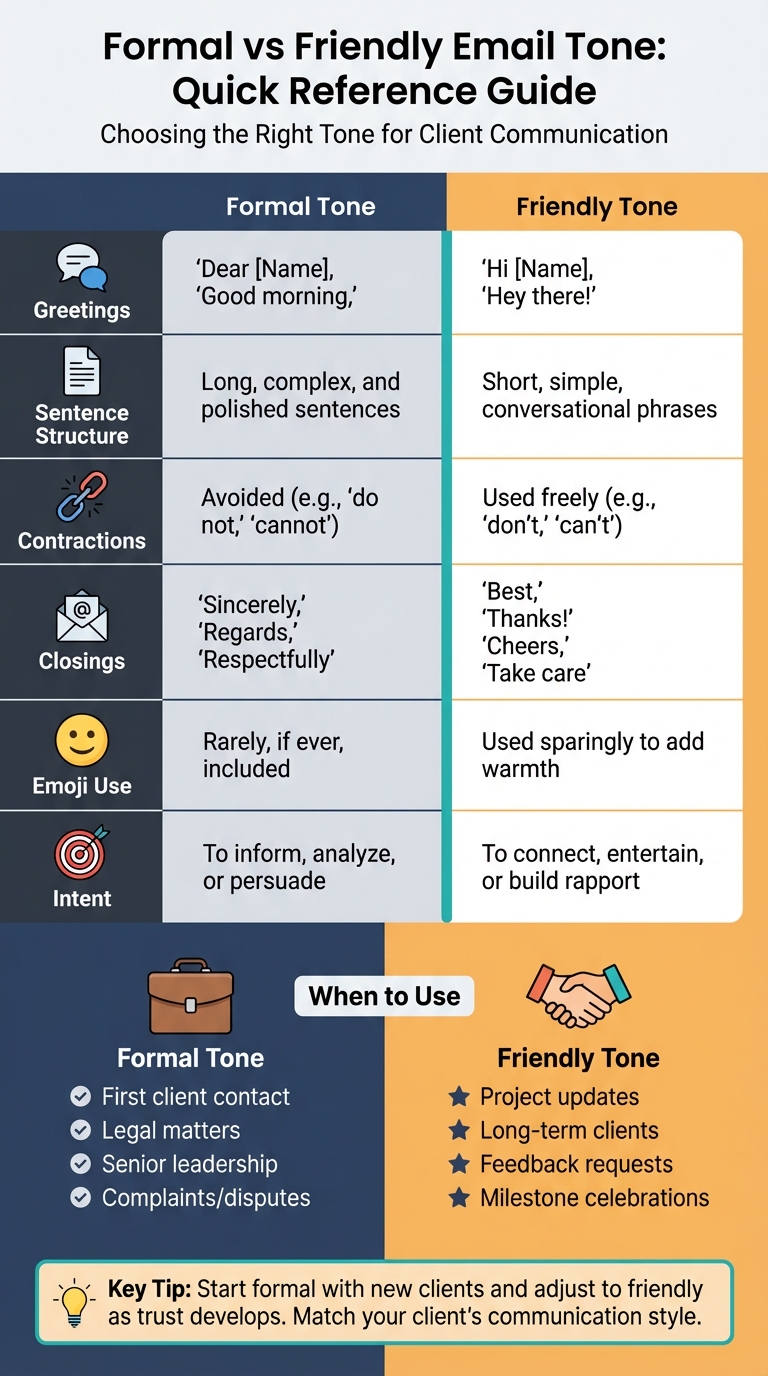
Formal vs Friendly Email Tone Comparison Guide
When deciding between a formal or friendly tone for your client email, think about the context: formal works best for new or high-stakes contacts, while friendly fits ongoing relationships.
The key difference lies in the language and structure. Formal emails favor precise, professional vocabulary and steer clear of slang or casual expressions. Friendly emails, on the other hand, lean into everyday language and conversational phrases that feel approachable. You’ll also notice that formal emails tend to use longer, more intricate sentences, whereas friendly emails stick to shorter, more direct statements.
Another distinction is how each tone engages the reader. Formal writing often uses a third-person perspective or passive voice, creating a sense of professionalism and distance. In contrast, friendly writing feels personal, using pronouns like "I", "we", and "you" to build connection. Justin Wong, Head of Growth at Jenni.ai, compares formal writing to a polished appearance:
"Formal writing serves as the backbone of professional, academic, and official communication. Think of it as wearing a well-tailored suit".
Comparison Table: Formal vs Friendly Elements
Here’s a quick breakdown of the differences to help you decide which tone suits your email:
| Element | Formal Email Tone | Friendly Email Tone |
|---|---|---|
| Greetings | "Dear [Name]", "Good morning", | "Hi [Name]", "Hey there!" |
| Sentence Structure | Long, complex, and polished sentences | Short, simple, conversational phrases |
| Contractions | Avoided (e.g., "do not", "cannot") | Used freely (e.g., "don't", "can't") |
| Closings | "Sincerely", "Regards", "Respectfully" | "Best", "Thanks!" "Cheers", "Take care" |
| Emoji Use | Rarely, if ever, included | Used sparingly to add warmth |
| Intent | To inform, analyze, or persuade | To connect, entertain, or build rapport |
This table highlights the main elements of each tone, helping you tailor your communication effectively. Use a formal tone for professional introductions or critical discussions, and switch to a friendly tone for fostering relationships or casual updates.
Always consider the context: match the recipient's tone and read your email aloud to ensure it feels appropriate.
When to Use Formal Tone
Using a formal tone is more than just a show of professionalism - it’s a key element in building trust and credibility, especially in situations where precision and respect are paramount. It’s particularly effective in critical or first-time interactions, helping to establish strong client relationships.
Best Situations for Formal Tone
First client contact is one of the most important moments to use a formal tone. When introducing yourself to a prospective client or customer, professionalism sets the right tone. As Meg Prater, Senior Staff Writer at HubSpot, explains:
"Formal emails are also a great way to show prospective clients that you respect their time and can handle their situation with care".
This approach ensures a polished first impression.
Legal and regulatory matters demand accuracy and careful wording. In these contexts, even small errors can lead to significant issues. Meg Prater emphasizes the importance of precision, noting that any misstep in legal documents or regulatory filings could result in liability concerns. A formal tone helps ensure clarity and reduces the risk of misinterpretation. This is especially true when managing client design feedback to avoid scope creep.
Complaints, disputes, and sensitive situations require a tone that is both neutral and professional. Whether dealing with billing discrepancies, missed deadlines, or project challenges, a formal tone keeps the focus on resolving design feedback issues without escalating tensions or assigning blame.
Senior leadership and enterprise clients often expect structured and respectful communication. When addressing C-suite executives or major corporate accounts, formal language acknowledges professional hierarchies and aligns with the expectations of industries like finance and corporate services .
These examples highlight the importance of a formal tone in maintaining professionalism, especially in high-stakes or delicate situations. It’s a foundation that ensures clarity and respect, paving the way for exploring when a more casual approach might be appropriate.
When to Use Friendly Tone
A friendly tone adds a personal touch to your communication, making clients feel valued and appreciated. As Mailchimp aptly describes it, "Your tone is the email's body language in written form". Opting for warmth over strict formality sends a clear message: the relationship goes beyond mere transactions.
This approach is especially effective for fostering long-term partnerships. Warm communication in updates, feedback exchanges, and milestone celebrations keeps the collaboration energized. Sara Kurczyńska, Content Writer at Selzy, explains:
"A friendly tone creates an atmosphere of respect, appreciation, and camaraderie. It motivates team members to be proactive, bring their best ideas to the table, and value each other's input".
Best Situations for Friendly Tone
Using a friendly tone is particularly effective in several scenarios:
- Project updates and progress reports: Conversational language keeps clients engaged and involved. Instead of formal status reports, using a BoastImage vs Ruttl comparison to find the right tool makes clients feel like active collaborators.
- Requesting website feedback: Whether it's for design mockups, website drafts, or marketing materials, phrases like "I'd love to hear your thoughts" encourage open and honest input without sounding pushy.
- Customer support: A warm, caring tone reassures clients that their concerns are taken seriously and handled with genuine care.
- Celebrating milestones: Whether it's a product launch, campaign success, or company anniversary, enthusiastic language highlights shared achievements and strengthens bonds.
- Marketing communications: Newsletters, blog updates, and promotional emails thrive on a conversational tone that builds direct, personal connections. Even transactional emails, like order confirmations or shipping updates, can incorporate friendly greetings to leave a positive impression.
Amy Irvine, Employee Development Consultant at UC Davis, sums it up well:
"The goal in business e-mails... is to come across as respectful, friendly and approachable".
Up next, we’ll explore how to balance formal and friendly tones to adapt to any client situation.
How to Mix Formal and Friendly Tones
Crafting client emails that strike the right balance between professionalism and warmth is key to effective communication. A professional structure - like clear subject lines, proper formatting, and complete email signatures - paired with approachable language helps maintain authority while building a genuine connection.
Finding the Right Balance
The secret to finding the right tone? Mirror your client's style. If they use casual greetings or toss in an emoji here and there, feel free to reflect that tone in your replies. This approach keeps your communication natural and relatable.
Start with a formal tone and gradually ease into a friendlier style as trust develops. For example, in initial emails, opt for "Hello [Name]" instead of the overly stiff "Dear Sir/Madam". Once the relationship grows, you can move to first names and use warmer sign-offs like "Best" or "Cheers" instead of "Sincerely."
Anjie Zheng from Grammarly highlights the importance of tone in emails:
"Striking a tone in emails that's polite and clear can either accelerate your career or hold you back".
Adjust your tone based on context. Show enthusiasm when sharing good news, but stick to a more formal tone for serious topics. A practical rule to follow is the "one-and-one" rule: limit yourself to one exclamation point and one simple emoticon per email. This keeps your message warm without crossing into unprofessional territory. No matter how friendly the email content becomes, always include a professional signature with your title and contact information. Reading your draft out loud can also help ensure the tone transitions smoothly.
Tone Recommendations by Situation
Different scenarios call for different tone adjustments. Here's how to match your tone to the context:
| Scenario | Recommended Tone Mix | Reason for Approach |
|---|---|---|
| Initial Outreach / Cold Email | 80% Formal / 20% Friendly | Establishes credibility while adding a touch of warmth to encourage a response. |
| Long-term Client Follow-up | 40% Formal / 60% Friendly | Focuses on maintaining rapport since trust is already built. |
| Delivering Bad News / Apology | 90% Formal / 10% Empathetic | Conveys respect and seriousness; too much friendliness could seem insincere. |
| Project Kick-off / Good News | 30% Formal / 70% Friendly | Builds excitement and team morale for the upcoming collaboration. |
| Technical Support / Instructions | 70% Formal / 30% Concise | Ensures instructions are clear and authoritative while remaining approachable. |
Keep in mind that your industry plays a role in tone selection. Creative fields often embrace a more relaxed style, while sectors like finance or enterprise lean toward structured communication. When working with international clients, err on the side of formality, as casual language can sometimes be misinterpreted across cultures .
Conclusion
Crafting the right email tone is all about striking a balance that nurtures client relationships. Each tone serves a purpose - formal tones establish trust and authority, while friendly tones help foster connection and rapport.
The key is knowing how to combine these approaches seamlessly. Start with a formal tone to set a professional foundation, then gradually introduce a friendlier touch as the relationship evolves. Pay attention to your client’s communication style, keep a professional framework even when using warm language, and tailor your tone to fit the situation - whether delivering sensitive news, launching an exciting project, or simply following up with unresponsive clients. Adjusting your tone thoughtfully ensures your messages resonate and remain effective.
Research highlights that 80% of customers value communication as much as the actual product or service. The tone of your emails plays a major role in building trust, encouraging engagement, and maintaining long-term client relationships. Mailchimp describes it best:
"Your tone is the email's body language in written form".
Professionals who strike the right balance between being assertive and approachable are rated 30% higher in competence than those who lean too heavily on harsh or overly casual tones. By tailoring your tone to each unique interaction, you can strengthen client relationships and keep communication productive.
As Jacqueline Whitmore wisely advises:
"You can hardly be wrong going too formal. But you can be dead wrong going too casual".
When unsure, lean toward professionalism while adding an authentic warmth through thoughtful language and personalized details. This approach ensures your emails leave a positive, lasting impression.
FAQs
How can I tell if my email is too formal?
To determine if your email comes across as too formal, pay attention to whether the tone feels stiff or distant. While formal emails typically steer clear of casual language, being overly rigid can make them seem cold or impersonal. Watch for things like unnecessarily complex wording or a lack of warmth in your phrasing. Aim for a middle ground - keeping it professional but still friendly helps encourage better engagement and nurtures stronger connections.
How can I be friendly without seeming unprofessional?
To strike the right balance between friendliness and professionalism, aim for a tone that's conversational but respectful. Start with polite greetings and express gratitude where appropriate - this adds a touch of warmth. Use approachable language to make your message accessible, but steer clear of overly casual phrases or slang that might come across as unprofessional. Adjust your tone to suit your audience and the context of your communication. This way, your message feels sincere, fosters trust, and maintains your credibility.
What tone should I use when emailing international clients?
When reaching out to international clients via email, aim for a tone that mixes professionalism with a touch of friendliness. Keep your language polite and straightforward, steering clear of casual expressions or slang that could be misunderstood. Adjust your tone depending on the relationship and the client's cultural norms - some may value a formal approach with respectful phrasing, while others might respond better to a more easygoing style. The key is to ensure your message is clear, respectful, and considerate of cultural differences.