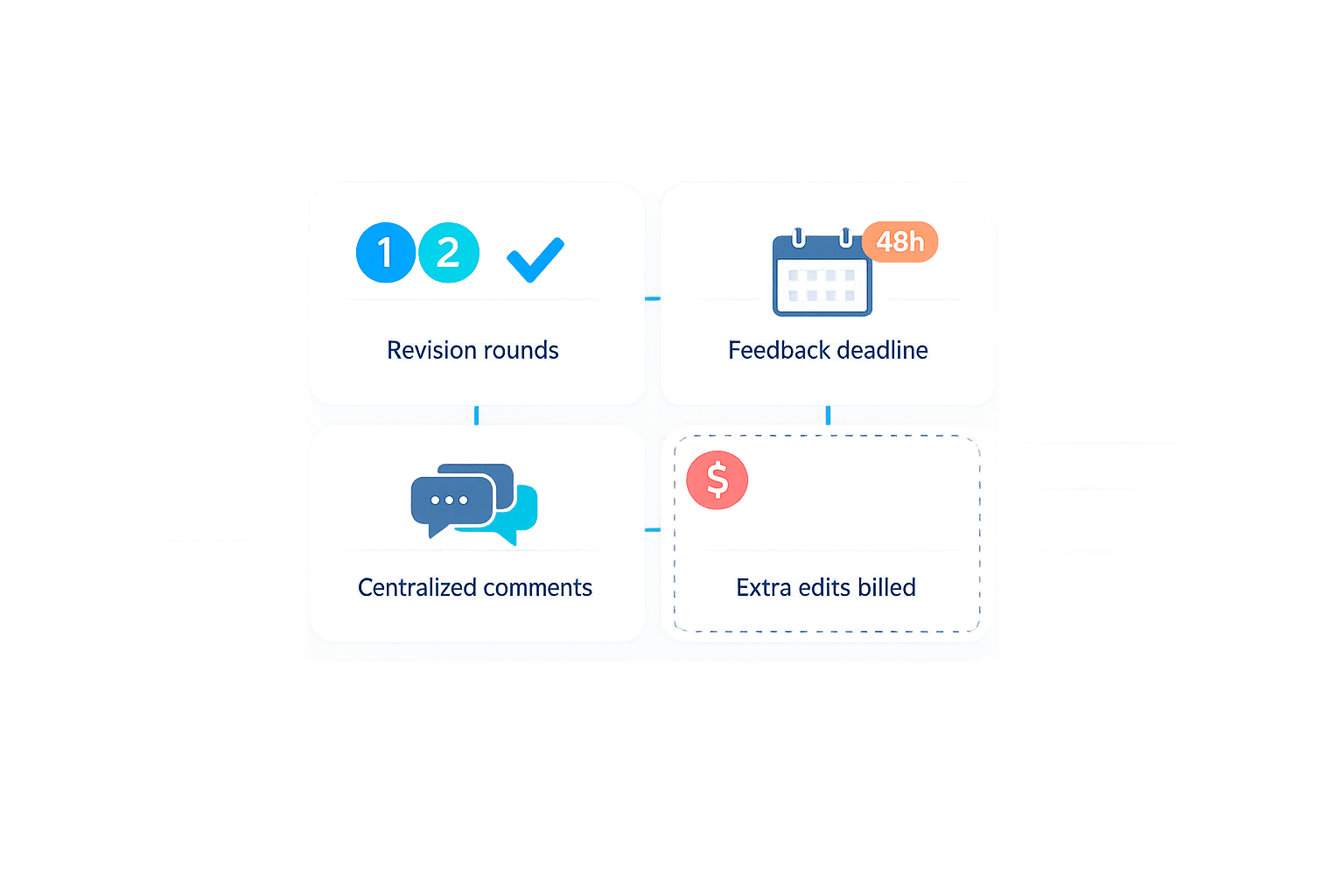
Client Revision Limits: Checklist For Agencies
Managing client revisions effectively can save your agency time, money, and frustration. Without clear limits, projects can spiral into endless changes, missed deadlines, and scope creep. Here’s how to set boundaries and streamline the revision process:
- Set clear revision limits upfront: Define the number of revision rounds (e.g., three: strategy, layout, and final tweaks) in your contract. Specify what counts as a revision versus a scope change.
- Establish deadlines: Require client feedback within five business days to keep projects moving.
- Use a single point of contact: Designate one client representative to consolidate and approve feedback.
- Leverage feedback tools: Platforms like BoastImage simplify communication by allowing clients to comment directly on designs.
- Track revisions: Maintain a detailed log of all feedback and revisions to ensure limits are respected.
- Charge for extra revisions: Include costs for additional rounds in your contract to protect your budget and time.
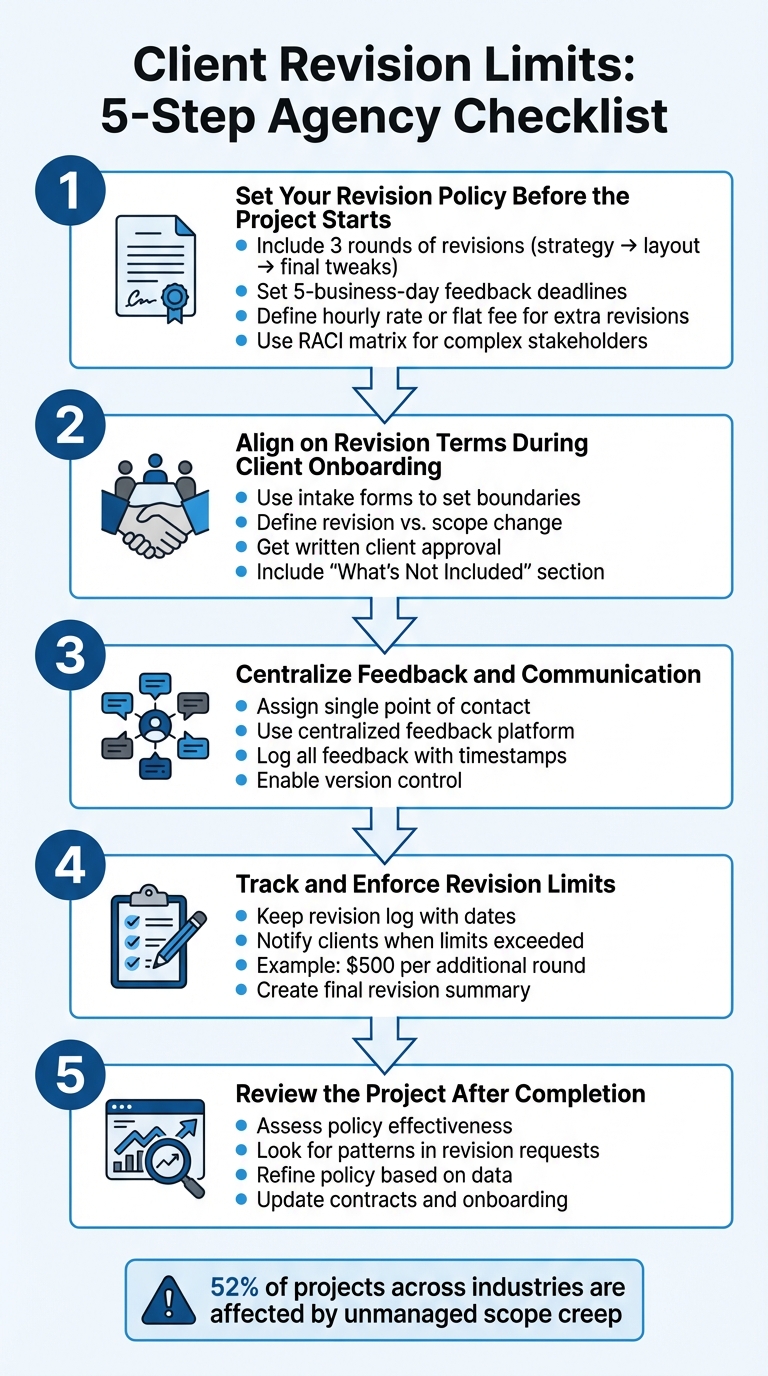
5-Step Client Revision Management Process for Agencies
Client Asking for Endless of Revisions Requests? Here's How to Fix It
Step 1: Set Your Revision Policy Before the Project Starts
To avoid headaches later, establish a clear revision policy before kicking off the project. This will help protect the project's scope, timeline, and budget right from the start. Make sure this policy is in place before the contract is signed.
Decide How Many Revision Rounds to Include
For most design projects, three rounds of revisions are standard. These rounds usually follow a logical progression: the first focuses on strategy, the second on layout, and the final round deals with minor tweaks. It’s important to clearly define what a "round" entails - specific adjustments, not a complete overhaul. Also, make sure to differentiate between major revisions (like rearranging sections of a page) and minor ones (like updating text or swapping images). This helps keep the project on track and prevents scope creep.
If your client has a complex decision-making process - say, multiple stakeholders or no clear point of contact - you might run into conflicting feedback. In such cases, consider using a RACI matrix (Responsible, Accountable, Consulted, Informed) during onboarding. This tool identifies who has final approval authority, making it easier to manage feedback and set realistic expectations for the number of revision rounds.
Set Feedback Deadlines and Approval Authority
Deadlines are essential for keeping things moving. Include a five-business-day window for client feedback in your contract. This ensures the project doesn’t stall. If the client misses the deadline, the contract should specify that the project either progresses to the next phase or is temporarily paused, freeing up your time for other work.
Also, require the client to designate a single approval authority. Late-stage rejections can throw off schedules and frustrate teams. In fact, unmanaged scope creep affects 52% of projects across industries. Having one person responsible for consolidating all internal feedback into a single, unified document can prevent these issues. As Clemens Rychlik, COO of Hello Operator, explains:
"Once everyone understands that additional edit rounds are invoiced extra, this can actually often work as an educational tool to get more organized internally on their side".
Spelling out these terms in your contract will reduce confusion and keep everyone on the same page.
Add the Policy to Your Contracts
Your contract should clearly outline the number of included revision rounds, deadlines for feedback, and any additional charges for extra revisions. Specify the hourly rate or flat fee for revisions beyond the agreed limit. It’s also a good idea to list the exact deliverables and file formats (e.g., Photoshop files or Word documents) to avoid unexpected requests for last-minute file conversions.
Step 2: Align on Revision Terms During Client Onboarding
Once you’ve established your revision policy, the next step is to solidify these terms during client onboarding. After the contract is signed, use this phase to clarify and reinforce revision boundaries. Break down any legal jargon into clear, actionable expectations.
Use an Intake Form to Set Boundaries
An intake form can do much more than gather basic project details. It’s a chance to understand how your client approaches revisions and what they expect from the process. Include questions about their internal approval process, the number of stakeholders involved, and any aesthetic preferences they might have. Keywords like "minimalist", "energetic", or "trustworthy" can help define the project’s visual direction early on.
This form also acts as a filter. If a client provides incomplete answers or avoids questions about budget or revision preferences, it could signal potential challenges ahead. Spotting these red flags early can save you from investing time in a project that might become overly complicated.
Define Scope Boundaries
During onboarding, take the time to explain the difference between a revision (refining work within the agreed scope) and a scope change (altering the strategy, audience, or format). Framing revision limits as a way to maintain focus and quality can help clients better understand their purpose.
If a client requests something outside the original agreement, offer them clear options: adjust the budget and timeline to include it now, save it for a future phase, swap it for an existing task, or simplify it to fit the current scope. Alex Wilson, Owner of One Thing Digital, emphasizes this approach:
"My contracts specifically state what is out of scope, how many revisions and how long they have to approve. If they want something that is out of scope, I can either add it hourly or scope it out completely separately."
Including a "What’s Not Included" section in your onboarding documents can also help avoid unexpected requests. As Steven Noble, a Digital Designer and UI Developer, points out:
"If you've been in the trenches long enough you know what the stakeholder might ask for next so a short 'What's not included' section can sometimes help."
This kind of clarity ensures that both parties are on the same page from the start.
Get Written Client Approval
Before diving into the project, secure written sign-off from the client, confirming they understand and agree to the revision policy. This step is crucial for preventing untracked work and distinguishing between legitimate revisions and scope changes that require formal adjustments.
When clients know that exceeding the agreed revision rounds will incur additional charges (often at rates like $80/hour), they tend to streamline their internal feedback process. This protects your agency from undercharging and reinforces the value of your time and expertise.
Step 3: Centralize Feedback and Communication
Scattered feedback - whether it’s coming from emails, texts, or phone calls - can derail your project. It creates confusion, muddles revision requests, and risks pushing you beyond your agreed limits. To stay on track, centralizing feedback into one system is essential. This approach ensures everyone is on the same page and holds all parties accountable.
Assign a Single Point of Contact
Appointing one person to manage client feedback is a game-changer. Without this, you might get conflicting input - like one stakeholder asking for a larger logo while another wants it smaller. By clarifying roles at every approval stage, you can channel all feedback through the right person. This eliminates back-and-forth chaos and ensures decisions are made efficiently. Plus, it sets the stage for using structured tools to streamline the process.
Use a Centralized Feedback Platform
Forget juggling emails and vague requests. A centralized feedback platform adds clarity and precision to the process. Tools like BoastImage let clients directly annotate specific design elements, removing the guesswork from comments like "make it pop." Clients don’t need accounts or training to use it - they just click a link and provide targeted feedback. Features like version control ensure clients are always reviewing the latest draft, and you can disable comments on older versions to avoid confusion. Behind the scenes, Kanban boards turn feedback into actionable tasks, so every revision is accounted for and nothing slips through the cracks.
Log All Feedback and Revisions
Keeping detailed records of feedback and revisions is crucial. Track every comment with timestamps and define what constitutes a "revision round" - a consolidated set of feedback within a set timeframe. This stops clients from trickling in minor edits over days and encourages them to gather input from all stakeholders before submitting their notes. Having a centralized log not only helps enforce revision limits but also protects your team in case of disputes. You’ll have clear documentation of what was agreed upon and when approvals were made, keeping the process transparent and manageable.
sbb-itb-32f6eb2
Step 4: Track and Enforce Revision Limits
After centralizing feedback, the next step is making sure revision limits are followed. Without proper tracking, clients might unknowingly exceed their limits, and teams could lose track of progress. By building on centralized feedback systems, tracking revisions helps ensure everyone stays within agreed boundaries.
Keep a Revision Log with Dates and Details
A detailed log of all revision requests keeps both sides accountable and protects everyone involved. This log should include key details like the number of revisions, approval timelines, and stakeholder responses. Define a revision round as a single, consolidated set of feedback submitted within a five-business-day window. This approach prevents clients from sending scattered edits over an extended period and encourages them to gather all stakeholder input before submitting feedback.
Using tools like BoastImage can simplify this process. Features like version history automate the tracking of revisions, making it easy to see how many rounds have been completed and when feedback was provided.
Explain Additional Costs When Limits Are Exceeded
If the client exceeds their allotted revision rounds, notify them in writing immediately. This step ensures transparency and reinforces the terms of your agreement. Ideally, your contract should already outline the cost for extra revisions - for example, $500 per additional round - so this conversation shouldn’t catch anyone off guard. Be clear about the difference between minor tweaks and entirely new project phases, as the latter may require a separate quote.
As Norman ODEH, Founder of Fivani, puts it:
"Designer will notify Client in writing when included revisions have been exhausted before proceeding with additional billable work."
This pause is an opportunity to revisit the project’s direction and budget, ensuring everyone is aligned before moving forward. It also underscores the importance of adhering to the agreed-upon revision rounds.
Create a Final Revision Summary
At the end of the project, prepare a comprehensive summary of all revisions made. This summary should clearly distinguish minor changes from major shifts in direction, showing what was included in the original agreement versus what incurred additional costs. Include details like when changes were requested, when they were approved, and how many revision rounds were used.
This final summary not only confirms that both parties fulfilled their commitments but also serves as a valuable reference for improving your revision policies in future projects. It’s a clear, documented record of the entire process, ensuring transparency and accountability.
Step 5: Review the Project After Completion
Once the project wraps up and the revision summary is finalized, it's time to evaluate the entire process. Skipping this review can leave inefficiencies unchecked and miss chances to improve how you work.
Assess How Well the Revision Policy Worked
Take a close look at how your revision policy performed. Did it help keep the project on track in terms of scope, timeline, and budget? Pay attention to approval turnaround times - how long it took between sharing a design and receiving final approval. If clients often took longer than expected to respond, consider adjusting feedback deadlines or implementing automated reminders. Also, check if clients stuck to their allotted revision rounds. If they frequently exceeded the limit, it might be worth revisiting your standard three-round policy to better match the complexity of certain projects.
Evaluate the effectiveness of your feedback system. Did tools like BoastImage streamline communication, or were clients still sending scattered emails and texts? If feedback remained disorganized despite having a centralized platform, the problem might lie in how well clients were onboarded and educated about the process. Make sure your onboarding materials clearly explain where and how feedback should be submitted.
Look for Patterns in Revision Requests
Dive into revision logs and feedback to identify recurring issues or bottlenecks. Metrics like the number of revisions per client, response times from stakeholders, and approval delays can reveal where the process is slowing down. Categorize feedback into themes - layout, branding, content, etc. - to see if certain areas consistently require more revisions. This might point to gaps in your initial brief or the way you present concepts.
Pay attention to how often requests involve significant changes to core project elements. If scope creep is common or conflicting stakeholder input comes in late, it may signal a need to improve onboarding or clarify roles using tools like a RACI matrix. Be wary of warning signs like multiple revisions on already-approved work or requests that completely shift the creative direction midway through the project.
Refine Your Revision Policy
Turn your findings into actionable updates for your revision policy. If clients regularly exceed three revision rounds, consider updating your contracts to set more realistic expectations or adjust pricing to reflect the extra work. If certain stages of the review process are consistently delayed, involve slower departments or key decision-makers earlier in your workflow for future projects.
You might also create a quick-reference guide for clients, showing them how to provide clear, actionable feedback instead of vague comments like "make it pop" or "needs more energy." Make it a habit to review feedback metrics monthly and share insights with your team. This ensures your revision policy stays aligned with both your agency's experience and your clients' evolving needs. Use these lessons to refine future contracts, onboarding materials, and overall processes.
Conclusion
Setting clear revision limits isn’t about restricting clients - it’s about safeguarding your agency’s profitability and maintaining efficient workflows. Without proper boundaries, you could end up in situations like Norman ODEH’s, where an open-ended "revisions until Client approval" clause led to $18,000 in unpaid work and $14,000 in lost opportunities. By implementing a three-round revision policy, establishing five-business-day feedback windows, and distinguishing between a "revision" and a "new direction", you create a structure that keeps projects on schedule and budgets in check.
Streamlined communication also plays a huge role in improving efficiency. When clients can easily pin comments directly to specific design elements - without needing to create accounts or navigate confusing platforms - they’re more likely to provide timely, actionable feedback. Tools like BoastImage replace unclear emails and scattered messages with precise design annotations, ensuring everyone works on the latest version of the project.
Beyond communication, tracking revisions rigorously can significantly enhance your project management. Document every round of revisions with dates and details, clearly communicate additional costs when limits are exceeded, and review patterns after project completion. If you notice clients regularly exceeding three rounds of revisions or delaying approvals, use that data to refine contracts, adjust onboarding processes, or involve decision-makers earlier in the workflow.
FAQs
How do I define what counts as a revision vs. a scope change?
Defining revisions and scope changes is all about setting clear boundaries right from the start. Revisions are usually small adjustments - like correcting typos or altering colors. On the other hand, scope changes involve major shifts, such as adding entirely new tasks or making significant modifications that go beyond the original agreement.
Including a set number of revision rounds in contracts is a smart way to manage expectations. It reduces confusion, avoids unnecessary back-and-forth, and helps keep scope creep under control.
What should I do if a client misses the feedback deadline?
If a client misses a feedback deadline, take action quickly to keep things moving. Begin by politely reminding them of the originally agreed timeline. Then, have an open conversation to see if adjustments are needed to align with their current schedule. Setting clear expectations from the start - like defining revision limits and firm deadlines - can prevent setbacks and keep the workflow organized. This way, you can maintain steady progress without falling into the trap of endless revisions.
How can I enforce extra revision fees without harming the relationship?
To handle extra revision fees while keeping your client relationships intact, start by setting clear boundaries upfront. Include a specific limit on revisions in your contract, and make sure clients understand that going beyond this limit will result in additional fees. Position this as necessary to maintain timelines and deliver high-quality work.
Being transparent and professional is crucial here. Clearly communicate why these limits exist and how they benefit both parties. It’s not just about protecting your time - it’s also about ensuring the project stays on track.
Another tip? Use structured feedback tools. These can simplify communication by guiding clients to provide focused, actionable input. This reduces misunderstandings and helps cut down on unnecessary revisions, saving time and avoiding frustration for everyone involved.