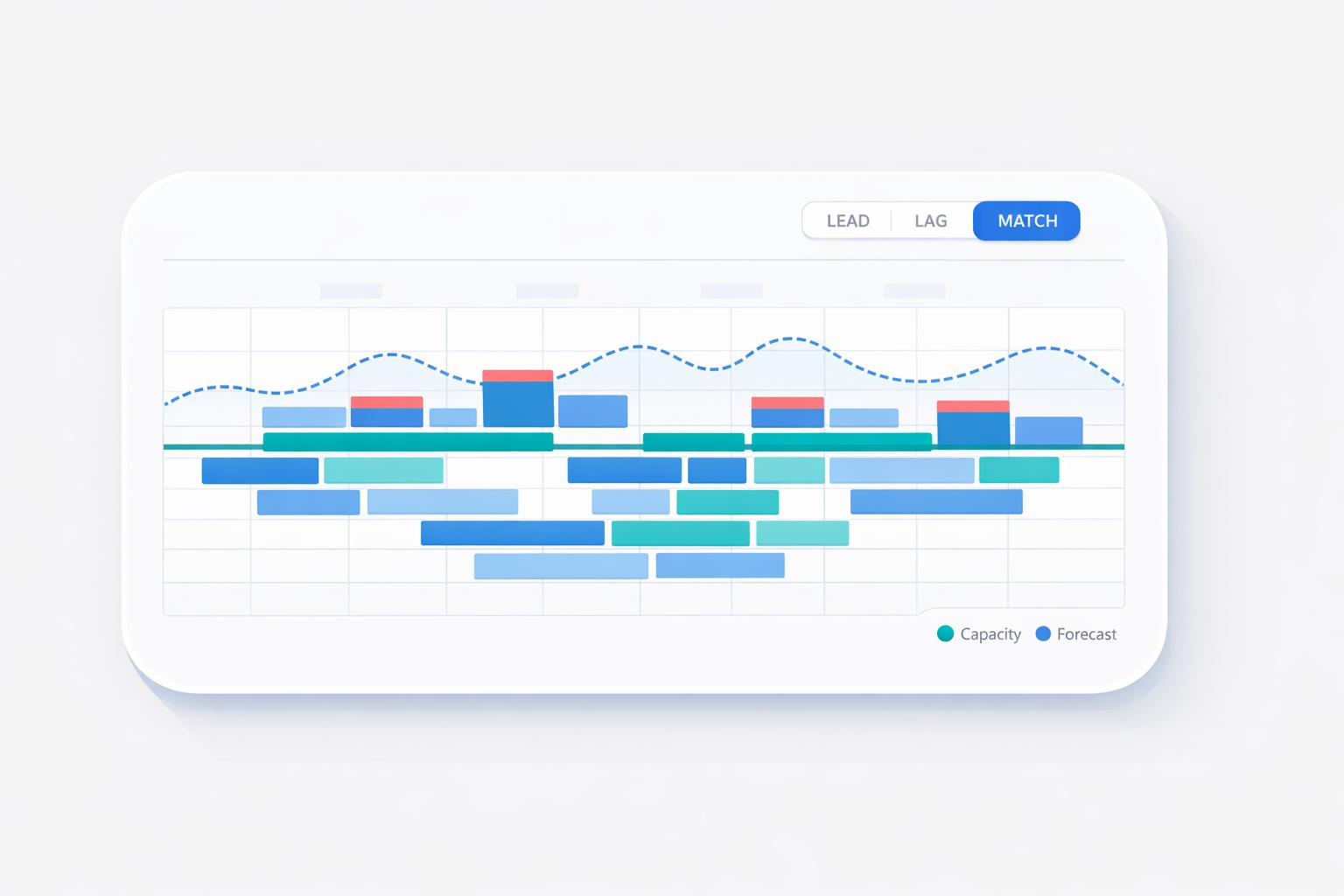
Capacity Planning for Agencies: A Complete Guide
Managing resources effectively is the backbone of any successful agency. Capacity planning ensures you have the right people, with the right skills, at the right time to meet client demands. Without it, you risk missed deadlines, overworked teams, and lost profits.
Here’s what you’ll learn:
- What capacity planning is: A structured way to match your team’s availability and skills with upcoming work.
- Why it matters: Poor planning leads to burnout, turnover, and wasted resources - costing agencies thousands annually.
- Key strategies: Choose between lead (hire early), lag (hire after demand), or match (adjust incrementally) approaches.
- How to calculate capacity: Factor in holidays, non-billable time, and realistic utilization rates (ideally 70%-80%).
- Avoiding mistakes: Don’t overcommit resources, underestimate project complexity, or rely solely on spreadsheets.
The 3 Strategies for Capacity Planning
sbb-itb-32f6eb2
3 Capacity Planning Strategies for Agencies
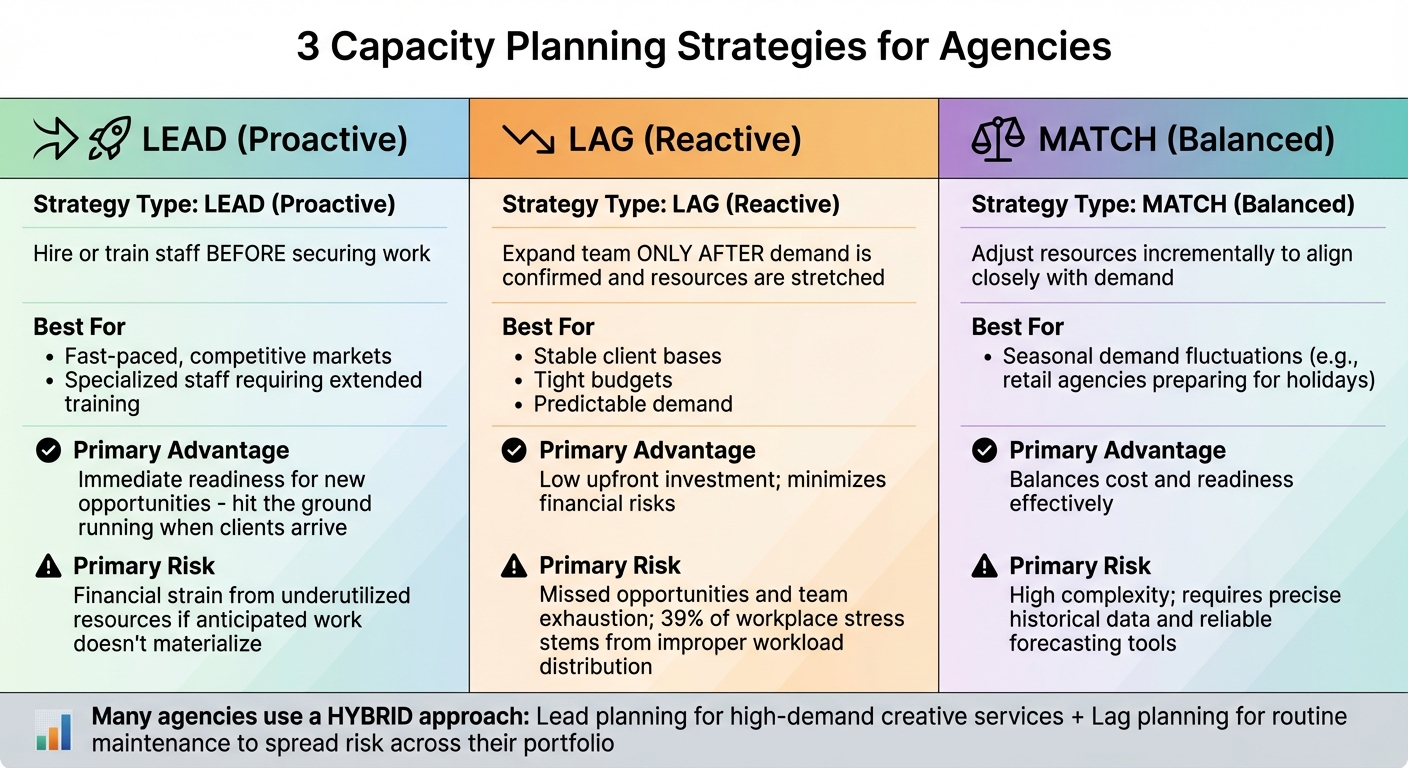
Agency Capacity Planning Strategies Comparison: Lead vs Lag vs Match
Choosing the right capacity planning strategy for your agency depends on factors like growth objectives, financial constraints, and market dynamics. Here’s a breakdown of three approaches to help you manage resources and forecast capacity effectively.
Lead Capacity Planning
Lead capacity planning involves hiring or training staff before securing the work. This forward-thinking strategy ensures you're ready to act as soon as opportunities arise. It's particularly useful for agencies in fast-paced, competitive markets or when specialized staff require extended training.
The benefit? You can hit the ground running when new clients come on board. The risk? If the anticipated work doesn’t materialize, you’re left with underutilized resources. Tom Whatley, CEO of Grizzle, shared his experience:
We grew too quickly; initial revenue boosted our confidence, but our capacity fell short, leading to client losses within six months.
If this proactive approach feels too risky, consider a more cautious alternative.
Lag Capacity Planning
Lag capacity planning takes a reactive stance - you expand your team only after demand is confirmed and your current resources are stretched thin. This strategy is ideal for agencies with more stable client bases or tight budgets, as it minimizes upfront costs and financial risks.
However, it’s not without challenges. Delaying hiring can result in missed opportunities and overworked teams. Eli Rubel, owner of No Boring Design, described the impact:
Our biggest problem for three years was that we couldn't hire quickly enough to meet the demand... I spent nearly $1,000,000 on recruiter fees over that period.
Given that 39% of workplace stress stems from improper workload distribution, this approach requires careful monitoring to avoid burnout.
Match Capacity Planning
Match capacity planning strikes a balance, adjusting resources incrementally to align more closely with demand. This approach is particularly effective for agencies that experience seasonal fluctuations - like retail-focused agencies preparing for the holiday season.
The downside? It’s complex and costly to execute. Success depends on having accurate historical data, reliable forecasting tools, and the flexibility to make frequent adjustments. Some agencies adopt a hybrid approach, using lead planning for high-demand creative services and lag planning for routine maintenance. This allows them to spread risk across their portfolio rather than relying on a single method.
Each of these strategies offers unique advantages and challenges, giving agencies the tools to improve resource management and forecasting accuracy.
| Strategy | Best For | Primary Advantage | Primary Risk |
|---|---|---|---|
| Lead | Fast-paced, competitive markets | Immediate readiness for new opportunities | Financial strain from underused resources |
| Lag | Stable budgets and predictable demand | Low upfront investment | Missed opportunities and team exhaustion |
| Match | Seasonal demand fluctuations | Balances cost and readiness | High complexity; requires precise data |
How to Calculate and Forecast Agency Capacity
Planning capacity accurately starts with calculating gross available hours and then adjusting for real-world factors like holidays, meetings, and other non-billable time.
Assess Current Resource Availability
To get a clear picture of your team's true capacity, start by calculating the total hours available. Then subtract non-billable time spent on internal meetings, administrative work, and training. Don’t forget to account for time off, public holidays, and sick leave, which can reduce availability by 5–8%.
It’s important to avoid assuming 100% productivity. Industry benchmarks suggest that agencies operate best at utilization rates between 70% and 80%. For production-level staff, this figure can range from 70% to 90%, while account managers typically average between 60% and 80%. Pushing beyond these limits can lead to burnout and higher employee turnover costs.
Another critical step is to assess your team’s skills and expertise. Keep detailed profiles of each team member, outlining their specific skill sets and seniority levels. This ensures you can assign the right person to the right task. For example, a senior UX designer and a junior designer might both have 40 hours available per week, but their capabilities are not the same. Centralized resource management tools can help streamline this process, providing real-time visibility into team allocation. Surprisingly, 17% of agencies still don’t use any software for resource management, and 35% are still relying on Excel.
Once you’ve mapped out your current capacity and skill distribution, you’re ready to anticipate upcoming project demands.
Forecast Client Demand and Project Scope
With your current capacity defined, shift your focus to forecasting future project needs. Collaborate with your sales and leadership teams to review the sales pipeline for the next 6–12 months. Assign probability percentages to potential projects - this allows you to prioritize secured contracts over proposals with lower likelihoods of approval.
Use historical data from similar projects to estimate the hours, budget, and specific roles required for new work. Instead of relying solely on headcount, break forecasts down by skills and roles. As Toggl explains:
Capacity planning is a predictive discipline. It's the process of making sure you have the right people with the right skills available at the right time to meet future demand.
Consider external factors like seasonal trends and industry cycles, and always leave room for unknowns like scope creep. Scenario planning can also be helpful - model different combinations of potential projects to see how various outcomes might impact your overall capacity. Brendon Nicholas, Co-founder and Technical Director at DotDev, provides insight into this approach:
If we know we're doing 30% on internal projects, then we know we've got the capacity to take on more client work.
These forecasts are critical for fine-tuning your capacity plan and preparing for future demand.
Identify Capacity Gaps and Overlaps
Once you’ve calculated available capacity and forecasted demand, compare the two to identify mismatches. Utilization rates above 80% often signal a capacity gap and an increased risk of burnout, while rates below 70% may indicate unused capacity that’s costing you money.
Capacity gaps aren’t just about hours - they often involve specific skills. In fact, 77% of agencies report gaps in leadership roles. To address shortages, consider upskilling existing employees (which McKinsey research suggests is 1.5 to 3 times more cost-effective than hiring new staff), hiring freelancers or contractors for short-term needs, or recruiting new team members using lead, lag, or match strategies.
On the flip side, if you find yourself with excess capacity, consider reallocating underutilized staff to internal projects, training, or business development. You could also focus sales efforts on services with available capacity or adjust the start dates of non-urgent projects to fill slower periods. Ilija Brajković, CEO of Kontra Agency, highlights the value of this analysis:
We ended up terminating contracts with two of our oldest clients after only a few months of using Productive... it turned out that we were losing money because the money they paid us did not cover salaries, fixed overhead per hour, and variable overhead per hour.
To stay on top of things, use visual tools like heatmaps to quickly identify overbooked team members or idle "bench time." Conduct weekly capacity reviews to reassign resources before small gaps or overlaps turn into bigger problems. Spotting these mismatches early will help you make the necessary adjustments to keep your team running smoothly.
How to Build and Implement a Capacity Plan
Once you've pinpointed gaps and overlaps, it’s time to transform your analysis into an actionable system. A capacity plan only delivers results when it’s seamlessly woven into everyday operations.
Create a Capacity Planning Template
Start by cataloging all your resources - this includes human resources (skills, seniority, availability), technology, and financial assets. Your template should cover key details like task priorities, resource allocation by skill set, timelines, and tracking billable versus non-billable hours. To save time, incorporate automated formulas that calculate utilization rates, eliminating the need for manual recalculations every week.
Determine net capacity by accounting for holidays, vacations, sick leave, meetings, training, and administrative tasks, which typically consume 5%–8% of total hours. Aim for an 80% utilization rate to leave room for unplanned work.
Standardize your service offerings by breaking them into repeatable modules, such as "number of content pieces" or "design revisions included." This approach makes estimating time far more accurate when filling out your template. Use placeholders to reserve time for potential contractors or future hires. This ensures you don’t overburden your current team while waiting for new hires to join.
Once your template is ready, integrate it into your project management tools to align planning with execution.
Integrate Capacity Planning into Project Management
Your capacity plan should function as a single source of truth, seamlessly connected to your project management system. This integration provides real-time visibility across all areas of your workflow. Jason Devoy, Delivery Director at Joi Polloi, highlights the impact of this approach:
If I had to choose the main benefit of switching to Productive, it would be having visibility of everything in one place: from sales through resources, projects to delivery.
Align long-term capacity planning with short-term scheduling to ensure daily tasks contribute to your broader business objectives. Include leave management in your system so vacation requests, public holidays, and sick leave automatically adjust available capacity. This way, you’re never caught off guard by resource shortages.
Once integrated, continuous monitoring is essential to fine-tune resource allocation and respond to changes in real time.
Monitor and Adjust Your Capacity Plan
Capacity planning isn’t a set-it-and-forget-it process. Review your capacity data weekly to reallocate resources before minor issues escalate into major challenges. Use dynamic dashboards and automated alerts to quickly identify scheduling conflicts or capacity limits. Compare actual time spent on tasks against your forecasts to catch inaccuracies and potential budget risks early.
Keep an eye on utilization rates, ideally between 70% and 90%, using visual tools like heatmaps to spot imbalances at a glance. When unexpected changes occur - like a team member calling in sick or a rush project landing on your desk - shift to tactical adjustments that address immediate needs.
Maintaining an 80% utilization target provides a buffer for surprises. Interestingly, only 43% of businesses track forecasted revenue, and just 18% manage their project budget burn rate in real time. Don’t let your organization fall behind. By consistently monitoring and refining your plan, you’ll turn it into a dynamic tool that evolves to meet real-world demands.
Common Capacity Planning Mistakes and How to Avoid Them
Even the best agencies can hit roadblocks when it comes to capacity planning. Spotting these issues early can save you a lot of money and help your team avoid burnout before it disrupts your workflow.
Overcommitting Resources
A common mistake is assuming employees can dedicate all eight hours of their workday to productive tasks. In reality, meetings, emails, admin duties, and brainstorming eat into that time. Aiming for 80% utilization - about 32 billable hours per week instead of 40 - is a more realistic approach.
Don’t forget to account for time off. Vacations, holidays, and sick days typically reduce capacity by 5-8%. As project management expert James Elliott warns:
Working at 110% for a long period of time isn't sustainable. Burnout is a major cause of turnover.
Burnout isn't just bad for morale; it’s costly. Replacing an employee can set you back around $4,700.
Another pitfall is planning only for confirmed projects while ignoring work in your sales pipeline. If several leads come through at once, you could find yourself short-staffed. To avoid this, assign probabilities to potential projects. For example, if a promising bid has a 50% chance of closing, include that in your capacity calculations.
Underestimating Project Complexity
Project complexity is another big challenge. Scope creep - when the work expands beyond the original plan - and "gold plating", where teams add unrequested features to impress clients, can push resources beyond their limits. This often happens when contract terms are vague or teams don’t adjust timelines for added work. Kontra Agency, for instance, discovered through real-time tracking that two long-term clients were unprofitable because their retainer fees didn’t cover the actual workload. The result? They had to terminate those contracts.
The solution? Use historical data to guide your planning. Reviewing past projects can help you estimate hours more accurately. Standardizing your services into clear, repeatable packages - like setting a fixed number of content pieces or design revisions - can also make forecasting easier. If clients ask for extras, make sure to explain how the changes will affect deadlines and overall quality.
Real-time monitoring tools can also help catch scope creep and complexity issues before they spiral out of control.
Skipping Real-Time Tracking Tools
Relying on static spreadsheets can cause major inefficiencies. Without real-time updates, it’s hard to spot problems like bottlenecks, scope creep, or team burnout until the damage is done. This lack of visibility delays solutions and hinders proactive planning. Agencies that switch from spreadsheets to dedicated tools often report better profit margins and lower stress levels.
Real-time tracking transforms capacity planning from reactive problem-solving to strategic management. For example, DotDev used real-time reporting to maintain a 30% buffer for internal projects. This allowed technical director Brendon Nicholas to pinpoint exactly when the agency could take on new client work, contributing to three years of 50% year-over-year growth.
For creative teams, tools like BoastImage can streamline resource planning by speeding up feedback loops. With BoastImage, clients can comment directly on designs, images, or PDFs without needing to create an account. This reduces delays, keeps projects on track, and improves forecasting accuracy.
To stay on top of things, monitor utilization rates and aim for a healthy range of 70% to 80%. Use visual dashboards to quickly identify imbalances. Also, watch for warning signs like your "Budget Spent" percentage outpacing actual project completion - a clear indicator of underestimated work or scope creep. Encourage daily time logging to maintain accurate data; waiting until the end of the week often leads to errors.
Conclusion
Key Takeaways
Capacity planning goes beyond just managing schedules - it's about creating a thriving agency that balances growth with team well-being. The key principle? Aim for 70% to 80% utilization rates, not 100%. Overloading your team can lead to burnout and costly turnover, with replacement expenses averaging around $4,700 per employee. Choose a strategy that aligns with your agency's needs: a lead approach for aggressive growth, a lag approach for cautious capacity expansion after demand is confirmed, or a match approach to handle seasonal fluctuations in demand.
Successful agencies treat capacity planning as a long-term strategy, spanning 6–12 months, rather than reacting to sudden project surges. They simplify service offerings into repeatable modules, making time estimates more reliable. Structuring teams around core skills - like creative development or account management - rather than specific platforms allows for flexibility as market demands change. Additionally, replacing static spreadsheets with real-time tracking tools creates a unified view of availability, budgets, and team assignments.
For creative workflows, tools such as BoastImage help streamline processes by letting clients provide direct feedback on designs without hassle, ensuring projects stay on track. These strategies provide a clear path to improving both efficiency and team satisfaction.
Next Steps for Your Agency
Put these ideas into action with a few practical steps. Start by auditing your current capacity. Calculate your total team hours, then subtract at least 20% to account for administrative tasks, meetings, and time off. This gives you a clearer picture of your actual capacity. Then, analyze your sales pipeline for the next 6–12 months. Assign probabilities to potential projects - like factoring in a 50% chance for a promising bid - and include those estimates in your planning.
Centralizing your data is another critical move. Beth Trejo, CEO of Chatterkick, captures the challenge perfectly:
Finding the balance between giving people space to be creative and having the data to manage effectively is the hardest thing I've done. It's a mix of art and science.
Switching from spreadsheets to dedicated capacity tools can provide the visibility needed to make smarter decisions - whether it’s hiring, bidding on new work, or even declining unprofitable projects. Finally, involve your team. Share metrics during coaching sessions to ensure everyone understands how time tracking contributes to better workload management. By taking these steps, your agency can ensure smoother operations and a more engaged, productive team.
FAQs
How do I choose between lead, lag, and match planning?
Choosing the right approach - lead, lag, or match planning - requires a clear understanding of your agency's goals and how you manage demand:
- Lead planning: This proactive method involves preparing resources ahead of time to meet anticipated client needs before they arise. It works well when demand is predictable and you want to avoid delays.
- Lag planning: A reactive strategy where resources are adjusted only after demand materializes. It's particularly effective for handling unpredictable workloads or when minimizing upfront costs is a priority.
- Match planning: This approach strikes a balance by aligning resources with current demand. It offers a middle ground, blending flexibility with controlled risk.
The choice depends on factors like how predictable your projects are, how adaptable your resources can be, and how much risk you're willing to take.
How do I set a realistic utilization target for my team?
To establish a practical utilization target, it's helpful to look at industry averages. For instance, producers and freelancers often aim for 75–80%, while managers typically target 35–50%. Admin or sales staff usually aim for 10% or more. Agencies, on the other hand, generally set their sights on 65–80% to strike a balance between maintaining productivity and avoiding burnout.
To keep workloads reasonable and resources well-utilized, try forecasting demand 4–6 weeks in advance. Also, tracking hours on a weekly basis can help ensure your team stays productive without feeling overwhelmed.
How can I forecast capacity when my sales pipeline is uncertain?
Forecasting capacity when your sales pipeline is uncertain can feel like trying to hit a moving target. But there are ways to tackle it effectively. Start by analyzing a mix of factors: expected client work, historical trends, and growth objectives. These give you a foundation to estimate resource needs.
From there, consider using forecasting models such as lead, lag, or match strategies. Each approach offers a different way to align resources with demand. Keep a close eye on how your pipeline is performing, and adjust your forecasts as needed - flexibility is key.
To make this process smoother, leverage capacity planning tools. These tools provide real-time tracking and help you make quick adjustments, so your team can stay responsive even when conditions shift unexpectedly.