Best Practices for Scenario Planning in Agencies
Scenario planning helps agencies prepare for uncertainties like shifting client needs, team availability, and project timelines. Instead of relying on a single prediction, it outlines multiple scenarios - best case, worst case, and most likely case - allowing teams to plan for disruptions like delayed feedback or unexpected project scope changes. This approach improves decision-making around staffing, budgeting, and resource allocation.
Key takeaways:
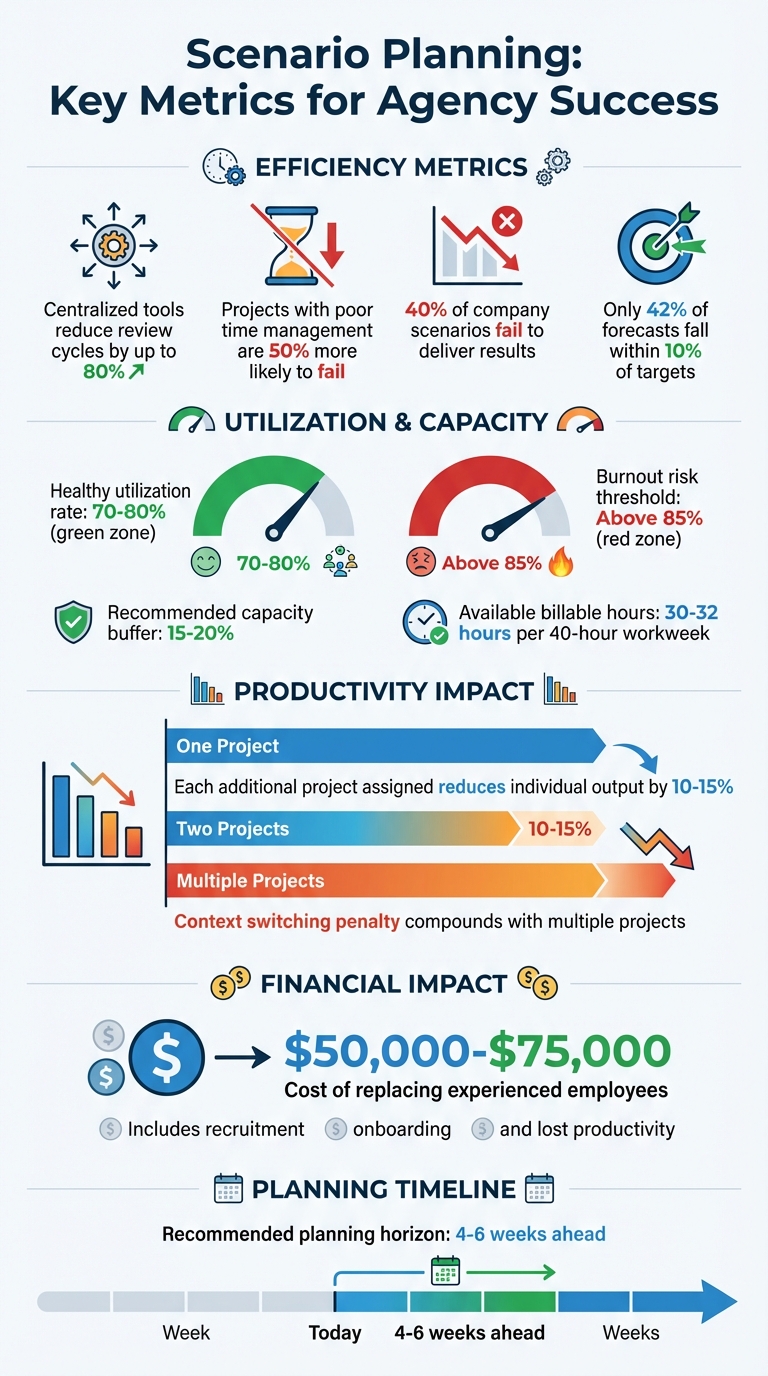
- Centralized tools can reduce review cycles by up to 80%.
- Healthy utilization rates are 70–80%; exceeding 85% risks burnout.
- Each additional project assigned can cut individual output by 10–15%.
- Maintain a 15–20% capacity buffer to handle unexpected challenges.
Steps for scenario planning include identifying uncertainties, building realistic scenarios, analyzing outcomes, setting contingency plans, and continuously reviewing them. With leadership support, cross-team collaboration, and real-time monitoring, agencies can better manage resources and deliver projects on time without overloading teams.
Scenario Planning Key Metrics and Best Practices for Agencies
What is Scenario Planning & How to Use it in Your Strategic Plan
sbb-itb-32f6eb2
5 Steps for Scenario Planning
Scenario planning helps agencies prepare for various possible futures by following a structured approach. This process focuses on identifying uncertainties, creating realistic scenarios, and crafting contingency plans to navigate challenges like shifting client communication or resource availability. Here's a breakdown of how to implement scenario planning in your agency.
Step 1: Identify Key Uncertainties and Drivers
Start by pinpointing factors that could disrupt your resource plans. These may include external influences like market trends or economic shifts and internal challenges such as workflow bottlenecks or inconsistent use of collaboration tools.
Client communication is a major factor. Examine where feedback gets delayed or lost, and identify patterns like vague comments or repeated follow-ups. These insights will help you focus on the uncertainties that matter most.
Engage team members across roles - account managers, creative leads, and project coordinators - to uncover conflicting priorities early. Using centralized feedback tools can streamline this process by enabling simultaneous input rather than sequential rounds. Tools that require minimal onboarding or logins can also reduce the risk of low participation.
Organize unstructured feedback into clear, actionable tasks. This helps you track pending items, uncover blockers, and see where delays are occurring. Align these findings with your resource allocation to understand the areas most affected by uncertainties.
Once you've identified key uncertainties, you can move on to creating scenarios.
Step 2: Develop Plausible Scenarios
Limit your scenarios to 3–4 realistic possibilities based on the uncertainties you identified. For example:
- Scenario A: Maintain current team capacity with standard hours and costs.
- Scenario B: Hire contractors to support an overburdened team.
- Scenario C: Use senior staff at higher rates to meet deadlines.
When crafting scenarios, consider capacity modeling. On average, agency employees have 30–32 billable hours in a 40-hour workweek. Subtract time spent on meetings, admin work, and PTO to get a realistic view of team output.
Evaluate strategies like a "Lag strategy" (waiting for confirmed demand before hiring), a "Lead strategy" (hiring ahead of anticipated growth), or a "Match strategy" (adjusting incrementally based on pipeline activity). Each approach comes with its own risks and benefits, depending on your agency's financial situation and growth plans.
"Finding the balance between giving people space to be creative and having the data to manage effectively is the hardest thing I've done. It's a mix of art and science." - Beth Trejo, CEO, Chatterkick
Once scenarios are built, compare their outcomes and implications.
Step 3: Analyze and Compare Scenarios
Use a planning matrix to evaluate each scenario's projected revenue, profit margins, utilization rates, and hiring needs. This analysis will reveal which options are feasible and which carry too much risk.
Keep an eye on utilization rates. Healthy agencies aim for 70% to 80% utilization to allow for scope changes, sick days, and unexpected client demands. Sustained rates above 85% can lead to burnout and declining work quality. If a scenario pushes utilization too high, it's likely unsustainable.
Adjust work hours based on deal probabilities. For instance, if a 200-hour project has an 80% chance of closing, plan for 160 hours instead. This prevents overcommitting resources to deals that might not materialize.
Also, account for the impact of context switching. Each additional project assigned to a team member reduces their effective output by 10% to 15%. Factor this into your analysis to avoid spreading resources too thin.
After comparing scenarios, it's time to define contingency plans.
Step 4: Define Contingency Plans and Triggers
Create backup plans for each scenario and establish clear triggers to activate them. Triggers should be specific and measurable, such as a 10% budget overrun, a key staff departure, or a 20% drop in lead volume.
Differentiate between "no-regret moves" (actions that are beneficial in all scenarios, like standardizing processes) and "big bets" (strategic actions tied to specific high-probability scenarios, like hiring a senior specialist before demand is confirmed). Implement no-regret moves immediately, while monitoring conditions before committing to big bets.
Set up a weekly review process to monitor triggers and take corrective action as needed. Look 2–4 weeks ahead to identify potential conflicts before they escalate. Assign ownership for risks and contingency responses to ensure accountability.
Maintain a 15–20% capacity buffer to handle unexpected challenges. Identify contractors or fractional talent in advance so they can step in quickly if needed. This preparation ensures you're ready to act when scenarios change rapidly.
"Designating trigger points and signposts to highlight changes." - Bain & Company
With contingency plans in place, focus on continuous review.
Step 5: Review and Update Scenarios
Regularly revisit and refine your scenarios as new data becomes available. Compare your projections to actual outcomes to identify which scenarios are taking shape and where assumptions fell short.
Incorporate new insights, such as shifts in client feedback patterns or pipeline activity. For example, if centralized tools are reducing review cycles by up to 80%, adjust your scenarios to account for shorter timelines and increased capacity.
Ensure transparency by maintaining a "single source of truth" for project status and utilization data. This allows stakeholders to see triggers in real time and make quick decisions when conditions shift.
Leverage historical data to improve future planning. Track which uncertainties caused disruptions, which contingency plans worked, and how effective your triggers were. Over time, this feedback loop will make your scenario planning more precise and reliable.
Best Practices for Scenario Planning in Agencies
Scenario planning delivers the best results when agencies stick to strategies that bring teams, leadership, and tools together under a shared vision. Research highlights that 40% of scenarios created by companies fail to deliver, often because they focus on unlikely events rather than addressing critical uncertainties. To avoid this pitfall, agencies need to adopt practices that keep their planning efforts realistic and responsive. These strategies help align leadership, encourage adaptability, foster collaboration, enable timely responses, and integrate essential tools.
Get Senior Leadership Support
For scenario planning to have a real impact, it needs the backing of senior leaders like the CEO or CFO. Their involvement ensures that planning results are taken seriously and influence real decisions. Without this support, scenario planning risks becoming a theoretical exercise that doesn’t affect resource allocation or hiring strategies. Leadership involvement brings accountability and helps align planning with top priorities.
It’s crucial to balance high-level goals with the realities on the ground. Start by identifying board-level objectives and validate them using a "Base Case" built on real data, such as billable hours and utilization rates. This approach keeps scenarios grounded in operational capacity and ensures leadership decisions are based on reliable metrics.
Build a Learning and Adaptive Culture
Agencies that view scenario planning as a learning tool, rather than just a forecasting exercise, are better equipped to adapt when conditions shift. After each planning cycle, review what worked and what didn’t. Identify which uncertainties caused disruptions, which contingency plans proved effective, and how well your triggers functioned. This feedback loop sharpens future planning and aligns it more closely with actual outcomes.
Encourage creative problem-solving by avoiding groupthink. The Adobe Experience Cloud Team emphasizes:
"Scenario planning thrives on diverse perspectives. It encourages participants to think independently and bring unique insights to the table, avoid groupthink, and promote innovative problem-solving".
By fostering independent thinking, agencies can challenge assumptions and uncover risks that might otherwise go unnoticed.
Collaborate Across Teams and Functions
Cross-functional collaboration is essential for effective scenario planning. Bring together representatives from finance, marketing, operations, sales, and external affairs to ensure a variety of perspectives are considered. This approach not only reduces blind spots but also helps identify potential conflicts early, before they disrupt projects or strain resources. Corporate FP&A teams can play a key role here, acting as a bridge between divisions and leadership to ensure feedback reaches decision-makers.
Use structured frameworks like PESTLE (Political, Economic, Social, Technological, Legal, Environmental) during brainstorming sessions to systematically identify external risks. Stakeholder interviews can help define project goals and align the scope with client expectations. Establish a regular communication schedule - such as weekly or bi-weekly FP&A calls - to track progress and provide centralized support.
Research indicates that less than half (42%) of forecasts fall within 10% of their targets, while about 10% miss by more than 25%. Tapping into insights from teams on the front lines can improve accuracy and lead to better planning outcomes.
Monitor and Respond to Triggers
Ongoing monitoring helps agencies catch early warning signs before problems escalate. Use tools like capacity heatmaps to identify overbooking in real time. Set up automated alerts for key thresholds, such as when utilization rates exceed 80% or budget overruns reach 10%.
Stay alert for major economic shifts or unexpected events - like significant interest rate hikes - that may require a new planning cycle. Regularly review triggers and compare forecasted scenarios with real-time data to make timely adjustments to scope or staffing.
Connect Scenario Planning with Agency Tools
To streamline execution, integrate scenario planning with the tools your agency already uses. Data is often scattered across systems for time tracking, task management, resource allocation, and invoicing. Bringing these tools together creates a single source of truth, making decision-making more efficient. Real-time visibility allows leaders to see how different scenarios will impact utilization and profit margins before finalizing decisions.
Replace spreadsheets with integrated platforms that can handle complex projections. These platforms link resource planning with budgets and live project data, minimizing manual errors and providing automated alerts when thresholds are exceeded.
Leveraging historical data from time-tracking and project management tools ensures scenario assumptions - like task duration or costs - are grounded in actual performance rather than guesses. Automated utilization tracking also helps prevent planning from overburdening teams. Additionally, skill indexing speeds up talent matching during the planning process.
Key Insights and Measurable Outcomes
Scenario planning isn't just a theoretical exercise - it delivers real operational and financial advantages. Projects with poor time management are 50% more likely to fail. By using diversified scenarios instead of guesswork, agencies can explore staffing options - like comparing the costs and benefits of hiring contractors versus using senior in-house staff - before committing to a project proposal.
The operational improvements directly connect to financial benefits. Burnout among experienced employees can cost between $50,000 and $75,000 when factoring in recruitment, onboarding, and lost productivity. To avoid this, agencies can aim for utilization rates between 70% and 80%. Pushing past 85% often leads to higher turnover, more sick days, and a decline in work quality. Keeping utilization in a manageable range also allows agencies to handle unexpected client demands without blowing their budgets.
Another critical insight: each additional project a team member takes on reduces their output by 10–15%. Planning 4–6 weeks ahead and aligning team members' skills with their tasks can help maintain profitability and ensure projects stay on schedule. Orion Jensen, CEO of Clear Launch, highlights the importance of structured planning:
"Being able to take all that variability and put it into a consistent process allows us to actually manage it with transparency".
Having reliable capacity data doesn’t just improve internal workflows - it also builds client trust. Patric Osburn, Service Operations Manager at Quintica, shared how this data empowers decision-making:
"As a Project Manager, it definitely gave me more confidence to make decisions because I've got the data to do it now. If I need to move resources around, add a change request, pull things back, I have the visibility to do that".
Clear timelines, streamlined client reviews, and well-communicated trade-offs lead to happier, more loyal clients .
Proactive planning also reveals untapped capacity. Brendon Nicholas, Co-Founder and Technical Director at dotdev, explained:
"If we know we're spending 30% of our time on internal projects, then we know we've got the capacity to take on more work".
This level of visibility transforms scenario planning into a practical, growth-driving tool that not only enhances operational efficiency but also safeguards the well-being of the team.
Conclusion
Scenario planning replaces guesswork with clarity, enabling agencies to prepare for various future scenarios and adapt to changing project demands instead of simply reacting during crises.
This approach has a direct impact on both efficiency and financial outcomes. Poor time management can increase the risk of project failure by 50%, and replacing experienced employees can cost between $50,000 and $75,000. By adopting proven strategies - such as securing leadership support, fostering collaboration across teams, and actively monitoring key triggers - agencies can protect both profitability and team well-being.
It also strengthens stakeholder trust and ensures project delivery aligns with client expectations.
Over time, integrating scenario planning helps maintain profit margins, supports scaling during periods of increased demand, and reduces the risk of burnout caused by over-allocation. Planning 4–6 weeks ahead while maintaining 70–80% team utilization provides a buffer to manage unexpected client needs.
Ultimately, scenario planning shifts uncertainty from being a challenge to an opportunity. It equips agencies with the visibility and confidence to make informed decisions, safeguard their teams, and consistently deliver top-notch service - even in unpredictable markets. This proactive approach ensures your agency remains competitive and resilient in ever-changing conditions.
FAQs
What data do we need to start scenario planning?
To kick off scenario planning, start by collecting detailed information about your current resources. This includes team capacity, skill sets, available time, and financial data. You'll also want to factor in project timelines and external influences, such as market trends or operational shifts.
Incorporate insights from past performance, ongoing project updates, and future projections to pinpoint areas of uncertainty. By analyzing "what-if" scenarios using this data, you can simulate different outcomes, evaluate potential risks, and develop strategies to handle disruptions more effectively.
How do we set realistic utilization targets without burnout?
To create achievable utilization targets and prevent burnout, it's important to align workloads with your team's capacity. Start by evaluating the available capacity, factoring in both billable and non-billable hours, and ensure key team members aren't overwhelmed. Incorporate buffer time into your planning to handle unexpected challenges effectively. Keep a close eye on workloads, make adjustments to targets when necessary, and encourage open communication. This approach helps balance productivity with employee well-being, promoting consistent performance without unnecessary stress.
What triggers should prompt changes in staffing or scope?
Significant events or disruptions - like economic changes, new product launches, or unexpected challenges - can require updates to staffing or project scope. Adjustments become crucial when current strategies no longer align with reality or when initial assumptions no longer apply.