5 Steps To Attract High-Value Clients Online
Want better clients who value results over price? High-value clients are businesses with over $1M in annual revenue, clear goals, and a focus on ROI. They see you as a partner, not just a vendor. Attracting them means refining your strategy to stand out online.
Here’s the 5-step formula:
- Define Your Ideal Client: Focus on the top 20% of clients driving 80% of your profit. Use tools like RFM analysis to identify patterns and create detailed buyer personas.
- Optimize Your Website: Highlight measurable results, simplify feedback processes, and use SEO to target niche-specific keywords.
- Share Expertise Through Content: Publish case studies, educational content, and interactive tools like ROI calculators to build trust.
- Leverage Social Media and Ads: Use LinkedIn and targeted ads to connect with decision-makers. Share video testimonials for credibility.
- Use Testimonials and Feedback: Showcase detailed success stories with data and simplify how clients provide feedback to boost trust.
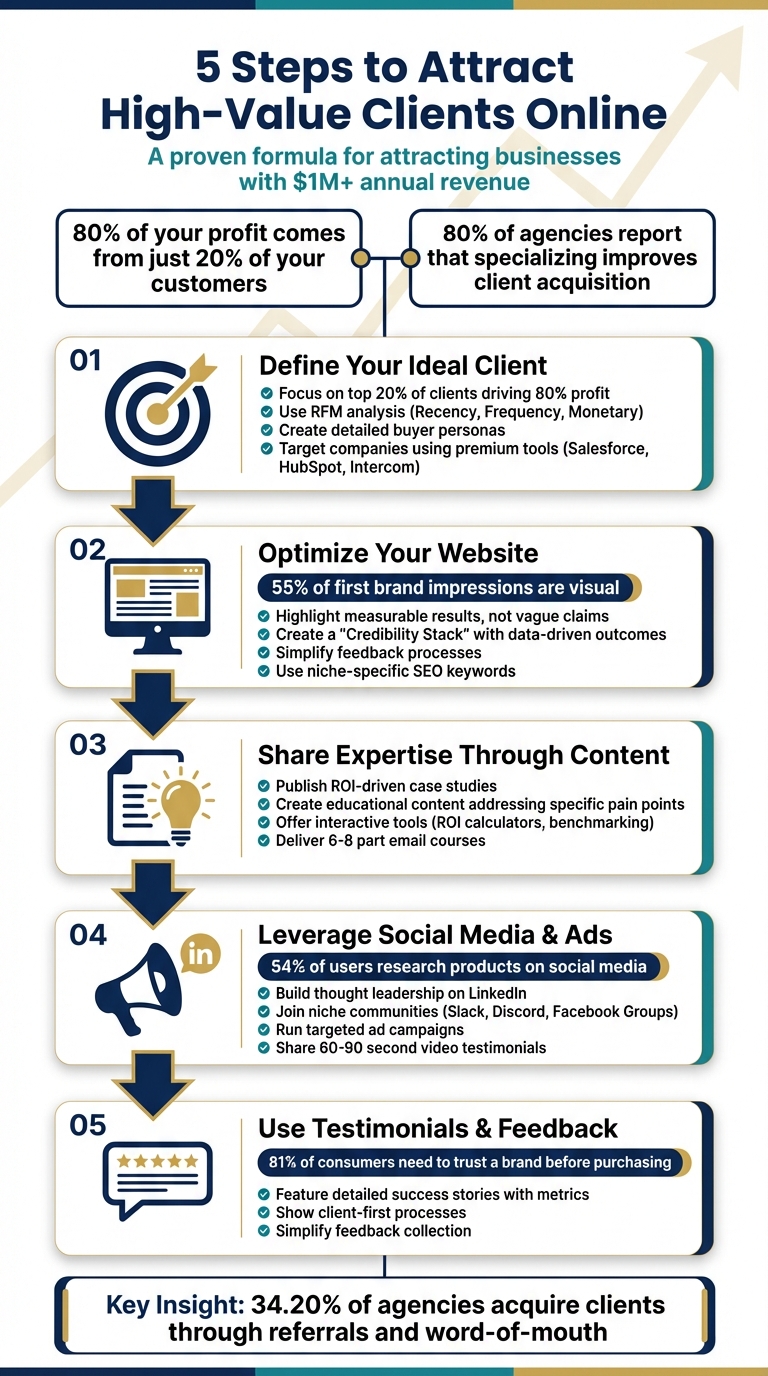
5-Step Process to Attract High-Value Clients Online
How To Attract Higher Paying Clients Online
sbb-itb-32f6eb2
Step 1: Identify Your Target High-Value Client
If you want to attract premium clients, you need to start by clearly defining who they are. The 80/20 rule plays a big role here - about 80% of your profit typically comes from just 20% of your customers. That means your focus should be on identifying and catering to this profitable 20%. By honing in on these clients, you can fine-tune your approach to meet the needs of the ones who truly drive your business forward.
Identify Key Characteristics
High-value clients tend to stand out in a few key ways. Unlike budget-conscious buyers, these clients have solid financial stability and see your services as an investment rather than a cost. They are focused on results - things like generating leads, increasing sales, or growing market share - and they value measurable outcomes over chasing the lowest price. They also tend to communicate professionally, provide clear project scopes, and view you as a strategic partner, not just a vendor.
Look for companies that use premium tools like Salesforce, HubSpot, or Intercom - a good indicator that they have the budget to invest in your services. Emerging industries like Green Tech, Telemedicine, and AI-driven businesses are also worth targeting, as they often have large budgets and are open to innovation. In fact, 80% of agencies report that specializing in a specific industry vertical improves their ability to attract high-value clients.
To pinpoint these clients within your current customer base, try conducting an RFM (Recency, Frequency, Monetary) analysis. This method helps you evaluate clients based on how recently they purchased, how often they buy, and how much they spend. It’s a great way to identify patterns among your most profitable clients. As Neil Hoyne, Google’s Chief Strategist for Data and Measurement, puts it:
"You start getting this picture of what makes these great customers so special".
With these insights, you’ll be better equipped to refine your messaging and strategy in the next step.
Create a Detailed Buyer Persona
Once you’ve nailed down what makes your high-value clients tick, it’s time to turn those insights into a detailed buyer persona. This should include their business goals, pain points, decision-making processes, and preferred communication channels. It’s also essential to identify the key decision-makers - whether it’s the CTO, founder, or marketing director - and understand the unique challenges they face.
To stand out, narrow your focus even further by targeting specific sub-sectors. For instance, instead of offering generic "IT services", you could position yourself as an expert in "AI-powered automation for e-commerce". This kind of specialization not only helps you charge premium rates but also makes you the go-to solution for a specific problem.
Take it a step further by surveying your top-tier clients. Ask them what made them choose your brand and use their feedback to refine your persona. Pay close attention to the exact words and phrases they use to describe their challenges. Incorporating these into your messaging ensures it will resonate with your target audience right away.
Step 2: Optimize Your Website for Trust and Conversions
Your website needs to answer one critical question right away: Why should someone choose you? Avoid vague phrases like "quality service" or "customer satisfaction." Instead, focus on specific, measurable results that address the challenges your ideal clients face. Back up your claims with real numbers and outcomes.
Show Results and Demonstrate Expertise
High-value clients aren't interested in fluff - they want to see results. Turn your case studies into compelling ROI stories with tangible data.
Take United Medical Education, for example. In February 2026, CEO Brian Clark created a custom tracking dashboard for an Idaho hospital administrator scrambling to meet an audit deadline for 140 employees. By automating roster entries and test scores, the system cut the administrator's workload by 60% and secured a $38,000 contract. That success even led to three additional system referrals.
To build trust, MarketingSherpa suggests creating a "Credibility Stack" on your website. This means combining:
- Clear, data-driven outcomes
- Context that compares your results to industry standards
- Transparency about how you achieve results
- Independent validation, such as certifications or media coverage
Another great example is Opus Virtual Offices. In February 2026, web content writer Elliot Sterling analyzed chat logs and support tickets to uncover common client concerns like "feeling isolated" or "compliance challenges." With this insight, they revamped their website copy to include a targeted offer: "Secure a Fortune 500 address to sort your mail and answer calls while you focus on closing deals - all for $99 per month." The result? A 65% jump in inquiries and an increase in average booking value from $120 to $285.
Don’t be afraid to include "non-fit" statements on your site. These are sections that clearly outline who your services are not for. As Daniel Burstein, Senior Director at MarketingSherpa, points out:
"Sometimes the most persuasive credibility element is a sentence like, 'We're not the right fit if…' because it reduces suspicion and increases trust".
While showcasing results builds trust, simplifying how clients provide feedback strengthens your reputation even further.
Make Client Feedback Easy
If your feedback process seems overly complicated - think multiple logins or lengthy training sessions - prospects may assume that working with you will be just as frustrating. Instead, highlight how effortless it is to collaborate with you.
Tools like Boast can help. They allow clients to give feedback with a simple click, no account creation or training needed. For example, clients can comment directly on designs, streamlining communication. Behind the scenes, your team can still use advanced features like version control and task management. This approach reduces friction for clients while keeping your operations efficient, resulting in stronger relationships and better profitability.
Boost SEO and Fine-Tune Landing Pages
Even with great results and smooth feedback processes, your website must still be easy to find. That’s where SEO comes in. Focus on high-intent, niche-specific keywords like "best web design agency for fintech startups" to attract the right leads.
For instance, Grid Dynamics demonstrated the power of SEO in February 2026. Led by Chris Rodgers, CEO of CSP Agency, the team used targeted SEO analysis and persona-based keywords to achieve a 73% increase in organic traffic. This effort drove 4,221 lead submissions, with 20% qualifying as viable leads, delivering a staggering 5,342% ROI.
Dedicated landing pages are another key tool. These pages should address specific problems your ideal clients face. To get it right, review customer support tickets, chat logs, and sales call recordings to identify the exact language your prospects use when describing their challenges. Elliot Sterling offers this advice:
"Service providers should scan their homepage for one executive problem to solve, ask five prospects for feedback, and listen to calls for two weeks. Talk about the problems your prospects are talking about and make it easy for them to take action".
Use that language in your headers and copy, and include clear calls-to-action - like paid diagnostics, benchmark reports, or tailored workshops. These options let prospects test your expertise with minimal risk, making it easier for them to commit.
Step 3: Create Content That Demonstrates Your Expertise
Once you've established a trustworthy website and shown clear results, your next step is to create content that directly highlights your expertise. The goal? Build trust by addressing the real challenges your ideal clients face with actionable insights tailored to their needs.
Publish Educational Content
Focus on creating content that speaks to prospects actively searching for solutions. This could include comparison articles like "Agency vs. In-House", alternatives pages, or niche-specific "Best for" guides. For example, instead of a generic headline, try something highly specific like "Why Your Google Ads ROAS Dropped After $50,000/Month Spend".
Videos are powerful trust builders. Short, personalized videos - like a quick 5-minute audit of a prospect's website or marketing funnel - can showcase your expertise immediately. This approach builds what experts call "parasocial trust", helping prospects feel connected to you even before your first meeting.
For case studies, shift the focus to ROI-driven stories with clear, relatable metrics. As Faye Thomassen, Head of Marketing at Mediahawk, advises:
"Incorporate specific metrics that resonate with your audience's pain points and goals, such as percentage increases in lead generation, reductions in customer acquisition cost (CAC), improved conversion rates, or measurable revenue growth".
To complement these strategies, consider adding interactive tools that engage and qualify your leads.
Provide Lead Magnets
Educational content builds trust, but interactive lead magnets take it a step further by actively engaging prospects. Move beyond static PDFs and offer dynamic tools like ROI calculators, competitor benchmarking tools, or self-assessment audits. These give prospects instant, customized insights while providing you with valuable data to qualify leads.
Another effective approach is a 6-to-8-part email course delivered weekly. This format allows you to stay in touch while delivering real value. Once the course ends, keep the connection alive with a monthly newsletter focused on actionable advice - not sales pitches. You can even repurpose email course content into guest posts or social media updates to extend its reach.
For high-value clients, industry-specific benchmarking reports can be especially compelling. These reports show prospects how they stack up against competitors, which is particularly effective if you're targeting a specific industry. Since 80% of agencies report that specializing in a particular vertical improves client acquisition, your lead magnets should reflect this level of focus.
Step 4: Use Social Media and Ads to Reach Decision-Makers
Building a strong digital presence isn’t just about creating great content - it’s about making sure that content reaches the right people. To connect with high-value clients, you need to meet them where they’re already active. For B2B decision-makers, LinkedIn is your go-to platform. Meanwhile, niche communities on platforms like Slack, Discord, and Facebook Groups offer smaller, high-trust spaces where relationships can grow naturally. Once you’ve established your presence, it’s time to position yourself as a trusted voice in your field.
Establish Thought Leadership
Consistency is key on LinkedIn. Regularly share insights from your work, post case studies with specific results, and weigh in on industry trends. This not only positions you as an expert but also builds trust with potential clients. Considering that 54% of social media users research products on these platforms, maintaining an active presence can help establish credibility even before you make direct contact. Focus on providing examples and actionable advice that decision-makers can relate to.
Beyond LinkedIn, dive into private Facebook groups or niche Slack channels. Engage by answering questions, sharing your expertise, and offering real-world solutions. These smaller, focused communities can be excellent for building meaningful connections.
Run Targeted Ad Campaigns
After building your organic presence, amplify your reach with targeted ad campaigns. Platforms like Google Ads and LinkedIn are perfect for getting in front of decision-makers who are actively searching for solutions. Tools like LinkedIn Sales Navigator can help you identify prospects - such as companies that recently hit revenue milestones like $1 million. Tailor your ads to address their specific challenges, showcasing clear results like improved lead generation, lower customer acquisition costs (CAC), or increased revenue.
Specializing in a specific industry or vertical can set you apart. In fact, 80% of agencies report that focusing on a niche improves client acquisition. So, instead of a generic message like "We help businesses grow", try something more specific: "AI-powered automation for e-commerce brands scaling past $5M." This kind of hyper-focused messaging positions you as the go-to solution for their unique needs. To further build trust, include client video testimonials in your ads.
Share Video Testimonials
Video testimonials are a fast and effective way to establish trust. Post short clips (60 to 90 seconds) on LinkedIn, where your clients share their challenges, the solutions you provided, and the measurable outcomes they achieved. Since 81% of consumers need to trust a brand before making a purchase, these videos can make a big impact. They show - not just tell - what it’s like to work with you, giving potential clients a clear picture of the value you bring.
Step 5: Build Trust with Testimonials and Client Feedback
To justify premium pricing, you need to show high-value clients that you deliver results. Testimonials and client feedback are your strongest tools for this. Research shows that 81% of consumers need to trust a brand before making a purchase.
But here's the catch: generic praise like "Great work!" won't cut it. Instead, focus on detailed transformations with measurable results. As Faye Thomassen, Head of Marketing at Mediahawk, advises:
"Incorporate specific metrics that resonate with your audience's pain points and goals, such as percentage increases in lead generation, reductions in customer acquisition cost (CAC), or measurable revenue growth".
Feature Client Success Stories
Showcasing success stories goes a long way in reinforcing your expertise. Highlight your top case studies on your homepage and service pages. Each story should outline the challenge your client faced, the strategy you implemented, and the results you achieved. Pair these narratives with data to make them even more compelling. As Lawrence Cavill Grant, Head of Commercial at Mediahawk, explains:
"Data is only as valuable as the story it tells. Clients don't just want numbers – they want clear, actionable insights that show how your efforts are driving results".
Visual aids like before-and-after infographics or data flows can make complex results easier to digest. Considering that 55% of first brand impressions are visual, professional presentation is critical. Plus, with 34.20% of agencies acquiring new clients through referrals and word-of-mouth, these success stories can spark conversations when satisfied clients share their experiences.
Show Your Client-First Process
Every interaction with your clients should reflect a smooth, client-first experience. As Janelle from Ellanyze, a web designer, points out:
"When any part of your process is a bit clunky or your clients are emailing you because they're not sure what comes next in the process, they'll be far less likely to recommend you to their friends".
This is where tools like Boast can make a difference. Boast simplifies feedback collection by allowing clients to leave comments directly through a link - no logins or training needed. While your team benefits from features like Kanban boards and task management, clients only see a sleek, user-friendly interface. This streamlined process shows your commitment to professionalism and ease, which high-paying clients expect. With plans starting at $9.95/month and unlimited external collaborators, you can maintain this polished experience without worrying about extra costs eating into your profits.
When paired with a strong online presence and targeted outreach, these testimonials and success stories will solidify your strategy for attracting premium clients.
Conclusion
Drawing in high-value clients isn't about luck; it’s about following a structured plan that positions you as a trusted partner. The process involves five interconnected steps: identifying your ideal client, creating a website that inspires trust, producing content that showcases your expertise, using targeted channels to reach decision-makers, and leveraging strong testimonials and case studies.
These strategies are supported by industry data that underscores the value of focusing on a specific niche and presenting yourself professionally. For instance, 80% of agencies report that specialization improves client acquisition, while 55% of brand perceptions are influenced by visual elements on your website. This approach not only helps you craft content that resonates deeply with your audience but also allows you to justify premium pricing while building instant credibility.
A smooth feedback system ties all of this together. Tools like Boast make it easy for clients to share their thoughts - no logins or training needed, just a simple click. This client-friendly experience, combined with competitive pricing and support for unlimited collaborators, lets you provide top-tier service while keeping your margins intact. Over time, this approach builds trust and encourages referrals, which remain a crucial source of client acquisition, accounting for 34.20% of how agencies are discovered. As Brian Clark, CEO of United Medical Education, aptly states:
"High-value customers show up at the right time because you have solved a particular problem for a customer at the precise moment a customer has been placed in a box".
FAQs
How can I identify which clients are truly high-value?
High-value clients play a critical role in driving your business's success. These are the customers who show loyalty, make frequent purchases, or maintain long-term relationships with your brand. To pinpoint them, leverage metrics like customer lifetime value, purchase frequency, and average order value. Additionally, reviewing the profitability of past projects can provide valuable insights. Prioritize clients who not only contribute financially but also align with your business goals and the unique value your brand offers. This alignment ensures a stronger and more meaningful partnership.
What should I change on my website to justify premium pricing?
To support premium pricing, focus on highlighting your distinct value, specialized expertise, and proven results. Share case studies that clearly outline ROI, emphasize exclusive tools or processes that set you apart, and create content that showcases your industry leadership. By weaving specific metrics and outcomes into your narrative, you can build trust and demonstrate your ability to deliver exceptional results, making your services feel worth the investment.
How can I get faster, clearer client feedback without extra logins?
Using a client-first visual feedback tool like BoastImage makes gathering feedback a breeze. Clients can leave comments directly on web pages, images, or PDFs through a simple shared link - no need for accounts, logins, or lengthy onboarding. This approach removes obstacles, encourages faster responses, and ensures clearer communication, making the entire process easier for everyone.