Top Strategies To Prevent Agency Burnout
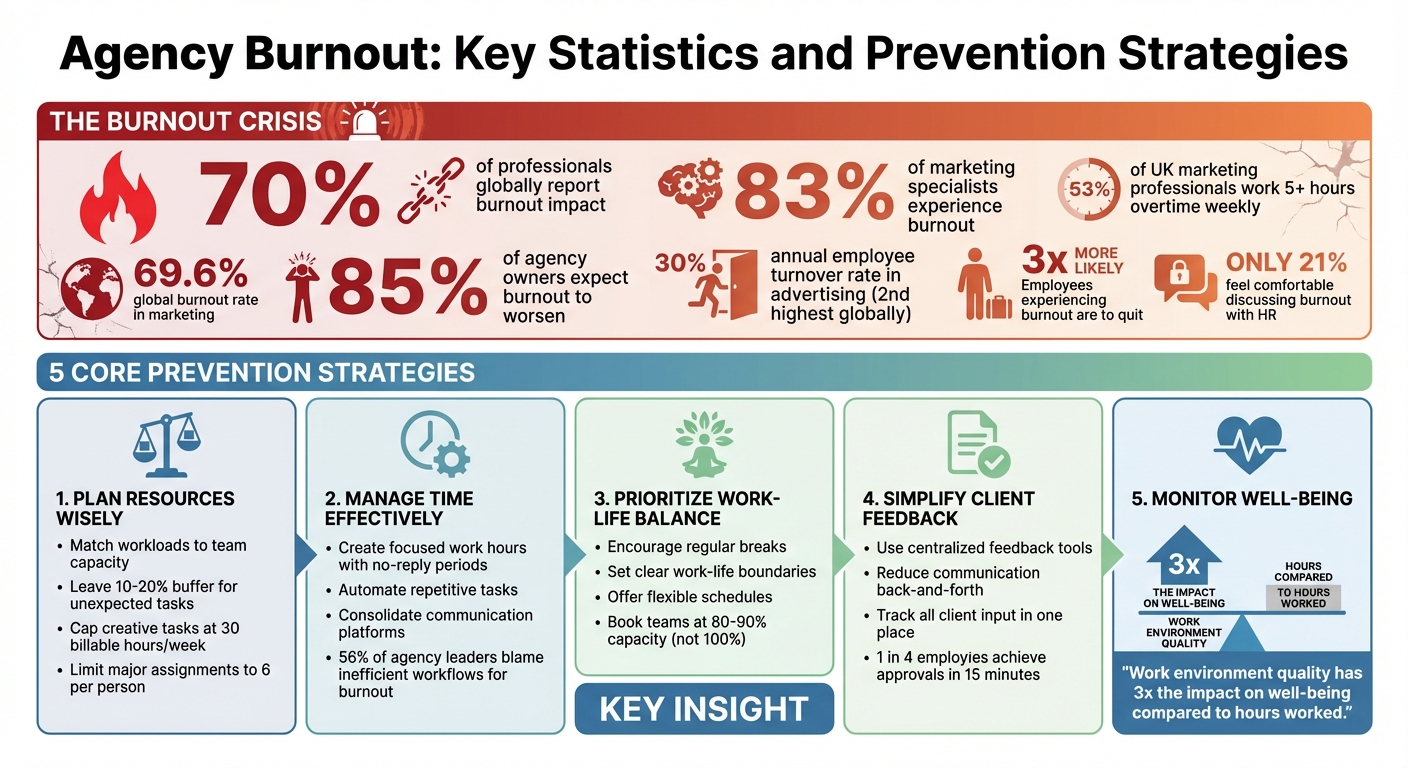
Overwhelmed teams. Missed deadlines. Constant stress. Burnout is a growing problem in creative and marketing agencies, with 70% of professionals globally - and 83% of marketing specialists - reporting its impact. But burnout isn’t inevitable. The solution lies in managing workloads, setting boundaries, and improving processes.
Here’s how agencies can reduce burnout:
- Plan Resources Wisely: Align workloads with team capacity, set realistic deadlines, and use tools to track availability.
- Manage Time Effectively: Create focused work hours, automate repetitive tasks, and streamline communication.
- Prioritize Work-Life Balance: Encourage breaks, set clear boundaries, and offer flexible schedules.
- Simplify Client Feedback: Use centralized tools to organize and track input, reducing inefficiency.
- Monitor Well-Being: Use dashboards and regular check-ins to spot and address stress early.
Burnout doesn’t just hurt employees - it impacts creativity, client relationships, and overall agency performance. By addressing its root causes, agencies can create a healthier, more productive work environment.
Agency Burnout Statistics and Prevention Strategies
Building a Burnout-Proof Agency That Can Scale ft. Steve Guberman
sbb-itb-32f6eb2
Resource Planning to Prevent Overload
Poor resource planning is a surefire way to push your team toward burnout. Surveys show that 85% of agency owners expect burnout to worsen due to economic pressures, and the global burnout rate in marketing currently sits at a staggering 69.6%. Below are practical strategies to help balance workloads, set achievable goals, and allocate resources effectively.
Match Workloads to Team Capacity
The first step in preventing burnout is ensuring that the workload matches your team's actual capacity. Before assigning new tasks, take a close look at the current workload - both in terms of quantity and complexity. For instance, a brand designer tasked with six minor revisions has a very different workload compared to one handling two complete rebrands, even if the task count is the same.
It's also important to assign tasks based on skills. Misaligning work - like asking a UI designer to take on brand strategy - can slow progress and cause unnecessary stress. Set clear limits to avoid overloading your team, such as capping creative tasks at 30 billable hours per week or limiting major assignments to six per person.
Another common mistake is booking your team to full capacity. Always leave a 10–20% buffer for unexpected, high-priority tasks. As Ben Brigden, Content Marketing Manager at Teamwork.com, advises:
Keep a keen eye on team capacity to make sure no one is being over or under utilized.
Set Realistic Deadlines and Goals
Unrealistic deadlines don’t just stress your team - they also lead to rushed work and disappointed clients. Use historical data to set achievable deadlines. For example, if your last five website redesigns took an average of 120 hours, don’t promise to complete the next one in 80 just to win a project.
To prioritize effectively, consider using the Urgent-Important Matrix. A site crash or security breach? Urgent and important - drop everything. A minor tweak to a campaign from last month? Not urgent or important - schedule it for later or delegate it. With 53% of UK marketing professionals already clocking at least five hours of overtime weekly, adding aggressive deadlines only makes burnout more likely. Align deadlines with your team’s capacity to keep things manageable.
Use Tools for Clear Resource Allocation
Visual dashboards can be game-changers for resource management. They provide a clear view of each team member’s active tasks, total weekly hours, and skill availability. This isn’t about listing names and projects - it’s about understanding who’s maxed out and who has room to take on more work.
Integrate your client intake process with capacity tracking. Before committing to new projects, verify that your team has the bandwidth to handle them. Spending just 5–10 minutes each week reviewing these dashboards can help you catch potential overloads early and redistribute tasks as needed.
For added flexibility, cross-train your team in overlapping skills. When one designer is swamped, another with similar expertise can step in to handle smaller tasks. This prevents bottlenecks and reduces the need for late-night scrambles. With streamlined resource planning, you can build a more resilient and balanced team.
Time Management and Structured Workflows
Good time management paired with structured workflows can make a huge difference in resource planning, helping teams stay creative without hitting burnout. When 56% of agency leaders blame inefficient workflows as a major cause of burnout, it’s clear that how you organize your day is just as important as what you accomplish. Poor time management doesn’t just delay projects - it creates ongoing stress that makes employees three times more likely to quit. Adjusting how your team manages time and organizes tasks can go a long way in reducing burnout.
Create Focused Work Hours
Creative work thrives in uninterrupted time blocks. One way to support this is by introducing "no-reply" periods where team members aren’t expected to respond to emails or messages after hours. Zach O'Rourke, Director at Social Directions Agency, leads by example:
From a team point of view, I would be pretty annoyed with people if they reply to clients after hours... I set a good example because they won't see me replying and I expect them to do the same.
Encouraging employees to turn off notifications and shut down their work devices at the end of the day helps combat the "always-on" culture that disrupts focus and recovery time. Automating repetitive tasks - like status updates or client onboarding emails - can also free up mental energy for more strategic work. For instance, Barclays introduced a "dynamic working" policy in 2015, and by 2017, 57% of their employees had adopted flexible schedules. This shift resulted in engagement scores 5% higher than those on traditional schedules. Establishing clear work hours not only protects downtime but also improves communication and keeps deadlines on track.
Improve Internal Communication
Once work hours are clearly defined, streamlined communication is essential to maintaining focus. Scattered updates across email, Slack, and WhatsApp create confusion and waste valuable time. Consolidating all updates, task assignments, and progress tracking into a single platform ensures your team can easily find what they need without digging through multiple channels. Providing 100% clarity on roles and responsibilities also prevents duplicated work and unnecessary frustration.
Avoid "tool fatigue" by reducing the number of platforms your team uses. When employees stop juggling multiple tools, they can concentrate on their tasks instead of managing the tools themselves. Use time-tracking tools not to micromanage but to help identify time-consuming tasks that could be streamlined or automated.
Track Deadlines and Milestones
Visual dashboards that display real-time project progress can help keep deadlines visible and manageable. Tools like boards, calendars, and Gantt charts give everyone a clear view of what’s due and when. Automating task dependencies ensures schedules adjust smoothly as priorities shift.
Incorporate milestones into your workflows that align with billing cycles. This approach avoids revenue leaks and invoicing disputes while giving your team clear goals to work toward. Start each week by reviewing dashboards to spot potential overloads and reassign tasks before they become overwhelming. Guy Hudson, Founder of Bespoke Marketing Plans, highlights the value of organized processes:
Time is everything for a small & growing agency. Spending lots of time on one task is not only has financial effects but can also burn out the agency owner mentally... Allowing for processes to be simple & effective allows for easier onboarding of staff members alongside a less stressful environment.
Work-Life Balance
While structured workflows can make work hours more productive, protecting personal time is just as important for maintaining long-term creativity and well-being. A staggering 83% of marketing and communication professionals report experiencing burnout in their roles. With the advertising industry facing a 30% annual employee turnover rate - the second highest of any sector globally - it's clear that prioritizing work-life boundaries isn't just a nice-to-have; it's essential for keeping teams engaged and productive.
Encourage Regular Breaks
Taking short breaks during the workday - like a quick 10-minute walk or some light stretching - can help ease mental stress and refocus energy when returning to tasks. These moments of rest aren’t indulgences; they’re fundamental to staying effective. Employees should also feel encouraged to fully use their vacation time to disconnect and recharge. Another helpful practice is building "buffer time" into schedules, where teams are booked to about 80–90% capacity. This cushion allows room for unexpected tasks without forcing overtime or cutting into planned downtime.
Set Clear Work-Life Boundaries
Creating both physical and digital boundaries is key to preventing work from creeping into personal time. For remote workers, having a dedicated workspace can help draw the line between job responsibilities and home life. Turning off work notifications and shutting down computers at a set time each day reinforces this separation. Some organizations even provide employees with work-only phones that can be switched off after hours, ensuring clients don’t intrude on personal time.
Leaders play a critical role here. When managers send emails or messages outside of regular hours, it can unintentionally set a precedent for constant availability. By modeling healthy boundaries themselves, leadership can encourage the entire team to follow suit. On top of these boundaries, flexible work arrangements give employees the freedom to structure their schedules in ways that better integrate work and life.
Offer Flexible Work Arrangements
Flexible work options - like remote work, adjustable hours, or mental health flex days - allow employees to align their schedules with their most productive periods, reducing the risk of burnout. Michelle van Blerck from Digital Freak sums it up perfectly:
"Hustle culture doesn't deliver anything except disengagement and burnout. When people feel valued and cared for, they naturally deliver their very best work."
Simplifying Client Feedback Processes
Cutting through the chaos of client feedback is essential to keeping teams energized and avoiding burnout.
When approval requests pile up or feedback comes from every direction - Slack, WhatsApp, email - it creates a perfect storm of inefficiency. Instead of focusing on creative work, teams spend hours hunting down scattered comments. This constant juggling not only wastes time but also drains energy, pulling attention away from meaningful tasks and increasing the risk of burnout.
The problem isn't just about convenience. When client priorities are unclear, it can feel like the goalposts are always moving. Sudarshan Somanathan, Head of Content at ClickUp, puts it plainly:
Catering to the ambiguous, ever-changing priorities of clients makes employees feel far away from touching the finishing line. The sense of work never getting done reduces morale and creates frustration, eventually resulting in employee burnout.
This challenge is especially tough for creative agencies, where subjective feedback and endless approval loops are often the norm.
Make Client Collaboration Easy
The real obstacle in feedback workflows isn't your team's efficiency - it’s getting clients to actively participate. When clients ignore feedback requests or send unclear responses, projects stall, and deadlines slip. The key is to make participation effortless for them. Tools like BoastImage simplify the process: clients can just click a link and leave comments directly on web pages, images, or PDFs. No accounts, logins, or training needed. Meanwhile, your team benefits from advanced features like version control, task management, and Kanban boards. This frictionless setup keeps projects on track and eliminates unnecessary delays.
Reduce Communication Back-and-Forth
Simplifying feedback cycles can prevent projects from dragging endlessly. When clients can provide clear, visual input in one centralized platform, there's no need for endless follow-up emails like “Which version are you referring to?” or “Which section do you mean?” Automating status updates ensures clients know exactly when their input is required, eliminating the need for constant reminders. Some agencies even report client approvals happening in as little as 15 minutes when using these tools.
Organize and Track Client Feedback
Centralizing feedback ensures nothing gets lost in the shuffle. When client comments are automatically turned into actionable tasks with assigned owners, there’s no confusion about who’s responsible for what. Guy Hudson, Founder of Bespoke Marketing Plans, highlights why streamlined processes matter:
Allowing for processes to be simple & effective allows for easier onboarding of staff members alongside a less stressful environment.
Another helpful strategy? Build buffer time into your schedules. Booking teams at 80–90% capacity instead of maxing them out leaves room for unexpected revisions without forcing overtime. This approach keeps workloads manageable and morale high.
Monitoring Well-Being and Early Intervention
To keep burnout at bay, early monitoring of well-being paired with thoughtful resource planning and structured workflows is essential. Burnout is a widespread issue - research reveals that one in four employees frequently faces it, with the marketing industry experiencing a staggering 69.6% burnout rate globally. For agencies, having systems to identify burnout warning signs before they become serious is non-negotiable.
Track Workload and Stress Indicators
Real-time dashboards that show task distribution are invaluable for spotting team members who might be nearing their limits. Employees working at 80–100% capacity are particularly vulnerable. Physical signs like constant fatigue, recurring headaches, and sleep problems, along with behavioral shifts such as irritability or withdrawal, are key indicators. Anonymous pulse surveys can also be a game-changer, offering a safe space for employees to voice concerns. This is especially important given that only 21% of workers feel comfortable discussing burnout with HR. Jennifer Moss, author of The Burnout Epidemic, highlights the broader perspective:
We measure burnout via exhaustion, engagement and cynicism - the idea that nothing will ever change.
Using these data points, agencies can take proactive steps, such as scheduling regular check-ins, to address concerns early.
Conduct Regular Check-Ins
Frequent one-on-one check-ins focused on well-being can make a big difference. Instead of generic questions, try something actionable like, "What’s one thing I could do differently to make your work easier?" This approach often yields more practical insights. These meetings can be seamlessly integrated into existing workflows or even done asynchronously through weekly "wins and lessons" updates. For instance, Barclays' Dynamic Working policy led to a roughly 5% improvement in engagement scores for 57% of its workforce.
Redistribute Tasks When Necessary
If signs of struggle appear, act quickly. Use workload dashboards to identify team members who can take on additional responsibilities. Reassign tasks thoughtfully, considering skills, seniority, and roles - not just who happens to be available. Setting clear limits, like capping creative work at 45 hours per week or limiting major tasks to six, can help prevent overload. Automating repetitive tasks is another way to free up mental bandwidth for creative endeavors. As Guy Hudson, Founder of Bespoke Marketing Plans, wisely notes:
Time is everything for a small & growing agency. Spending lots of time on one task not only has financial effects but can also burn out the agency owner mentally.
Conclusion
Preventing agency burnout isn't about quick fixes or motivational pep talks - it’s about addressing the root causes with thoughtful, structured strategies. The rising burnout rates highlight the need for a well-rounded approach to ensure long-term agency success and employee well-being.
Moving away from the reactive grind of "hustle culture" involves practical tools like visual dashboards for tracking real-time capacity and setting clear workload limits. As Michelle van Blerck of Digital Freak aptly states:
Hustle culture doesn't deliver anything except disengagement and burnout. When people feel valued and cared for, they naturally deliver their very best work.
By weaving together resource planning, effective time management, balanced workloads, and client feedback systems, agencies can create a strong foundation to combat burnout. This shift encourages a forward-thinking culture that prioritizes care and efficiency over constant crisis management.
Leadership also plays a pivotal role in ensuring these strategies take hold. When leaders set the tone by practicing work-life balance - stepping away after hours and taking necessary breaks - they empower their teams to follow suit. Adding clarity around roles, goals, and expectations further fosters an environment where employees feel comfortable addressing concerns before burnout becomes unmanageable.
Interestingly, the quality of the work environment has three times the impact on overall well-being compared to the sheer number of hours worked. By consistently applying these strategies, agencies can safeguard their greatest resource - their people - while continuing to thrive and deliver exceptional results for their clients.
FAQs
How can I tell if my team is nearing burnout early?
Burnout often shows itself through early signs like chronic fatigue, declining performance, emotional detachment, cynicism, or even higher turnover rates. You might also notice behavioral shifts, such as missed deadlines, more frequent mistakes, or irritability.
To catch these issues early, focus on regular check-ins, open communication, and keeping an eye on workloads. These steps can go a long way in supporting a motivated and healthy team.
What workload limits should an agency set to avoid overload?
Agencies can avoid overwhelming their teams by establishing clear workload boundaries that align with both team capacity and task complexity. Some practical approaches include:
- Limiting active projects: Assign a manageable number of projects per team member to prevent overcommitment.
- Setting realistic deadlines: Ensure deadlines are achievable based on the scope of work and available resources.
- Tracking availability: Use tools or systems to monitor team members' capacity, ensuring tasks are distributed evenly.
In addition, leadership plays a crucial role. Encouraging regular breaks, maintaining reasonable working hours, and fostering open conversations about workload can go a long way in keeping productivity steady while minimizing burnout risks. These steps create a healthier, more balanced work environment.
How can we get clients to provide faster, clearer feedback?
Simplify how clients give feedback by making the process straightforward and user-friendly. A tool like BoastImage can help - clients can click directly on parts of a web page, image, or PDF to leave comments, all without needing to create accounts or log in. To keep things running smoothly, set clear expectations from the start, encourage detailed feedback, and offer examples to guide them. This approach cuts down on delays and back-and-forth communication, saving everyone time and effort.