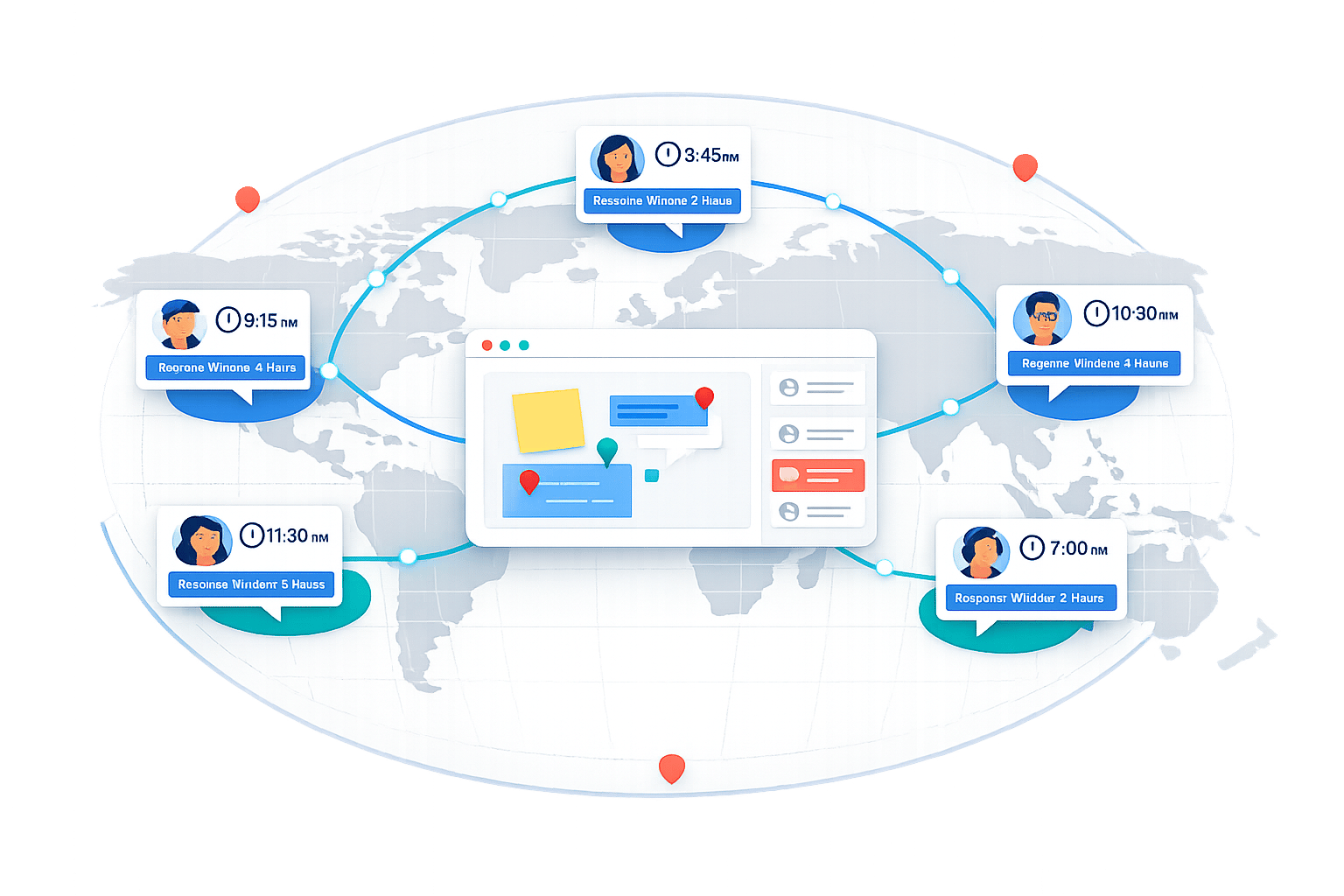
Managing Stakeholder Feedback Across Timezones
When teams work across timezones, feedback delays, scheduling conflicts, and unclear expectations can disrupt progress. Here’s what you need to know:
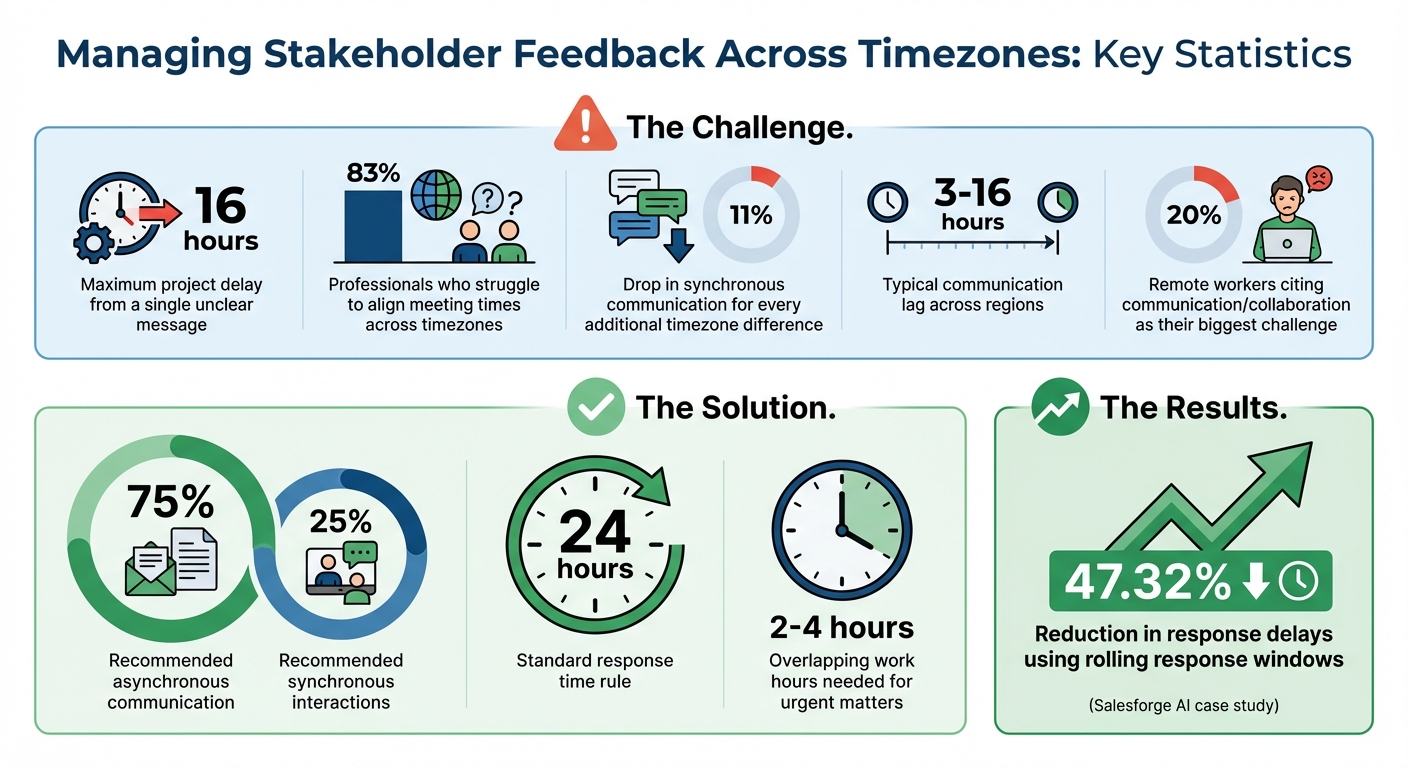
- Feedback delays: A single unclear message can stall projects by up to 16 hours.
- Scheduling challenges: 83% of professionals struggle to align meeting times across timezones.
- Communication gaps: Synchronous communication drops 11% for every additional timezone difference.
To solve these issues:
- Set clear response times (e.g., 24-hour acknowledgment rules).
- Use tools like Slack, Asana, or Loom for asynchronous updates.
- Rotate meeting times to balance inconvenience across regions.
- Centralize feedback with platforms like Boast for clarity and simplicity.
Shifting to asynchronous methods and clear protocols ensures smoother collaboration, even with timezone challenges.
Impact of Timezone Differences on Remote Team Communication and Collaboration
Common Challenges When Collecting Feedback Across Timezones
Delayed Responses and Project Bottlenecks
Timezones can turn straightforward queries into drawn-out conversations. A simple question might take days to resolve because of the 3–16 hour communication lag across regions. Picture this: a client in London asks for clarification on a design mockup at 4:00 PM GMT. By the time the Los Angeles team starts their day and responds, an entire workday has passed. These delays can snowball, slowing down projects and creating bottlenecks. And when it comes to real-time discussions, the hurdles don’t stop there.
Scheduling Conflicts for Real-Time Discussions
Coordinating live meetings across timezones is a logistical headache. With limited overlapping work hours, it’s no surprise that 83% of professionals report difficulties in scheduling cross-timezone meetings. Research even shows that synchronous communication drops by 11% for every additional hour of timezone difference. For instance, a New York team wrapping up at 6:00 PM EST may have almost no overlap with a Tokyo stakeholder starting their day at 9:00 AM JST.
Rotating meeting times can help distribute the inconvenience, but inconsistent schedules risk causing burnout. And then there’s Daylight Saving Time. Countries don’t observe DST uniformly, with some skipping it altogether. This can unexpectedly shift meeting windows by an hour, adding yet another layer of complexity. These scheduling struggles often lead to confusion about feedback timelines, as explored next.
Unclear Feedback Expectations
When teams lack clear feedback protocols, chaos ensues. Should a response come in two hours or twenty-four? Without defined expectations, some requests get answered quickly while others sit idle for days. Misaligned assumptions about availability - like ignoring split shifts or flexible schedules - only make things worse.
On top of that, differences in communication styles can slow things down further. Variations in tone or directness across cultures can lead to misunderstandings, compounding delays and making collaboration even trickier.
Managing Remote Teams Across Time Zones Without Burning People Out With Dmitrii Kustov
Setting Up Clear Communication Protocols
To tackle delayed responses and scheduling challenges, it's essential to establish clear communication protocols. These protocols remove uncertainty and ensure feedback flows seamlessly, even when team members are spread across different time zones. A key part of this is defining response times to create a steady rhythm for global collaboration.
Setting Response Times and Availability Windows
Start with a 24-hour response rule and identify 2–4 overlapping hours for handling urgent matters . For instance, TextExpander's team expects responses within 24 hours, even if it's just a quick acknowledgment.
"We tend to prioritize messaging each other in public channels to keep things transparent, ask questions directly, and respond to Slack messages within 24 hours, even if it's just to confirm that the communication was received." - TextExpander
For teams with limited overlap, split shifts can help. Leaders might work part of their day locally and add a few hours during off-peak times to bridge the gap.
Make it mandatory for team members to share their local work hours and holidays . Messaging platforms with status indicators can display local times and signal availability, helping set expectations. Once response times are in place, assign specific roles to each communication channel for better clarity and efficiency.
Selecting the Right Communication Channels
Choose tools based on their purpose: aim for 75% asynchronous communication (like email and project tools) and 25% synchronous interactions (like check-ins).
"To tackle communication and drive results, we've implemented daily asynchronous updates through video messages and a set weekly cadence for feedback sessions." - Josh Cremer, Business Owner
Develop a playbook that defines each channel's role. Use tools like Slack or Microsoft Teams for quick updates, enhanced with timezone-aware plugins. Platforms like Asana, Trello, or ClickUp are great for centralizing actionable feedback and tracking progress without requiring instant replies. For detailed or visual feedback, tools like Loom allow stakeholders to record screen-shares for review when convenient. To avoid interruptions, use email's scheduled send feature to deliver messages during recipients' working hours. Public channels should be prioritized to keep feedback accessible to everyone.
Creating Feedback Submission Guidelines
Encourage clear, actionable feedback to reduce unnecessary back-and-forth. Mark Cannon, a professor of management at Vanderbilt Business, suggests:
"In advance, consider what it is you are seeing and what specific behaviors are leading to the problem. A good thing to do in business is to communicate the 'business reason' why the feedback is important so the recipient doesn't feel as if the behavior that needs adjusting is a personal pet peeve..." - Mark Cannon, Professor of Management, Vanderbilt Business
Follow up any verbal feedback shared during meetings with a written summary to ensure nothing is forgotten. Using bullet points or numbered lists can further improve clarity . To avoid confusion, adopt a 24-hour time format (e.g., 14:00 instead of 2:00 PM). When setting deadlines, always list the recipient’s local time first to show consideration for their schedule. Lastly, store finalized feedback in a shared hub like Google Drive or Notion to provide consistent access across time zones .
Using Asynchronous Feedback Tools
Asynchronous tools take established feedback protocols to the next level by aligning with the varied work rhythms of global teams. These platforms remove the need for live meetings when time zones make real-time collaboration tricky. For example, remote teams that rely on asynchronous communication for 75% of their interactions maintain productivity without overloading schedules. This approach allows projects to flow seamlessly as team members across different time zones pick up tasks and keep things moving.
Simplifying Feedback Collection with Boast

Boast (boastimage.com) addresses the challenges of gathering feedback from diverse stakeholders. With just a shared link, clients can comment directly on web pages, images, or PDFs - no account creation, logins, or training required. This frictionless process encourages even non-technical users to engage, avoiding the common pitfalls of vague email responses or radio silence by reducing design revision cycles. While clients enjoy an easy point-and-click experience, teams benefit from features like version control, task management, and Kanban boards. Plus, with unlimited external collaborators included in all paid plans, expanding your client base won't lead to extra costs.
Centralizing Feedback in One Platform
When feedback is scattered across emails, messaging apps, and phone calls, confusion is almost inevitable. Contradictory input often gets lost, leaving teams to piece together unclear directives. A centralized platform with threaded comments solves this by tying discussions to specific design elements, making instructions clearer and easier to follow. Version control ensures teams work on the latest files, even as updates happen across different time zones.
Centralization is critical, but simplicity is just as important - especially for stakeholders who aren’t tech-savvy.
Making Feedback Easy for Non-Technical Stakeholders
Visual annotation tools make feedback straightforward. Stakeholders can click to comment, circle problem areas, or draw directly on digital assets. This is especially valuable since 20% of remote workers cite communication and collaboration as their biggest challenges. Tools that support screenshots, screencasts, and video recordings allow non-technical users to describe complex issues without struggling to find the right words. Automated email notifications keep everyone in the loop when deliverables are ready, eliminating the need for constant manual follow-ups. The aim is clear: providing feedback should be so intuitive that no one needs a manual or training session to get it right.
sbb-itb-32f6eb2
Scheduling Strategies for Feedback and Meetings
Even with asynchronous tools managing most feedback workflows, some conversations need that real-time touch. To keep things moving smoothly across time zones, smart scheduling becomes essential. Balancing time zones and fairness ensures everyone can participate without feeling overburdened.
Here’s how you can identify overlapping hours, handle time zone conversions, and rotate meeting times fairly.
Finding Overlapping Work Hours
A shared time zone map is a great starting point. Tools like World Time Buddy can help you line up cities side-by-side, making it easier to spot those golden 2–3 hours when everyone is online. These windows are often crucial for making important decisions.
Keep in mind that not everyone works the same hours. Some team members thrive in the early morning, while others hit their stride late at night. Encourage everyone to share their preferred working hours in a shared document or profile. Also, don’t forget about regions observing Daylight Saving Time - this can shift meeting times by an hour twice a year, turning a convenient 10:00 AM meeting into a less ideal 9:00 AM slot.
Using Time Zone Conversion Tools
Using UTC (Coordinated Universal Time) as a baseline is a reliable way to simplify scheduling. Always include dual time zone references in communications, like "3:00 PM CET / 9:00 AM EST", to avoid confusion. Tools like Google Calendar and Outlook also allow you to enable a secondary time zone view, so you can see a stakeholder’s local time alongside your schedule.
Slack’s "View Profile" feature can show a team member’s current local time, and tools like Calendly automatically detect the viewer’s time zone to display available slots in their local time. This eliminates the back-and-forth of coordinating schedules. To further avoid misunderstandings, consider using 24-hour time formatting in all communications.
Once you’ve got time zone conversions nailed, focus on rotating meeting times to distribute the inconvenience fairly.
Rotating Meeting Times Fairly
When your team spans multiple continents, someone will inevitably end up with a less-than-ideal meeting time. To address this, rotate meeting schedules monthly or quarterly, ensuring different regions take turns with the early or late slots.
"Rotating meeting times periodically is a smart strategy to keep clients across various time zones happy. This approach is like rotating where you sit in a classroom; everyone gets a chance to have the best seat." - Casey Meraz, Owner & Digital Marketing Expert, Casey Meraz
For those in particularly inconvenient time zones, consider making attendance optional. Share recordings and detailed notes immediately after the meeting. A buddy system can also help - assign someone in each time zone to relay updates to those who couldn’t attend live. Lastly, ask yourself if a live meeting is even necessary. Sometimes, a recorded video can deliver the same value without requiring everyone to join at odd hours.
Building Trust in Global Feedback Processes
Establishing trust in feedback processes is just as important as having clear communication protocols, especially for teams spread across different time zones. Trust ensures that every team member feels valued, no matter where they are.
Creating a Safe Environment for Open Collaboration
Transparency is the foundation of trust. Simple actions like sharing your local time, work hours, and availability can eliminate unnecessary guesswork. For example, updating your Slack status to show your timezone, setting auto-responders for when you're offline, and being upfront about when you're available for quick chats versus focused work hours can make a big difference.
"Setting clear expectations and being transparent about time zone limitations helps build trust. It makes the communication more human." - Daria Leshchenko, CEO and Managing Partner, SupportYourApp
Psychological safety is equally important. Team members need to feel comfortable speaking up about issues like inconvenient meeting schedules or receiving feedback outside of their working hours. Leaders play a crucial role here - by openly sharing their own schedules and respecting their colleagues' "off-hours", they set an example. When team members see that their boundaries are respected, they are more likely to contribute honestly without fear of being labeled as "difficult".
Acknowledging local holidays and cultural differences adds another layer to this trust. Adjusting deadlines to accommodate these factors shows that you value team members as whole individuals, not just for their work output. These small but intentional actions foster a sense of respect and inclusion.
Sharing Responsibilities Across the Team
To maintain fairness and avoid burnout, it's essential to distribute feedback and collaboration responsibilities evenly. When the same individuals are consistently asked to take meeting notes or lead discussions because of their timezone, resentment can build quickly. Instead, rotating these responsibilities on a monthly or quarterly basis ensures a more equitable workload.
A buddy system can also help bridge the gaps created by time zones. For instance, pairing someone in New York with a teammate in Singapore ensures that updates, meeting notes, and answers to questions are shared seamlessly, even when one half of the team is asleep. This approach not only creates redundancy but also ensures no one feels excluded from important decisions.
Documenting decisions with clear, data-backed reasoning is another key practice. When team members see that feedback is considered thoughtfully and fairly, it reinforces their trust in the process. Transparency and fairness in decision-making show that everyone's input matters, regardless of location.
Conclusion
Shifting from a real-time approach to an asynchronous model allows stakeholders to provide feedback on their own schedules, reducing delays and keeping projects moving smoothly.
A well-defined Communication Charter can further support this transition by clarifying response times, preferred communication channels, and documentation practices. This eliminates confusion and keeps everyone aligned.
The right tools play a big role here. For instance, Boast simplifies cross-timezone collaboration with its login-free design - stakeholders can just click and comment. This means a team member in Singapore can give feedback at 9:00 AM, just as your team in New York begins their workday.
Transparency and fairness also help build trust among global teams. Rotating meeting times ensures no single group is always inconvenienced. Take Salesforge AI as an example - they cut response delays by 47.32% with a "rolling response window" strategy. Even small adjustments like this can improve both efficiency and morale.
These practices ensure feedback is managed effectively, no matter the timezone, setting your team up for smooth global collaboration.
FAQs
How can teams handle feedback delays when working across different time zones?
Managing feedback delays across time zones can feel tricky, but a few smart strategies can keep things moving smoothly. Start by leaning on asynchronous communication tools like email or project management software. These tools let everyone share feedback at their own pace, without being tied to overlapping work hours.
It’s also crucial to set clear deadlines for feedback and response times. When everyone knows exactly when their input is expected, it reduces confusion and keeps the project on schedule. For those moments when real-time interaction is necessary, scheduling tools with automatic time zone adjustments can be a lifesaver. If meetings are required, consider rotating the times to spread the inconvenience evenly across team members.
Another helpful tip? Send updates or requests at the start of a stakeholder’s workday. This small adjustment can significantly cut down on delays and keep progress steady.
By putting these steps into action, you’ll create a collaborative environment where feedback flows efficiently, no matter how far apart your team members are.
How can I handle scheduling conflicts for meetings across time zones?
Managing schedules across different time zones can feel like a puzzle, but a few strategies can simplify things. One effective approach is asynchronous communication. Instead of requiring everyone to meet simultaneously, share detailed updates through written notes, record meetings for on-demand viewing, and use shared calendars that clearly display time zones to coordinate availability.
Another helpful tactic is rotating meeting times. This ensures that the burden of early mornings or late nights is distributed evenly among team members or clients. It’s also important to set clear expectations about availability and boundaries upfront. This helps avoid confusion and keeps everyone on the same page. Finally, scheduling tools with automatic time zone detection can suggest meeting times that work for everyone, streamlining the entire process.
How can asynchronous tools help global teams handle feedback across time zones?
Asynchronous tools simplify feedback management for global teams by allowing communication and task reviews to happen on flexible schedules, regardless of time zones. Instead of depending on real-time meetings, team members and stakeholders can leave comments, share input, and update tasks whenever it suits them. This ensures progress continues without unnecessary delays.
These tools also enable stakeholders to provide more in-depth and thoughtful feedback since they can review materials at their own pace. By clearly documenting comments and decisions, asynchronous tools minimize miscommunication and help maintain alignment across teams operating in different time zones. This approach promotes stronger collaboration, boosts productivity, and creates smoother workflows for teams spread around the globe.