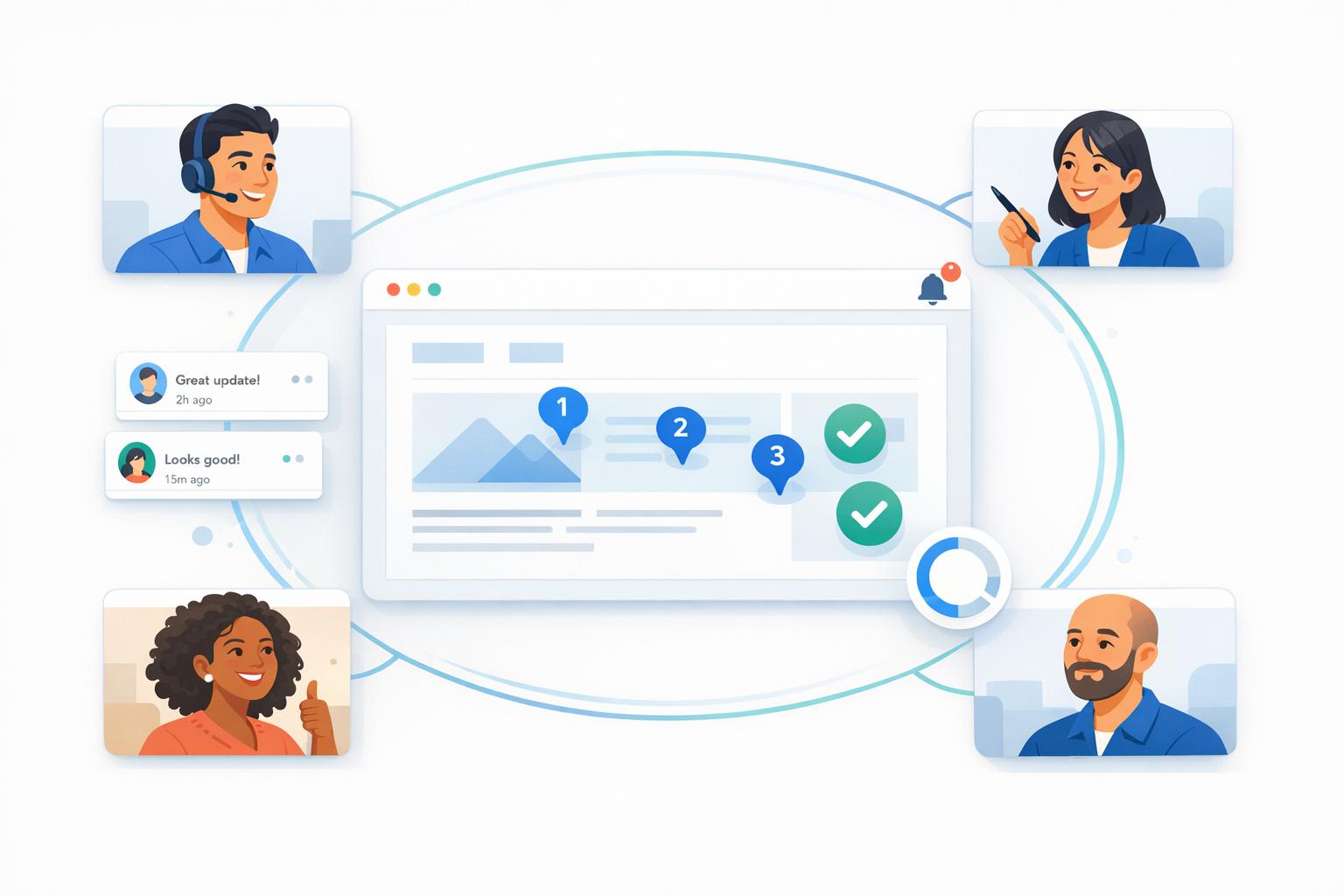
How Feedback Builds Trust in Remote Teams
Remote teams often struggle to build trust due to limited face-to-face interactions, unclear communication, and inconsistent feedback. Structured feedback systems are key to overcoming these challenges. Here’s why feedback matters and how it can create trust:
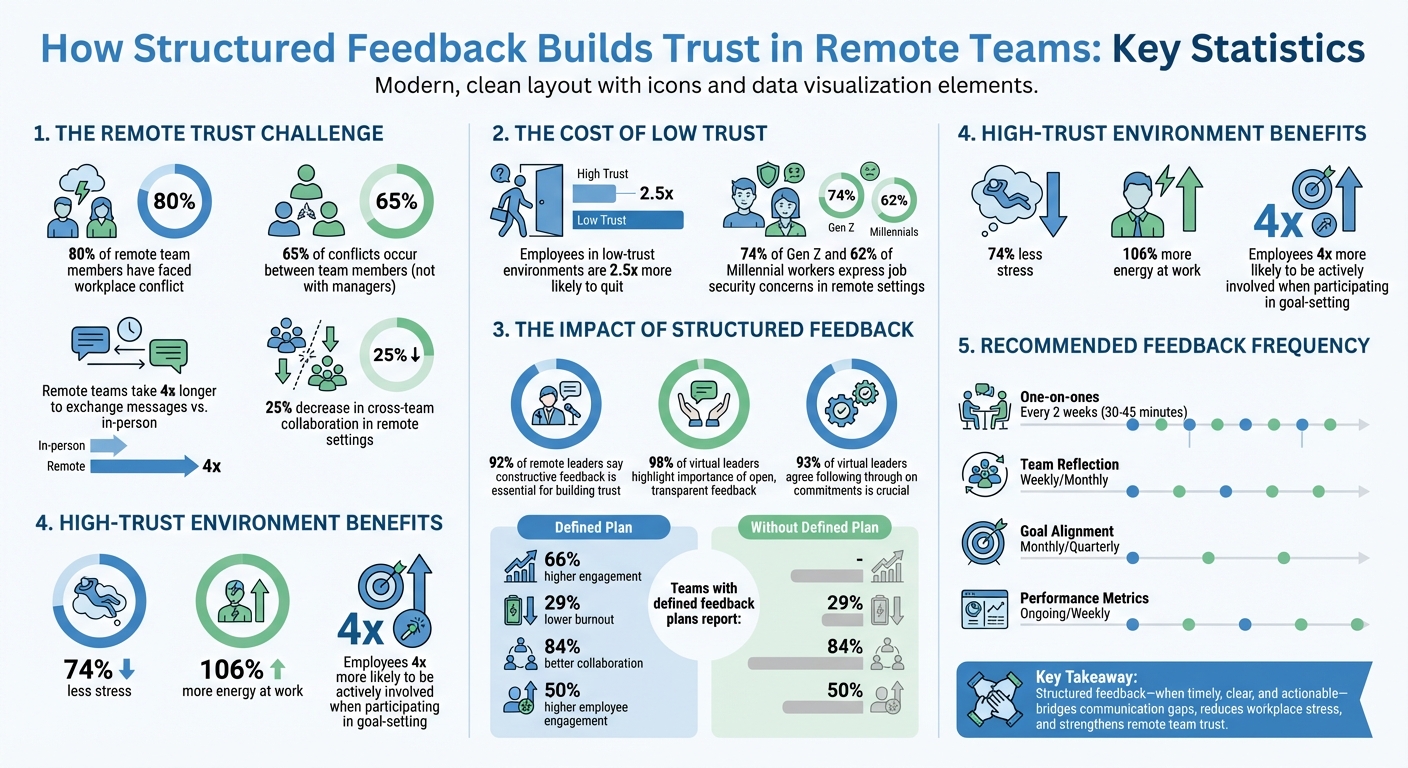
- Clear and Regular Feedback: Reduces confusion and helps team members understand expectations. Teams with defined feedback plans report 66% higher engagement and 29% lower burnout.
- Specificity Over Vagueness: Clear, actionable design feedback eliminate guesswork (e.g., "Align spacing to 24px" instead of "This feels off").
- Consistency: Scheduled check-ins (e.g., biweekly one-on-ones) prevent miscommunication and ensure alignment.
- Psychological Safety: Open dialogue and transparency encourage collaboration and prevent hidden issues.
Tools like Boast simplify feedback by allowing click-to-comment functionality, centralized task management, and easy client participation. These systems help remote teams work efficiently while maintaining strong relationships.
Key takeaway: Structured feedback - when timely, clear, and actionable - bridges communication gaps, reduces workplace stress, and strengthens remote team trust.
How Structured Feedback Builds Trust in Remote Teams: Key Statistics
How to Build Trust and Connection in Remote Teams
sbb-itb-32f6eb2
Why Remote Teams Struggle to Build Trust
Building trust in remote design teams comes with its own set of challenges. Unlike in-person settings, remote work lacks the natural trust-building that happens through physical proximity. Digital interactions, no matter how advanced, can’t fully replace the nuances of face-to-face communication. Without the ability to read body language, facial expressions, or tone of voice, even the most well-meaning feedback can come across as harsh or critical.
The statistics paint a clear picture: 80% of remote team members have faced workplace conflict, and most of these conflicts - 65% - occur between team members rather than with managers. A concept called "behavioral invisibility" plays a big role here. Team members can’t see the effort their colleagues are putting in or pick up on the subtle context that builds understanding in a shared workspace. These dynamics create several major hurdles.
Unclear Feedback Creates Confusion
Vague feedback is a trust killer. Phrases like "make it pop" or "this doesn’t feel right" leave designers guessing about what changes are actually needed. Text-based feedback strips away tone, so even friendly comments can come off as curt or overly critical. The problem is compounded by the slower pace of digital communication - remote teams can take up to four times as long to exchange the same number of messages as they would in person. What could be a quick clarification in a meeting often turns into a drawn-out email thread.
Irregular Communication Breaks Down Trust
Inconsistent communication creates uncertainty. When feedback is delayed or missing altogether, it’s easy for team members to interpret the silence as disapproval. For example, if a designer submits work and doesn’t hear back for days, they may start doubting the quality of their efforts.
This lack of communication doesn’t just affect individuals - it disrupts workflows. Reviews go unassigned, conversations stall, and crucial handoffs are missed. Remote work has led to a 25% decrease in cross-team collaboration, making it harder for teams to stay aligned. Without regular touchpoints like weekly demos or structured check-ins, teams develop "blind spots", where no one knows who’s doing what or when key decisions will be made.
Poor Feedback Affects Team Morale
When feedback fails, morale takes a hit. Unclear or untimely feedback erodes psychological safety, which is critical for team performance. Designers who don’t receive constructive input often feel undervalued and disconnected. This is particularly troubling given that 74% of Gen Z and 62% of Millennial workers already express concerns about job security in remote settings. Sparse or unclear feedback only amplifies these worries.
The impact is significant: employees in low-trust environments are 2.5 times more likely to quit due to stress and burnout. In remote design work, where visual feedback loops are crucial for refining ideas, a lack of trust can prevent team members from admitting mistakes or seeking help. Instead of fostering collaboration, poor feedback creates a culture where problems are hidden until they escalate into crises.
To address these issues, teams need to prioritize structured and clear feedback processes. This approach is essential for rebuilding trust and ensuring remote teams can thrive.
| Trust Barrier | Impact on Remote Teams | What Teams Need Instead |
|---|---|---|
| Text-only feedback | Messages lose tone; feel cold | Use video calls for sensitive discussions |
| Delayed responses | Seen as disengagement or disapproval | Set clear response-time expectations |
| Lack of visibility | Leads to micromanagement or overwork | Focus on results, not micromanaging |
| Physical isolation | Reduces psychological safety | Regular feedback rituals and openness |
How Structured Feedback Creates Trust
Structured feedback plays a key role in building trust within remote teams. Unlike in-office setups where casual chats or quick check-ins happen naturally, remote teams need intentional systems to bridge communication gaps. When feedback is regular, clear, and actionable, it fosters accountability and strengthens relationships.
The stats support this: 92% of remote leaders say constructive feedback is essential for building trust within their teams. Teams that engage in routine feedback see 84% better collaboration and 50% higher employee engagement. These practices directly address the communication challenges that remote work often presents.
Consistency and Clarity Build Confidence
Scheduled feedback removes uncertainty. When team members know they’ll have a one-on-one every two weeks or a team retrospective each month, they stop interpreting silence as disapproval. This kind of regularity is critical - 98% of virtual leaders highlight the importance of open, transparent feedback to build trust.
Clear communication shifts the focus from tracking hours worked to measuring actual outcomes. When expectations are tied to specific goals and performance metrics, team members know exactly what success looks like. This clarity allows them to work independently without feeling micromanaged.
Transparency is also a huge factor. As CoffeePals Staff explains:
"Transparency helps team members understand the rationale behind decisions, anticipate potential issues and feel like they are part of the decision-making process".
When feedback includes the reasoning behind requests, it provides context that builds confidence instead of confusion.
While consistency builds the framework, specificity is what deepens trust and respect.
Specific Feedback Builds Respect
Vague feedback like "this needs work" is not only unhelpful - it’s frustrating. Specific, actionable feedback shows that you’ve taken the time to review someone’s work thoughtfully. Using a design review checklist ensures no detail is overlooked. This level of detail demonstrates respect and creates fairness across the team.
93% of virtual leaders agree that following through on commitments is crucial for trust and accountability. Specific feedback makes follow-through possible. For example, instead of saying, "The design feels off", a structured approach might be: "The spacing between the header and body text is inconsistent - let’s standardize it to 24 pixels to match our design system." using a website feedback tool.
This kind of precision eliminates guesswork, reduces missed deadlines, and avoids the kind of last-minute surprises that can erode trust. As Wade Foster, CEO of Zapier, puts it:
"If you want to build trust, you can't have surprises".
By keeping feedback regular and specific, teams stay aligned, and trust grows naturally.
Fostering Open Dialogue
Structured feedback doesn’t just flow one way - it opens the door for honest, two-way conversations. Dedicated feedback sessions allow teams to address issues early, share ideas, and tackle roadblocks before they escalate.
Teams that prioritize these discussions report 29% less burnout. When leaders model vulnerability by admitting their own mistakes, they create a safe space for others to do the same. This psychological safety is the foundation for continuous improvement.
Feedback should be a regular part of the workflow, not a special event. Teams with a clear collaboration plan are more likely to use scheduled check-ins effectively - 67% of hybrid workers with such plans follow this practice. These sessions go beyond task updates; they help preserve the human connection that remote work often lacks.
| Feedback Element | Impact on Accountability | Recommended Frequency |
|---|---|---|
| Goal Alignment | Ensures individual tasks support team objectives | Monthly/Quarterly |
| Performance Metrics | Provides objective data for outcome evaluation | Ongoing/Weekly |
| Constructive Criticism | Identifies areas for improvement and growth | As needed/Scheduled |
| Team Reflection | Allows the team to adapt and solve problems together | Weekly/Monthly |
Structured feedback isn’t just about improving performance - it’s about creating trust through transparency, respect, and open communication. It ensures everyone feels valued and aligned, even in a remote setting.
How Boast Simplifies Feedback Workflows
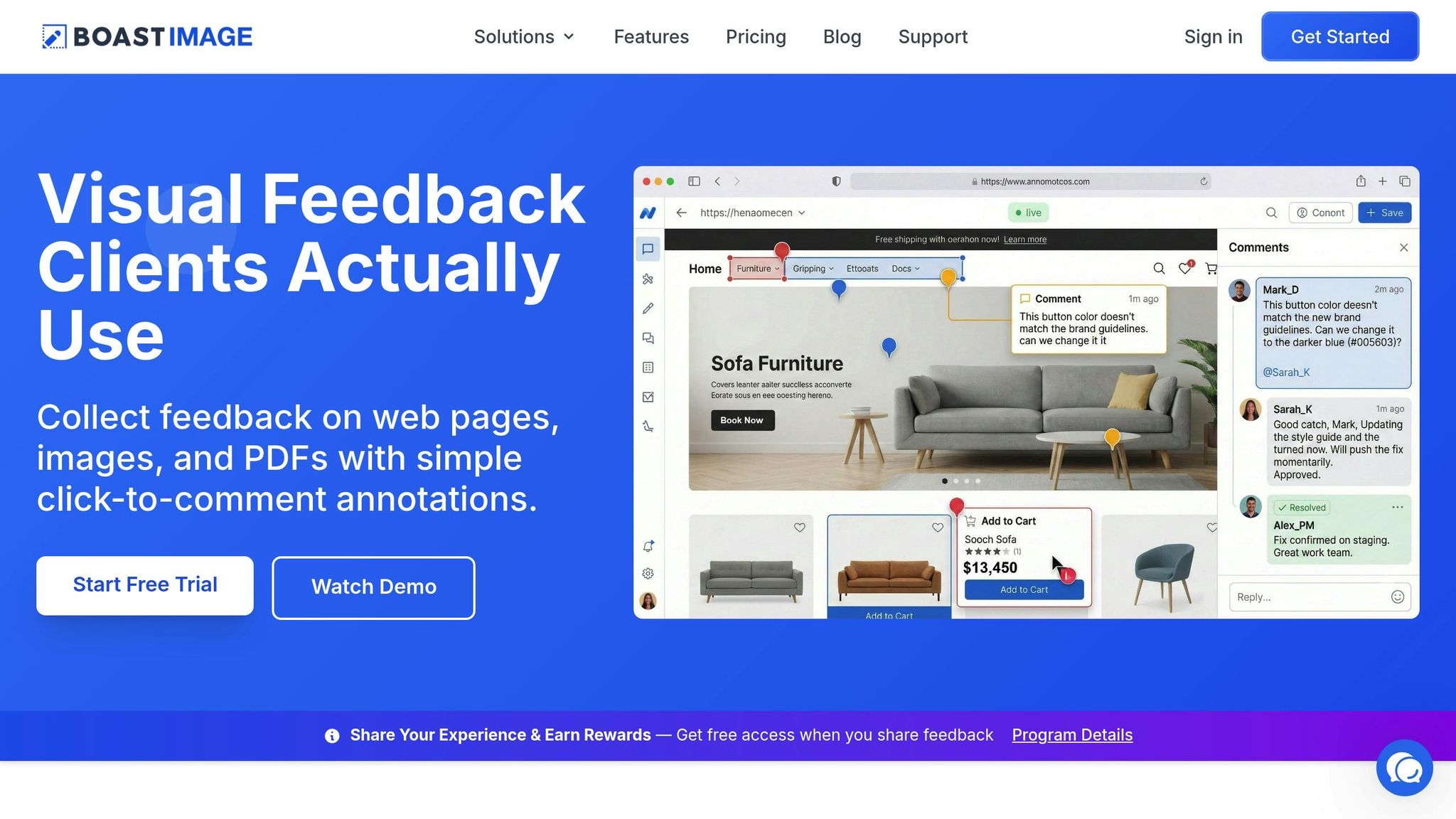
When it comes to feedback, even the best practices can stumble if the tools involved create unnecessary hurdles. For remote teams, where smooth communication is already a challenge, having the right tool can make all the difference. That’s where Boast steps in - a visual feedback board built with clients in mind. It’s designed to address the common challenges of remote collaboration and streamline the feedback and revision process.
One of the biggest hurdles for remote teams is the time it takes to communicate effectively. Research shows that computer-mediated teams can take up to four times longer to exchange the same amount of information as face-to-face teams. Boast is built to tackle this issue head-on, offering features that remove friction and keep projects moving.
No Login Required for Clients
Boast makes it easy for clients to jump into the feedback process. By using hosted links or embedded forms, clients can share their thoughts without needing to create an account or log in. This hassle-free setup encourages quick participation and ensures the feedback loop doesn’t stall. Plus, Boast’s responsive, mobile-friendly forms allow clients to submit feedback from any camera-enabled device, making it convenient for those on the go.
Click-to-Comment for Clear Communication
Ambiguous feedback like "something feels off" can be frustrating and time-consuming to resolve. Boast’s click-to-comment feature eliminates this problem by letting reviewers attach specific feedback directly to elements in a design, webpage, or PDF. This visual clarity reduces miscommunication and helps teams act on feedback faster. For instance, a comment like "The spacing here needs adjustment" becomes instantly actionable when it’s pinned to the exact spot that needs attention.
Built-In Task Management
Boast doesn’t just simplify client feedback - it also helps teams stay organized. With integrated Kanban boards and version control, teams can manage tasks and track progress effortlessly. These tools make priorities clear, ensuring that no effort goes unnoticed, even in remote settings where individual contributions can sometimes feel invisible.
By consolidating feedback and task management into one platform, Boast eliminates the clutter caused by scattered information across multiple apps - what some call "digital exhaust". This streamlined approach allows teams to track commitments, manage revisions, and monitor progress without overwhelming clients with complex interfaces. As Natalie Nagele, Co-founder of Wildbit, puts it:
"The value of remote work is that trust and that ability to empower every person to manage their time, to manage their days and their responsibilities around an output".
Steps to Build Trust Through Better Feedback
Establishing trust within a team requires intentional effort, especially when it comes to providing feedback. Structured feedback processes and centralized tools can make a huge difference. In fact, remote teams that implement clear feedback systems report significant benefits: employees in high-trust environments experience 74% less stress and have 106% more energy at work compared to those in low-trust organizations.
Set Regular Feedback Sessions
Consistency is key. Schedule 30–45 minute one-on-one sessions every two weeks with each team member, and share the agenda at least 24 hours beforehand. This predictability reduces anxiety about unexpected feedback. Including employees in goal-setting during these conversations can significantly boost engagement - employees are nearly four times more likely to be actively involved when they participate in setting their own objectives.
When delivering feedback, use the Situation-Behavior-Impact (SBI) method to ensure clarity and focus. For example, you might say: "In yesterday's client meeting (situation), you didn't share the design rationale (behavior), which left the client confused about our direction (impact)". This approach focuses on specific actions rather than personal traits, making it easier for the recipient to take constructive steps.
Use Boast to Centralize Feedback
Disorganized feedback can lead to misunderstandings and erode trust. Tools like Boast simplify the process by centralizing visual feedback in one place. This ensures both your team and clients are aligned on priorities. Features like version control and Kanban boards help keep everyone on the same page.
Set a clear expectation that all feedback should be acknowledged within 24 hours. This prevents misunderstandings caused by silence. Boast’s tagging system, which allows items to be marked as "needs review" or "ready for feedback", ensures nothing gets overlooked. Transparent communication tools, as Michael Pryor, Co-founder of Trello, explains, foster inclusivity:
"If you keep almost all discussion in public channels, no one needs to worry that they're being left out of important conversations".
Build Psychological Safety
Creating a safe environment for open dialogue is essential. Leaders can set the tone by admitting their own mistakes. Joel Gascoigne, CEO of Buffer, demonstrated this when he publicly addressed a major business mistake:
"The fact is, the challenge that I created has now irrevocably changed people's lives. I put the company in this position. I had poor judgement and took the wrong actions... I want to try to live our value of transparency and share everything about the big mistakes we've made".
This level of openness encourages team members to feel comfortable admitting errors or asking for help. To monitor psychological safety, consider running short, anonymous pulse surveys on a monthly basis. These surveys can help identify and address concerns before they escalate. It’s worth noting that 80% of remote team members have experienced workplace conflict, often because they hesitated to speak up early. Regular, open feedback can prevent these issues and build a stronger, more cohesive team.
Measuring How Feedback Improves Trust
When structured feedback practices are in place, the next step is to measure their impact. This helps reveal how trust is evolving within remote teams. Tracking the right metrics - those that highlight both efficiency and psychological safety - can provide deeper insights than simply focusing on productivity. These measurements ensure that feedback processes actively contribute to building trust across remote teams.
Track Feedback Response Times
How quickly feedback is acknowledged says a lot about trust. Long delays can create uncertainty, leaving team members feeling ignored or undervalued. Setting a 24-hour acknowledgment standard can serve as a practical benchmark.
To gauge this, measure the time between a feedback request and its acknowledgment or action. In environments with low trust, teams often spend extra time on defensive behaviors, like rechecking work, over-monitoring colleagues, or creating excessive documentation. Faster feedback responses and fewer redundant check-ins are signs of increasing trust. Since remote teams often take up to four times longer to exchange messages compared to in-person groups, keeping an eye on this metric is especially critical.
Survey Team Psychological Safety
Timing matters, but understanding how team members feel is just as important. Anonymous monthly pulse surveys can help uncover whether people feel safe speaking up, admitting mistakes, or challenging ideas. Questions like "Do you feel comfortable admitting mistakes to your manager?" or "Can you challenge ideas without fear of judgment?" can provide valuable insights when tracked over time. Research shows that employees in high-trust organizations are more energetic and collaborative compared to those in low-trust environments.
The real value lies in acting on survey results. Sharing findings with the team and committing to address at least one key concern each month can help strengthen trust further.
Monitor Review Speed and Revision Cycles
Once response times and psychological safety are assessed, the next focus is on how efficiently feedback leads to actionable changes. Track how many revision rounds are needed per project and how quickly feedback is implemented. Teams with high trust often need fewer revision cycles because feedback is clear and actionable from the start.
However, quality should always take precedence over speed. For instance, catching issues early in the process signals strong psychological safety, while a lack of early mistake-reporting might indicate the opposite. Addressing concerns quickly not only prevents costly late-stage errors but also keeps projects moving efficiently.
| Metric | What It Reveals | Recommended Tracking Frequency |
|---|---|---|
| Feedback Response Time | Accountability and reliability | Real-time / Weekly |
| Psychological Safety Score | Team comfort with vulnerability | Monthly |
| Revision Cycle Speed | Alignment and clarity of feedback | Per Project / Quarterly |
| Mistake Reporting Rate | Willingness to be transparent | Ongoing |
Conclusion
Building trust within remote teams hinges on creating structured feedback systems to replace the casual interactions that naturally happen in an office. Without those spontaneous, face-to-face moments, remote teams must rely on intentional processes to clarify tasks, reduce confusion, and maintain consistent performance.
The way trust is built shifts when the focus moves to evaluating the quality of outcomes. As Natalie Nagele, Co-founder of Wildbit, puts it:
"The value of remote work is that trust and that ability to empower every person to manage their time, to manage their days and their responsibilities around an output".
Structured feedback plays a key role in this shift by concentrating on the results rather than the hours spent or methods used.
Tools like Boast help simplify this process. One of the biggest challenges in remote feedback is engaging clients, and Boast solves this by removing login requirements and enabling click-to-comment feedback. This feature eliminates technical barriers and ensures feedback is both specific and actionable. By providing context directly within the feedback, Boast helps avoid the miscommunication that can easily arise in digital settings where tone and body language are absent.
The benefits are clear. Data shows that teams practicing regular feedback see 84% better collaboration and 50% higher engagement. For teams without structured systems, this represents a huge opportunity to improve both trust and performance.
FAQs
What should a remote feedback routine include?
A successful remote feedback routine thrives on clear expectations, the right tools, and open communication. Start by clearly defining goals, roles, and deadlines to prevent misunderstandings. For organized and precise input, leverage visual feedback tools like Boast, which allow teams to comment directly on designs. Regular check-ins and open communication channels help build trust and maintain transparency. Finally, encourage active listening and continuous dialogue to create a sense of emotional safety and strengthen team connections.
How do you give feedback that’s specific but not harsh?
Providing feedback that is clear and actionable doesn’t have to come across as harsh. The key is to focus on specific behaviors rather than making it personal. Stick to objective observations and avoid commenting on someone's traits or character. Using constructive language and framing suggestions with "I" statements - like "I noticed..." or "I think this could work better if..." - can help avoid sounding accusatory. This approach encourages clarity and growth while keeping the tone positive. After all, feedback should be about helping someone improve, not tearing them down.
What trust metrics should we track after changing feedback?
Track metrics like transparency levels, the frequency and quality of communication, team confidence in feedback systems, and how team members perceive psychological safety and collaboration. These metrics give insight into how feedback-related changes influence trust and overall team dynamics.