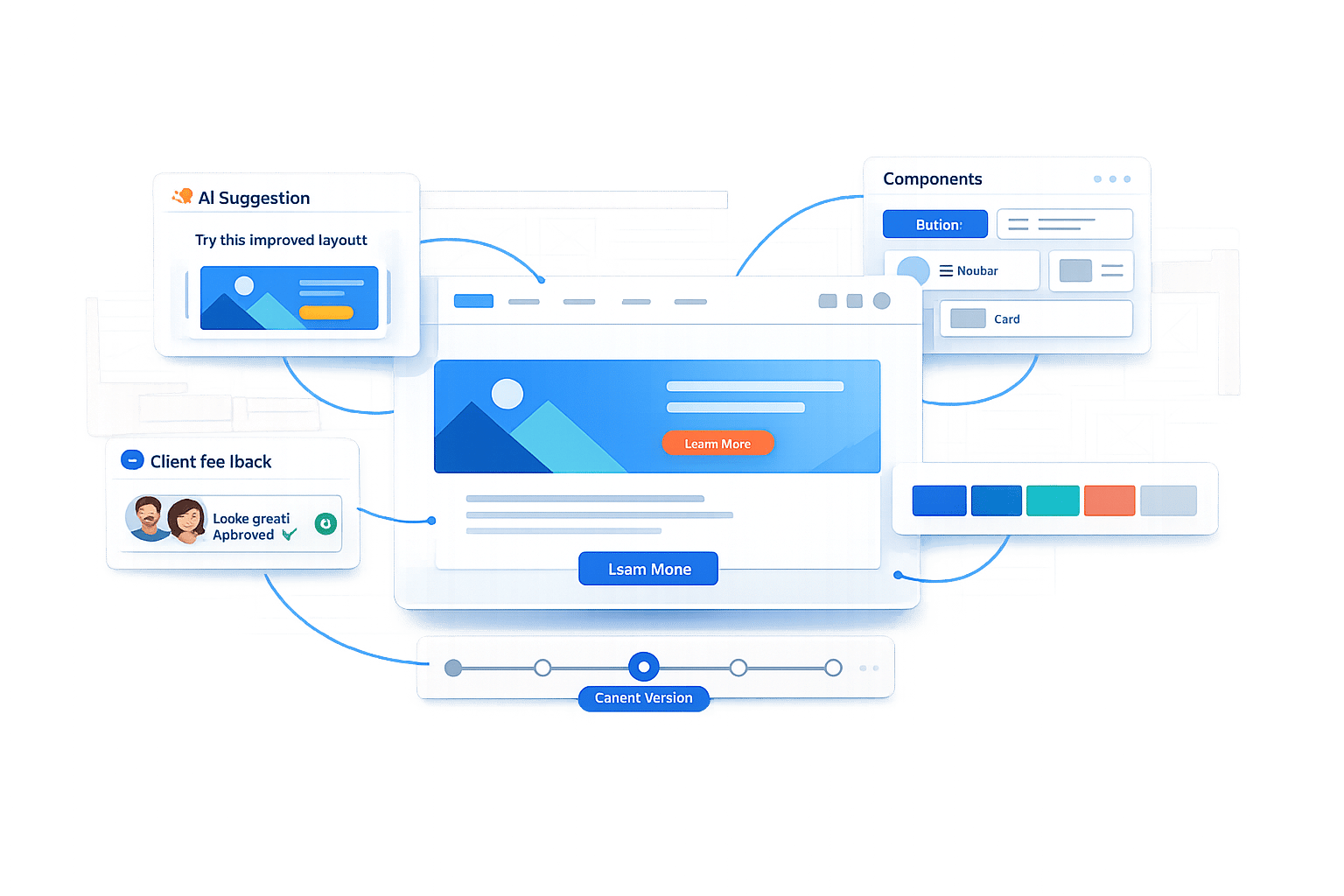
How AI Is Changing Web Design Workflows Now
The world of web design is undergoing a seismic shift, catalyzed by the integration of Artificial Intelligence (AI) into creative and development workflows. In a discussion with Corey Men, a seasoned web designer and developer, and Julian, a thought leader in AI-driven processes, we explore how AI has evolved from a prototyping novelty to a production-ready powerhouse. This article dissects the conversation, offering insights tailored to freelancers, creative agencies, and marketing teams seeking clarity on how AI can revolutionize their workflows.
A Paradigm Shift: From AI Prototypes to Production-Ready Solutions
Gone are the days when AI tools were limited to prototyping. Today, AI is capable of producing real, scalable deliverables for live projects. Corey highlighted that a year ago, even advanced internal teams at companies like Webflow relied on AI for prototyping disconnected from production. Fast forward to 2026, AI tools can now deliver production-grade outputs - marketing websites, dynamic interfaces, and seamless integrations - that are indistinguishable from those crafted manually by developers.
This evolution means teams can create functional, scalable, and visually polished solutions directly from AI-assisted workflows. As Corey put it, "The marketing site that our company relies on was entirely vibe-coded. It's been live for over a month." This shift has opened up opportunities for smaller teams or even individuals to operate at a level once reserved for large companies.
Key Insight: The Rise of the One-Person Powerhouse
One of the most provocative ideas discussed was the potential for AI to enable one-person ventures to rival companies worth billions. With AI tools handling complex coding, design, and iteration tasks, talented individuals can now execute projects that once required teams of engineers and designers. As Julian noted, "We're moving towards a time where people can focus on what they want to focus on." This democratization of tools empowers creators to innovate without being bogged down by technical barriers.
sbb-itb-32f6eb2
AI as a Collaborative Partner, Not a Replacement
The introduction of AI tools often sparks fear of job loss, particularly in creative and technical fields. However, Corey and Julian argue that AI is less about replacement and more about augmentation. Engineers, for example, are finding that AI can accelerate their workflows. Corey emphasized that while AI can write code faster than even seasoned developers, the human element remains essential for context, creativity, and quality assurance.
Julian shared a practical example from his team, where junior and non-developer contributors are empowered by AI. They can propose code changes, which engineers then refine and integrate into the production environment. This collaborative environment showcases how AI bridges gaps between idea generation and technical execution, creating a harmonious balance of efficiency and expertise.
Visual Editing and the Trust Barrier
Visual editing remains a cornerstone of creative workflows because it taps into the human need for tangible results. As Corey explained, "Seeing is believing." Tools like Webflow's visual editor allow designers and marketers to make immediate changes, review them in real-time, and publish with confidence. While AI offers unprecedented speed and flexibility, it sometimes lacks the inherent trust that comes from visually validating changes before they go live.
The conversation also touched on emerging solutions like agent-driven editing workflows. These allow users to issue commands to an AI agent, which then executes changes across a website. Enhancements, such as side-by-side comparisons of before-and-after states, will be key to building trust in agentic workflows. Corey noted, "We still need to be that infinite context window… ensuring the changes align with our vision."
The Evolution of Design Workflows
While traditional tools like Figma remain an industry staple, many designers are exploring workflows that bypass static mockups altogether. Julian and Corey both expressed a preference for jumping straight into functional environments like Webflow or even direct-to-code tools augmented by AI.
For Corey, the ability to skip static design workflows and iterate directly in a live environment streamlines the process. "Why build static mockups when you can have four live examples generated by AI and refine the best one?" he asked. This approach enables teams to focus on results rather than process, shortening revision cycles and reducing friction between design and development.
Education and the Next Generation of Designers
A critical challenge discussed is how to prepare the next generation of designers and developers for an AI-enhanced world. Corey highlighted that educational institutions often lag behind industry trends, leaving students unprepared to leverage tools like Figma, let alone AI-driven workflows. However, self-motivated learners are already using AI tools to leapfrog traditional pathways.
This creates a dual-speed dynamic in the industry: those who adapt quickly to new tools and workflows versus those reliant on outdated methods. For design and development professionals, staying ahead of the curve will be essential to thriving in this rapidly changing landscape.
Key Takeaways
- AI is Production-Ready: AI tools are no longer just for prototyping. They now enable the creation of fully functional, live websites and applications.
- Collaboration, Not Replacement: AI complements human creativity by handling repetitive tasks, allowing professionals to focus on high-level problem-solving.
- Visual Editing Builds Trust: Real-time visual feedback, as seen in tools like Webflow, remains crucial for ensuring confidence in changes made by AI.
- Faster Iteration Cycles: AI allows teams to generate multiple versions of a design or feature, enabling faster decision-making and refinement.
- Democratization of Power: AI tools empower individuals and small teams to compete at the level of large organizations.
- Adapting to New Workflows: Moving directly to functional design environments, rather than static mockups, streamlines processes and reduces friction.
- Education Needs to Catch Up: Institutions must update their curricula to include tools like Figma, Webflow, and AI-powered platforms to prepare students for the modern workforce.
- Trust Requires Refinement: For AI to gain widespread adoption, workflows need to provide transparency and reliability, such as visualizing changes made by AI agents.
Conclusion
The integration of AI into web design workflows is not a distant possibility - it’s happening now. From reducing revision cycles and improving collaboration to enabling production-ready outputs, AI offers transformative potential for creative teams. However, this transformation requires professionals to embrace change, experiment with tools, and refine workflows that balance the power of AI with human creativity.
As Corey summarized, "Exciting times… but it really is hard to step back and recognize what’s happening before our eyes." By leaning into this transformative moment, designers, developers, and marketers can redefine what’s possible in their work - and their industries.
Source: "From Webflow to Anthropic: Corey Moen on the Future of Web Design (Full Interview)" - Memberstack Team, YouTube, Feb 12, 2026 - https://www.youtube.com/watch?v=ib7ueNSDGnQ