Conflicting Feedback: Why It Happens And How To Fix It
Conflicting feedback can derail projects, waste time, and frustrate teams. It often stems from differing priorities, unclear communication, and subjective opinions. The solution? A structured approach to manage, prioritize, and align feedback with project goals. Here's how:
- Why It Happens: Stakeholders have different perspectives, communication gaps create misunderstandings, and personal preferences often override rational input.
- How to Fix It:
- Centralize Feedback: Use one platform to collect and organize input.
- Categorize Input: Group feedback by urgency, impact, and relevance.
- Set Clear Expectations: Define what feedback you need and what’s off-limits. This helps you get clear design feedback that is actually actionable.
- Use Prioritization Frameworks: Apply tools like weighted scoring to evaluate feedback objectively.
- Test and Validate: Use prototypes and measurable metrics to make data-driven decisions.
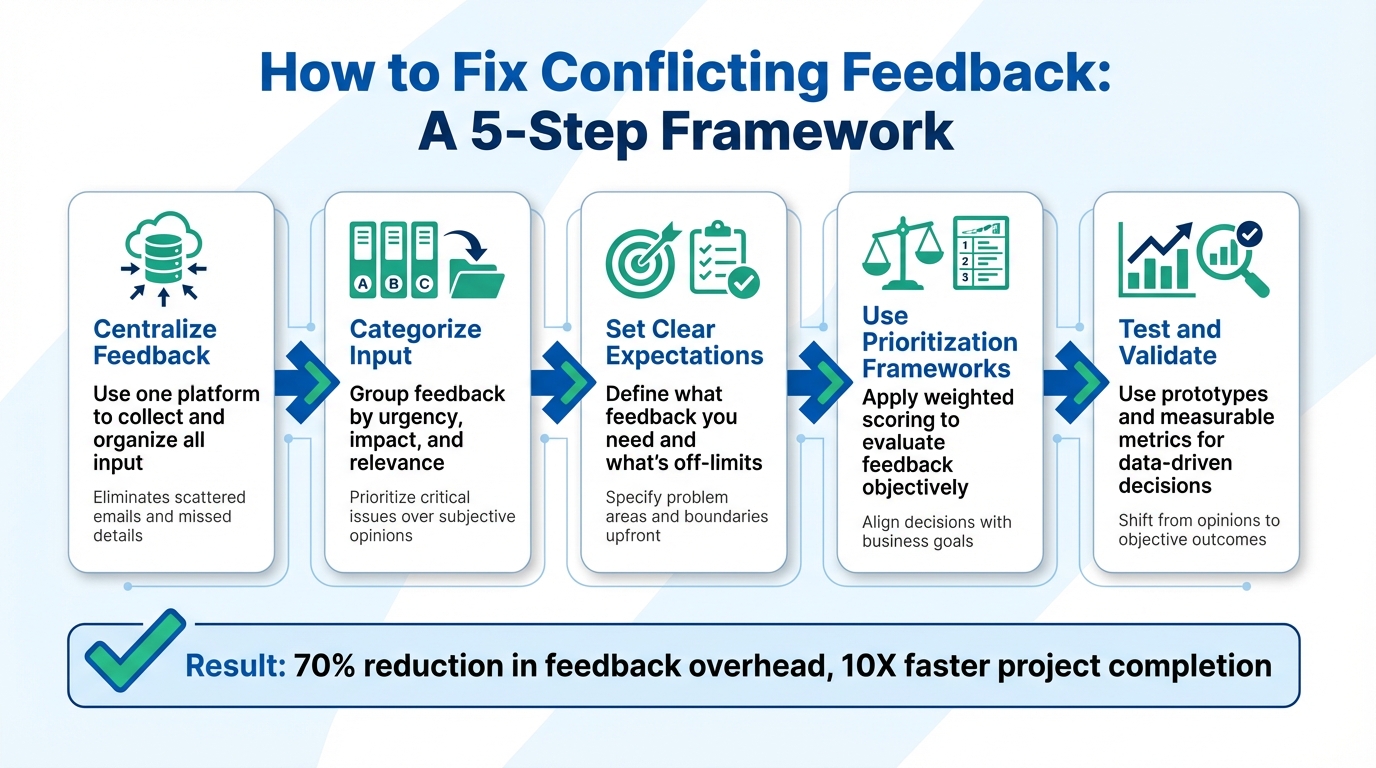
5-Step Framework for Managing Conflicting Feedback
Resolving Stakeholder Conflicts: Strategies to Align Priorities: 3 Strategies for Project Success
sbb-itb-32f6eb2
Why Conflicting Feedback Happens
Conflicting feedback doesn’t just appear out of nowhere - it often follows predictable patterns tied to how people approach creative work. By understanding these patterns, you can tackle the issue before it disrupts your project.
Different Stakeholder Priorities and Perspectives
Every stakeholder brings their own perspective, shaped by their role, expertise, and goals. A technical lead might zero in on precision and functionality, while someone in customer relations prioritizes user experience and engagement. Neither perspective is wrong - they’re just different.
This divide can grow even wider when organizational priorities clash. For example, upper management often prioritizes short-term wins and measurable results, while creative teams focus on long-term goals and the overall vision. Much of the feedback you receive may reflect the reviewer’s priorities more than the actual work.
Even the same trait can draw mixed reactions. Take a designer’s communication style - some might find it clear and effective, while others see it as overly blunt, especially if cultural differences come into play. The key takeaway? Feedback often reveals more about the reviewer than the work itself, and these varied perspectives can lead to communication breakdowns.
Misalignment and Communication Gaps
Communication issues are at the root of many workplace conflicts - 43%, to be exact. Creative projects are no exception. A common culprit is the difference in mental models, or "representational gaps" (rGaps), which lead to conflicting assumptions. One stakeholder might assume a design prioritizes brand consistency, while another assumes it’s focused on driving conversions.
Ambiguity in language makes things worse. Words like "cleaner", "bolder", or even "soon" can mean wildly different things depending on who you ask. In fact, 42% of workers cite differing communication styles as the main source of workplace miscommunication. This creates a breeding ground for conflicting feedback.
Consider the infamous $125 million loss of the Mars Climate Orbiter, where a mix-up between measurement systems caused a catastrophic failure. While creative projects don’t usually carry stakes that high, the principle is the same: unclear assumptions and poor communication can derail even the best efforts.
Emotional vs. Rational Feedback
Not all feedback is grounded in strategy. Sometimes, it’s driven by personal taste, gut reactions, or cognitive biases that have little to do with the project’s goals. For instance, when initial requests lack clear problem definitions, stakeholders often resort to subjective opinions like "make the logo bigger" or "I don’t like it".
This happens because of cognitive shortcuts known as rater errors, which distort judgment. The halo effect, for example, can cause someone to view all aspects of a project favorably if they like one part, while the horn effect can lead to overly harsh criticism based on a single perceived flaw. Without clear frameworks to guide feedback, emotional responses can overshadow rational decision-making and derail progress.
How to Organize and Consolidate Feedback
Once you understand why conflicting feedback happens, the next step is figuring out how to manage it effectively. Feedback that’s scattered across emails, texts, and meetings can lead to confusion and missed details. The key is to centralize feedback, sort it systematically, and set clear expectations from the start.
Centralizing Feedback in One Place
Keep all feedback in one platform or tool. When feedback comes through emails, text messages, phone calls, or casual chats, it’s easy to lose track of important details or miss patterns that could clarify conflicts.
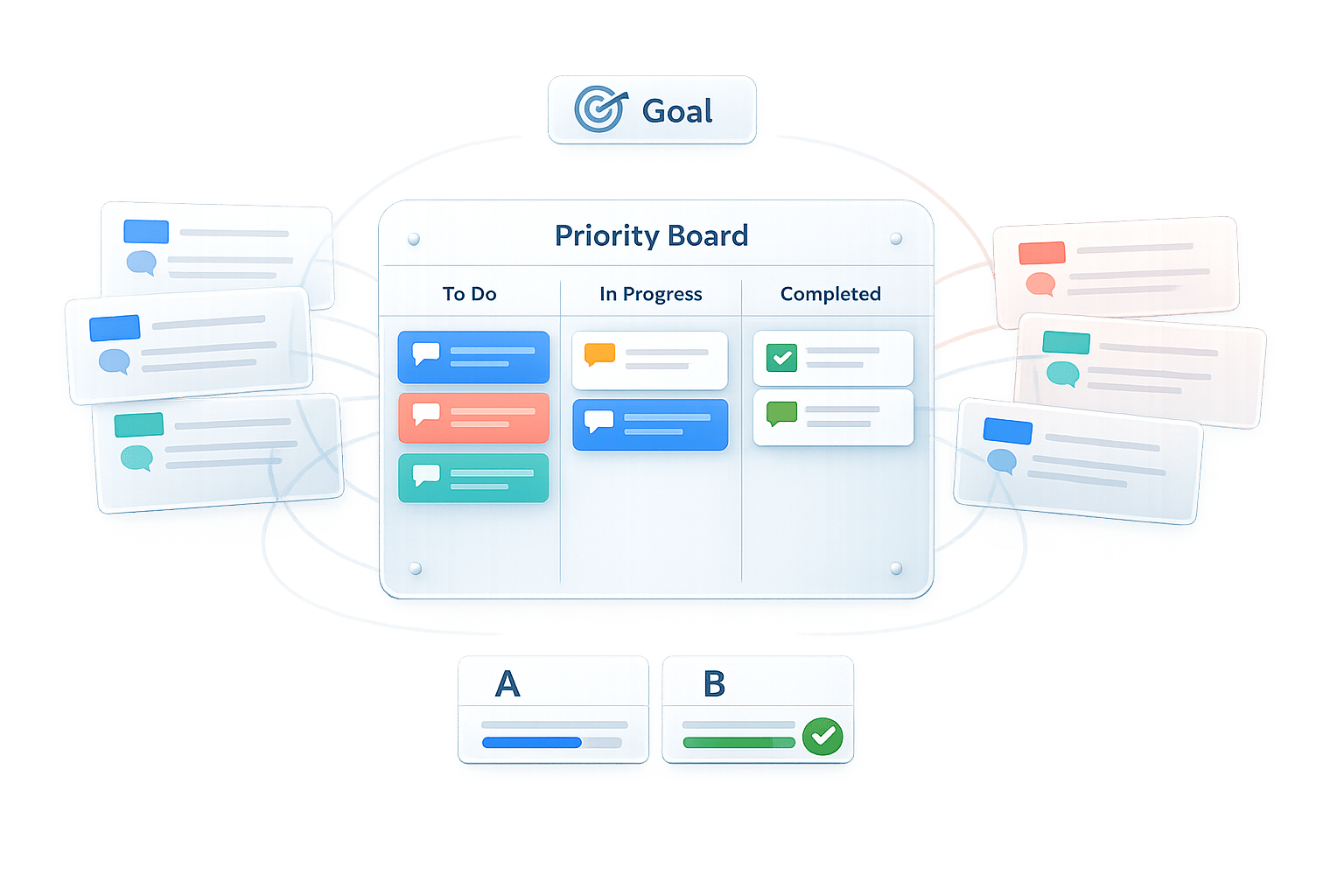
Using platforms like BoastImage can help. These tools allow clients to comment directly on work without needing accounts or training. They also organize feedback with features like versions, tasks, and Kanban boards. This approach tackles a common issue: when external stakeholders send vague emails or fail to respond, projects can grind to a halt. Centralizing feedback ensures that all input is accessible in one place, making conflicts easier to spot and address.
Categorizing Feedback by Type and Source
After centralizing feedback, the next step is to organize it systematically. Group feedback by factors like urgency, impact, and the perspective of the stakeholder providing it. This ensures that critical issues - like those affecting deadlines or core functionality - are prioritized, while feedback from technical experts or customer-focused stakeholders is appropriately weighted.
A feedback matrix can be a helpful tool for visually ranking and prioritizing inputs. Structured models, such as the Situation-Behavior-Impact (SBI) framework, can also turn vague feedback into actionable steps. Separate strategic feedback (aligned with business goals) from subjective opinions to ensure that the most relevant and problem-solving comments get the attention they need. This process helps clarify when seemingly conflicting feedback is actually addressing different aspects of the project.
Setting Clear Expectations for Feedback
With feedback consolidated and categorized, the next step is to define clear parameters for input. Be specific about the problem and the type of feedback you’re seeking - whether it’s strategic alignment, user flow insights, or validation of a design concept.
"When team members understand the criteria and expectations that guide feedback, it reduces ambiguity and helps align everyone's efforts."
- Editorial Team, HR Fraternity
Set clear boundaries. Let reviewers know which areas are open for feedback and which are already finalized. For instance, you might say, "We’re not looking for feedback on the visual design, but we do need input on the user flow".
Establishing timelines and urgency levels upfront also ensures that feedback is focused and actionable, rather than turning into an open-ended brainstorming session. And if feedback isn’t needed - like during an update-only presentation - make that clear to avoid unnecessary input.
Finally, always document the agreed feedback and actions in writing. Keeping everything in one "source of truth" promotes accountability and ensures everyone is on the same page.
Resolving Conflicting Feedback with Prioritization Frameworks
Once feedback is centralized and categorized, the next step is to analyze it objectively. Prioritization frameworks help turn subjective debates into clear, actionable decisions by evaluating feedback against specific criteria. This approach shifts the focus from debating "who's right" to identifying what best supports the business.
Weighted Scoring Models for Feedback
A weighted scoring model assigns scores to feedback based on measurable criteria. Factors like impact on deadlines, team morale, urgency, source credibility, strategic alignment, and feasibility are often considered.
For instance, you could use multipliers to weigh feedback based on its impact: high-impact feedback might get a 3× multiplier, medium-impact a 2×, and low-impact a 1×. Similarly, feedback from experts directly involved in the project may carry more weight than input from less-informed sources. Another method, the RICE framework, calculates scores by multiplying reach, impact, and confidence, then dividing by effort. A confidence score above 80% is considered strong, while anything below 50% might be too uncertain to prioritize.
"Feedback that directly affects project deadlines or team morale should be prioritized over suggestions that are more subjective or less time-sensitive."
- Editorial Team, HR Fraternity
Visual tools like a website feedback tool or a feedback matrix can help map feedback on an importance-versus-urgency grid. Frameworks like SBI (Situation, Behavior, Impact) can also refine vague feedback into actionable insights. For example, instead of a general comment like "I don't like this design", you could derive a specific observation: "During testing, users abandoned their carts at the payment screen, leading to a 15% drop in conversions." These structured assessments help balance varying stakeholder needs.
Balancing Stakeholder Needs with Business Objectives
Different teams bring diverse priorities to the table. Sales may focus on closing deals, engineering on technical feasibility, and marketing on user acquisition. When feedback conflicts, aligning decisions with a North Star Metric - a key action that drives the most customer value - can help. For example, Spotify might focus on "clicking play", while Google prioritizes "clicking a search result".
To navigate conflicting priorities, map out stakeholder influence and align their goals with broader business objectives. Applying the "Rule of Three" can also help - focus on the three activities that generate 90% of the business's value. When rejecting feedback, explain the trade-offs in terms of risks and resources. For example: "Delaying Feature Y minimizes the risk of performance issues in the current roadmap".
"Affirm differing viewpoints can co-exist, then focus conversation on collaborating around shared goals and priorities rather than who is 'right'."
- Jonathan H. Westover, PhD, Chief Academic & Learning Officer, HCI Academy
For highly polarized feedback, consider bringing stakeholders together for discussions. A collaborative, interest-based approach can help uncover whether disagreements stem from differing perspectives or competing agendas.
Communicating Decisions Transparently
Once feedback is prioritized and aligned with business goals, it’s critical to communicate the decisions clearly. Document the rationale, action steps, and objectives behind each decision. Transparency fosters trust and reduces pushback from stakeholders whose feedback wasn’t implemented.
Develop a shared scoring guide to ensure consistency in evaluation. For example, a score of "5" might indicate a 10% increase in monthly recurring revenue, while a "3" could represent an improvement in user experience without revenue impact. This shared understanding ensures everyone is on the same page.
"Prioritization is a never-ending and iterative process."
- Asal Elleuch, Senior Product Manager, Amazon Prime
When delivering decisions, use "I" statements to reduce defensiveness. For instance, saying, "I feel we should prioritize Feature X because it aligns with our Q2 revenue goals" is more constructive than stating, "You're wrong about Feature Y". Asking open-ended questions to understand underlying concerns also keeps the discussion focused on problem-solving rather than assigning blame.
Testing and Validating Solutions to Conflicting Feedback
Once feedback has been prioritized, the next step is to test your decisions to ensure they address the core issue. Testing transforms subjective debates into objective, data-driven decisions, making it easier to resolve conflicting feedback. This process shifts the focus from personal opinions to measurable outcomes.
Prototyping and Collecting User Data
Usability testing offers a hands-on way for stakeholders to understand why certain design choices succeed or fail. By grounding discussions in evidence rather than opinions, this method helps eliminate bias and personal preferences. For example, sharing a prototype that’s about 50% complete allows you to gather actionable feedback early in the process.
"Usability testing is a great way to instrument this learning process."
- Andy Budd, Design Founder and Startup Investor
This approach also helps prevent stakeholders from defaulting to subjective suggestions, like insisting on making a logo bigger. For more sensitive changes - such as shifting from an opt-out to an opt-in model for GDPR compliance - it's crucial to flag these decisions early and provide clear explanations. Be specific about the feedback you’re seeking. For instance, you might say: "We’re not focusing on the visual design right now; instead, we’d like feedback on the user flow".
After gathering feedback, the next step is to set measurable targets to validate your prototypes.
Establishing Measurable Success Metrics
Before testing begins, clearly define the success metrics. Instead of asking vague questions like, "What do you think?", set concrete expectations: "We believe this change will improve [specific metric] over the next [timeframe], and we’ll review the results by [date]". Identify key metrics such as conversion rates or user retention and monitor them consistently. Tools like a feedback matrix can help rank items by importance and urgency, providing a visual way to track progress. Additionally, documenting consensus on expectations ensures everyone is aligned and provides a baseline for evaluation.
Iterating Based on Results
Once the data is collected, use it to refine your approach. Feedback should be treated as data, not as personal criticism. Schedule regular follow-ups with stakeholders and users to assess how well solutions are working and address any new challenges that arise. These check-ins also provide an opportunity to evaluate the effectiveness of your feedback process and make adjustments based on the data.
"Great designers want to be proved wrong. Why? Because it's the most effective way to learn and get better."
- Andy Budd, Design Founder and Startup Investor
Documenting key decisions and their outcomes is equally important. When data supports a particular solution, communicate these findings transparently, emphasizing their impact on metrics like retention or acquisition. This documentation not only prevents repetitive debates but also builds institutional knowledge, helping teams understand what works and why. By iterating based on results, you not only resolve conflicting feedback but also build trust and confidence among stakeholders.
Conclusion
Conflicting feedback doesn’t have to throw your projects off track. The underlying issues are often predictable: stakeholders come with varying priorities, communication gaps lead to misalignment, and emotions can cloud strategic goals. When you recognize these patterns, you can tackle them systematically instead of reacting to every disagreement as it arises.
The best solutions focus on organizing, prioritizing, and aligning feedback with clear objectives. Take BoastImage as an example. Their tool simplifies the feedback process by letting clients comment directly on web pages, images, or PDFs - cutting out scattered emails and unclear instructions. Clients don’t even need to create accounts; they can just click a link and start commenting. With plans starting at $9.95 per month and unlimited external collaborators, tools like this have proven to reduce feedback overhead by 70% and speed up project completion by up to 10X.
Testing also plays a crucial role in resolving subjective disagreements. By prototyping early, defining success metrics, and iterating based on real data, you shift discussions from personal opinions to objective, data-driven decisions. This approach not only aligns teams but also makes decision-making faster and more efficient.
"Good designers hope to be proved right. However, great designers want to be proved wrong. Why? Because it's the most effective way to learn and get better."
- Andy Budd, Design Founder and Startup Investor
Adopting this mindset - seeing feedback as information rather than criticism - fosters trust and ensures the same conflicts don’t keep resurfacing.
FAQs
How do I decide whose feedback matters most?
To figure out whose feedback carries the most weight, tie it directly to your project goals and the priorities of your key stakeholders. Break feedback into categories based on its source, the type of user providing it, and the potential impact it could have. Then, focus on the input that aligns with and supports your objectives.
When you encounter conflicting feedback, dig into the reasons behind it. Be clear and open about how decisions are made to address these conflicts. Give priority to feedback that improves the user experience and fits your strategic goals. At the same time, stay flexible and ready to revisit decisions as new information or perspectives come to light.
What can I do when feedback is too vague to act on?
When feedback feels unclear, take a moment before responding. Recognize how you're feeling, but don’t let emotions drive your reaction. Instead, view the feedback as information to investigate. Ask follow-up questions or request specific examples to better understand and use it. Keep in mind that the context matters - people's perspectives or priorities can influence how they express feedback. By staying curious and digging deeper, you can transform vague comments into useful insights for improvement or decision-making.
How can I use data to settle subjective feedback debates?
When subjective feedback leads to debates, relying on objective data can help cut through bias and bring clarity to the conversation. However, it’s crucial to critically assess the data to ensure its reliability - watch out for pitfalls like small sample sizes or skewed datasets. Tools like visual aids and clear metrics (e.g., comparing averages to medians) can expose hidden patterns or discrepancies, offering a clearer picture.
By anchoring discussions in measurable facts, you can move away from personal opinions and toward a shared perspective, making it easier to find effective solutions.